2HL0 | pdb_00002hl0

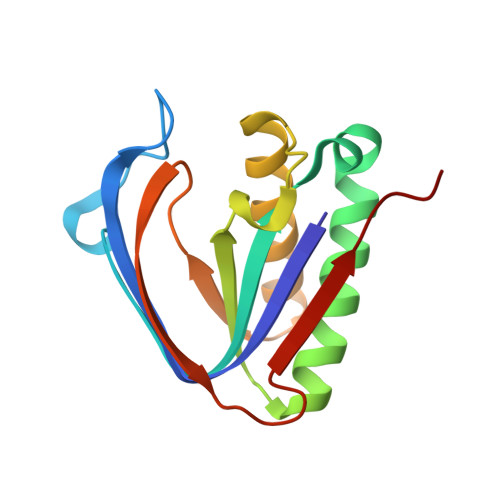
Crystal structure of the editing domain of threonyl-tRNA synthetase from Pyrococcus abyssi in complex with seryl-3'-aminoadenosine


Experimental Data Snapshot

  • Method: X-RAY DIFFRACTION
  • Resolution: 1.86 Å
  • R-Value Free: 
    0.220 (Depositor), 0.221 (DCC) 
  • R-Value Work: 
    0.193 (Depositor), 0.193 (DCC) 
  • R-Value Observed: 
    0.193 (Depositor) 

Starting Model: experimental
View more details

wwPDB Validation 3D Report Full Report

Validation slider image for 2HL0

Ligand Structure Quality Assessment 


This is version 1.3 of the entry. See complete history

Literature

Post-transfer editing mechanism of a D-aminoacyl-tRNA deacylase-like domain in threonyl-tRNA synthetase from archaea

Hussain, T.Kruparani, S.P.Pal, B.Dock-Bregeon, A.C.Dwivedi, S.Shekar, M.R.Sureshbabu, K.Sankaranarayanan, R.

(2006) EMBO J 25: 4152-4162

  • DOI: https://doi.org/10.1038/sj.emboj.7601278
  • Primary Citation Related Structures: 
    2HKZ, 2HL0, 2HL1, 2HL2

  • PubMed Abstract: 

    To ensure a high fidelity during translation, threonyl-tRNA synthetases (ThrRSs) harbor an editing domain that removes noncognate L-serine attached to tRNAThr. Most archaeal ThrRSs possess a unique editing domain structurally similar to D-aminoacyl-tRNA deacylases (DTDs) found in eubacteria and eukaryotes that specifically removes D-amino acids attached to tRNA. Here, we provide mechanistic insights into the removal of noncognate L-serine from tRNAThr by a DTD-like editing module from Pyrococcus abyssi ThrRS (Pab-NTD). High-resolution crystal structures of Pab-NTD with pre- and post-transfer substrate analogs and with L-serine show mutually nonoverlapping binding sites for the seryl moiety. Although the pre-transfer editing is excluded, the analysis reveals the importance of main chain atoms in proper positioning of the post-transfer substrate for its hydrolysis. A single residue has been shown to play a pivotal role in the inversion of enantioselectivity both in Pab-NTD and DTD. The study identifies an enantioselectivity checkpoint that filters opposite chiral molecules and thus provides a fascinating example of how nature has subtly engineered this domain for the selection of chiral molecules during translation.


  • Organizational Affiliation
    • Centre for Cellular and Molecular Biology, Uppal Road, Hyderabad, India.

Macromolecule Content 

  • Total Structure Weight: 16.64 kDa 
  • Atom Count: 1,364 
  • Modeled Residue Count: 143 
  • Deposited Residue Count: 143 
  • Unique protein chains: 1

Macromolecules

Find similar proteins by:|  3D Structure
Entity ID: 1
MoleculeChains  Sequence LengthOrganismDetailsImage
Threonyl-tRNA synthetase143Pyrococcus abyssiMutation(s): 0 
EC: 6.1.1.3
UniProt
Find proteins for Q9UZ14 (Pyrococcus abyssi (strain GE5 / Orsay))
Explore Q9UZ14 
Go to UniProtKB:  Q9UZ14
Entity Groups
Sequence Clusters30% Identity50% Identity70% Identity90% Identity95% Identity100% Identity
UniProt GroupQ9UZ14
Sequence Annotations
Expand
Reference Sequence

Small Molecules

Ligands 1 Unique
IDChains Name / Formula / InChI Key2D Diagram3D Interactions
A3S

Query on A3S


Download:Ideal Coordinates CCD File
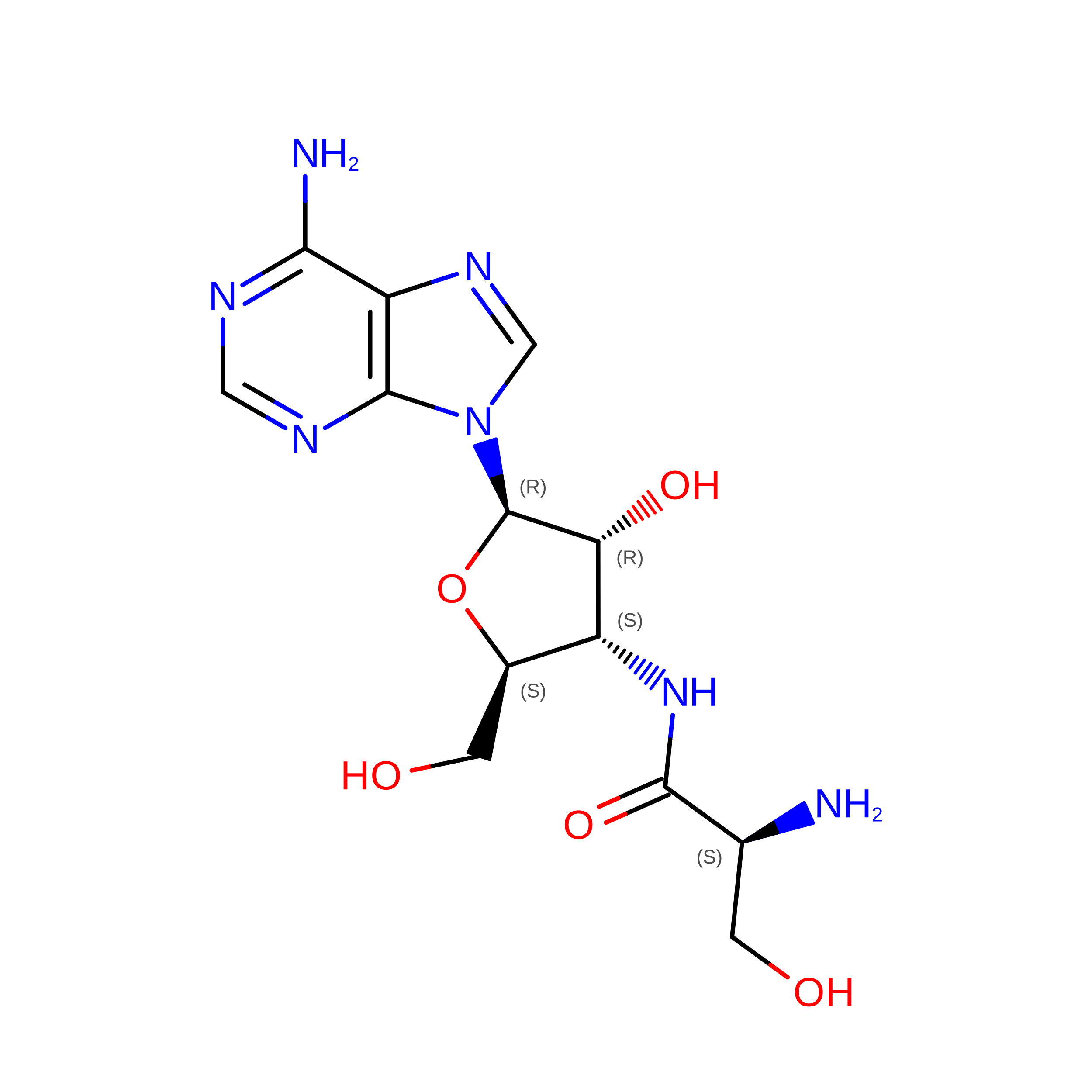
B [auth A]SERINE-3'-AMINOADENOSINE
C13 H19 N7 O5
ITDKSTILAWHDJI-AYEBZEFBSA-N

Experimental Data & Validation

Experimental Data

  • Method: X-RAY DIFFRACTION
  • Resolution: 1.86 Å
  • R-Value Free:  0.220 (Depositor), 0.221 (DCC) 
  • R-Value Work:  0.193 (Depositor), 0.193 (DCC) 
  • R-Value Observed: 0.193 (Depositor) 
Space Group: I 2 2 2
Unit Cell:
Length ( Å )Angle ( ˚ )
a = 53.022α = 90
b = 77.223β = 90
c = 90.952γ = 90
Software Package:
Software NamePurpose
CNSrefinement
DENZOdata reduction
SCALEPACKdata scaling
CCP4phasing

Structure Validation

View Full Validation Report


Ligand Structure Quality Assessment 


Entry History 

Deposition Data

Revision History  (Full details and data files)

  • Version 1.0: 2006-08-29
    Type: Initial release
  • Version 1.1: 2008-05-01
    Changes: Version format compliance
  • Version 1.2: 2011-07-13
    Changes: Version format compliance
  • Version 1.3: 2023-10-25
    Changes: Data collection, Database references, Derived calculations, Refinement description