2HI2 | pdb_00002hi2

Crystal structure of native Neisseria gonorrhoeae Type IV pilin at 2.3 Angstroms Resolution


Experimental Data Snapshot

  • Method: X-RAY DIFFRACTION
  • Resolution: 2.30 Å
  • R-Value Free: 
    0.282 (Depositor), 0.314 (DCC) 
  • R-Value Work: 
    0.259 (Depositor), 0.252 (DCC) 
  • R-Value Observed: 
    0.259 (Depositor) 

Starting Model: experimental
View more details

wwPDB Validation 3D Report Full Report

Validation slider image for 2HI2

This is version 2.1 of the entry. See complete history

Literature

Type IV Pilus Structure by Cryo-Electron Microscopy and Crystallography: Implications for Pilus Assembly and Functions.

Craig, L.Volkmann, N.Arvai, A.S.Pique, M.E.Yeager, M.Egelman, E.H.Tainer, J.A.

(2006) Mol Cell 23: 651-662

  • DOI: https://doi.org/10.1016/j.molcel.2006.07.004
  • Primary Citation Related Structures: 
    2HI2, 2HIL

  • PubMed Abstract: 

    Type IV pili (T4P) are long, thin, flexible filaments on bacteria that undergo assembly-disassembly from inner membrane pilin subunits and exhibit astonishing multifunctionality. Neisseria gonorrhoeae (gonococcal or GC) T4P are prototypic virulence factors and immune targets for increasingly antibiotic-resistant human pathogens, yet detailed structures are unavailable for any T4P. Here, we determined a detailed experimental GC-T4P structure by quantitative fitting of a 2.3 A full-length pilin crystal structure into a 12.5 A resolution native GC-T4P reconstruction solved by cryo-electron microscopy (cryo-EM) and iterative helical real space reconstruction. Spiraling three-helix bundles form the filament core, anchor the globular heads, and provide strength and flexibility. Protruding hypervariable loops and posttranslational modifications in the globular head shield conserved functional residues in pronounced grooves, creating a surprisingly corrugated pilus surface. These results clarify T4P multifunctionality and assembly-disassembly while suggesting unified assembly mechanisms for T4P, archaeal flagella, and type II secretion system filaments.


  • Organizational Affiliation
    • Department of Molecular Biology and Biochemistry, Simon Fraser University, Burnaby, British Columbia V5A 1S6, Canada.

Macromolecule Content 

  • Total Structure Weight: 17.92 kDa 
  • Atom Count: 1,455 
  • Modeled Residue Count: 158 
  • Deposited Residue Count: 158 
  • Unique protein chains: 1

Macromolecules

Find similar proteins by:|  3D Structure
Entity ID: 1
MoleculeChains  Sequence LengthOrganismDetailsImage
Fimbrial protein158Neisseria gonorrhoeaeMutation(s): 0 
Membrane Entity: Yes 
UniProt
Find proteins for P02974 (Neisseria gonorrhoeae)
Explore P02974 
Go to UniProtKB:  P02974
Entity Groups
Sequence Clusters30% Identity50% Identity70% Identity90% Identity95% Identity100% Identity
UniProt GroupP02974
Glycosylation
Glycosylation Sites: 1
Sequence Annotations
Expand
Reference Sequence

Oligosaccharides

Help  
Entity ID: 2
MoleculeChains Length2D Diagram GlycosylationD Interactions
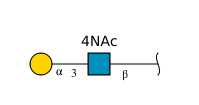
alpha-D-galactopyranose-(1-3)-2,4-bisacetamido-2,4-dideoxy-beta-D-glucopyranose
B
2N/A
Glycosylation Resources
GlyTouCan: G94245UE
GlyCosmos: G94245UE

Small Molecules

Ligands 2 Unique
IDChains Name / Formula / InChI Key2D Diagram3D Interactions
HTO

Query on HTO


Download:Ideal Coordinates CCD File
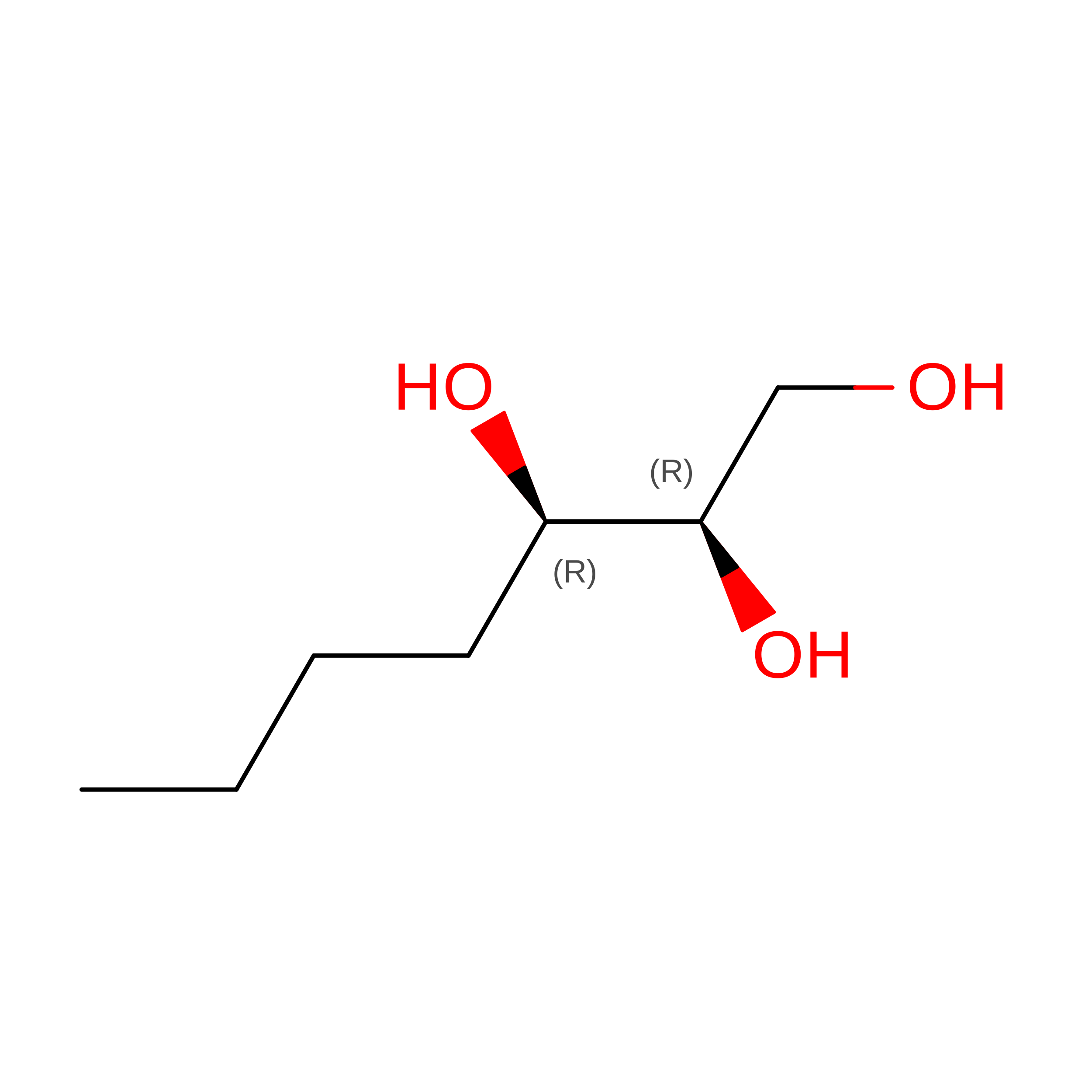
C [auth A]HEPTANE-1,2,3-TRIOL
C7 H16 O3
HXYCHJFUBNTKQR-RNFRBKRXSA-N
OPE

Query on OPE


Download:Ideal Coordinates CCD File
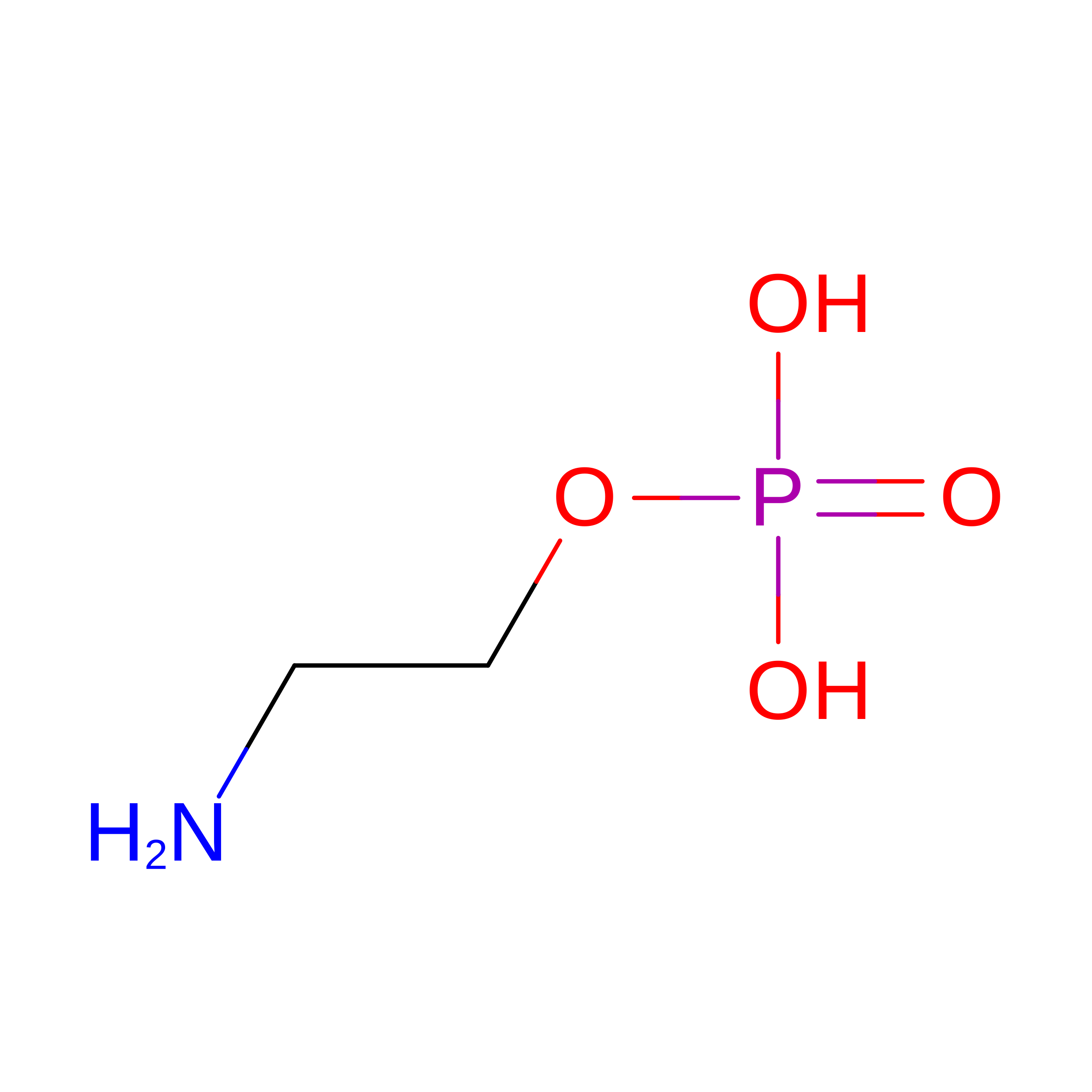
D [auth A]PHOSPHORIC ACID MONO-(2-AMINO-ETHYL) ESTER
C2 H8 N O4 P
SUHOOTKUPISOBE-UHFFFAOYSA-N
Modified Residues  1 Unique
IDChains TypeFormula2D DiagramParent
MEA
Query on MEA
A
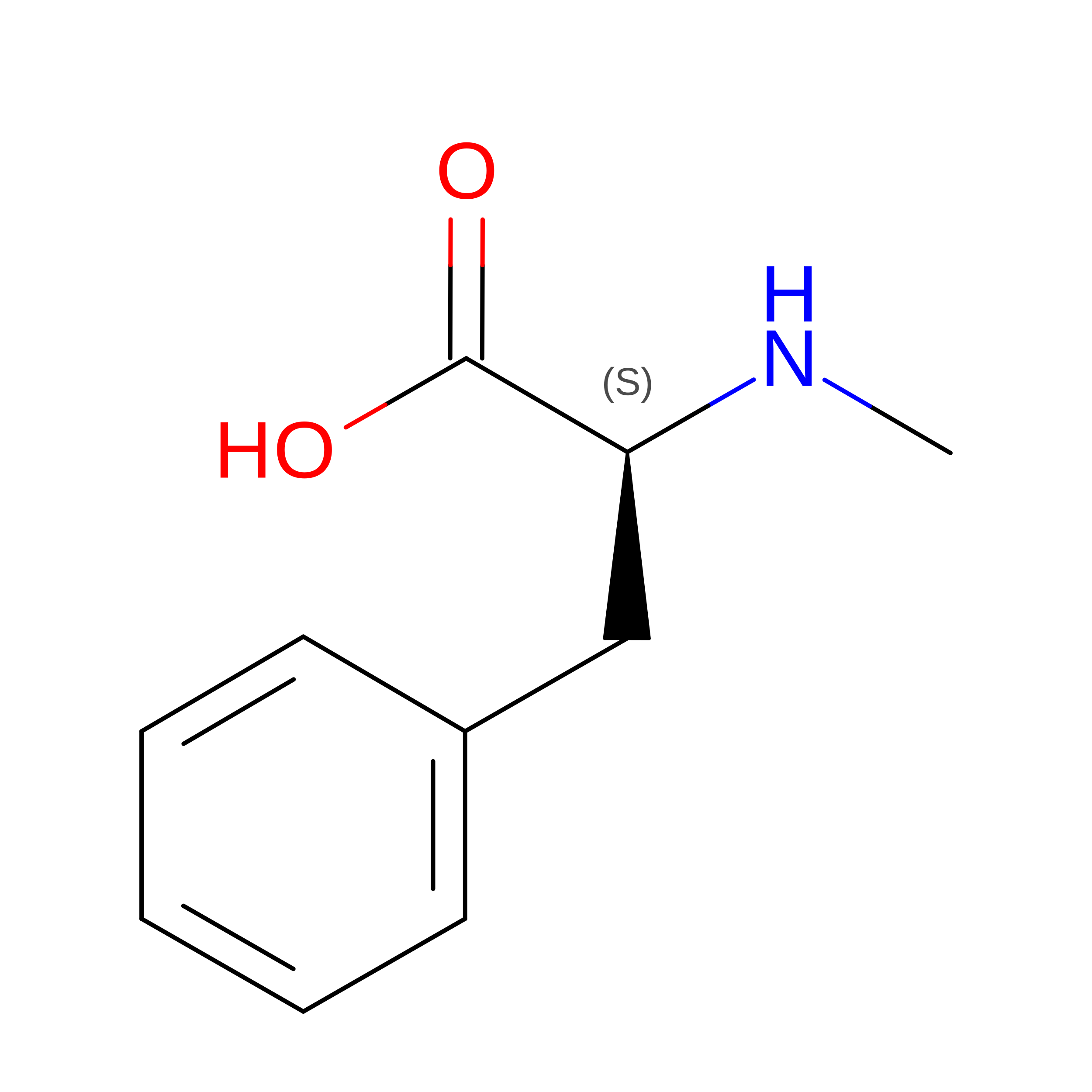
L-PEPTIDE LINKINGC10 H13 N O2PHE

Experimental Data & Validation

Experimental Data

  • Method: X-RAY DIFFRACTION
  • Resolution: 2.30 Å
  • R-Value Free:  0.282 (Depositor), 0.314 (DCC) 
  • R-Value Work:  0.259 (Depositor), 0.252 (DCC) 
  • R-Value Observed: 0.259 (Depositor) 
Space Group: C 2 2 2
Unit Cell:
Length ( Å )Angle ( ˚ )
a = 119.754α = 90
b = 124.941β = 90
c = 26.848γ = 90
Software Package:
Software NamePurpose
CNSrefinement
HKL-2000data reduction
HKL-2000data scaling
AMoREphasing

Structure Validation

View Full Validation Report


Entry History 

Deposition Data

Revision History  (Full details and data files)

  • Version 1.0: 2006-09-12
    Type: Initial release
  • Version 1.1: 2008-05-01
    Changes: Version format compliance
  • Version 1.2: 2011-07-13
    Changes: Version format compliance
  • Version 2.0: 2020-07-29
    Type: Remediation
    Reason: Carbohydrate remediation
    Changes: Atomic model, Data collection, Derived calculations, Structure summary
  • Version 2.1: 2023-08-30
    Changes: Data collection, Database references, Refinement description, Structure summary