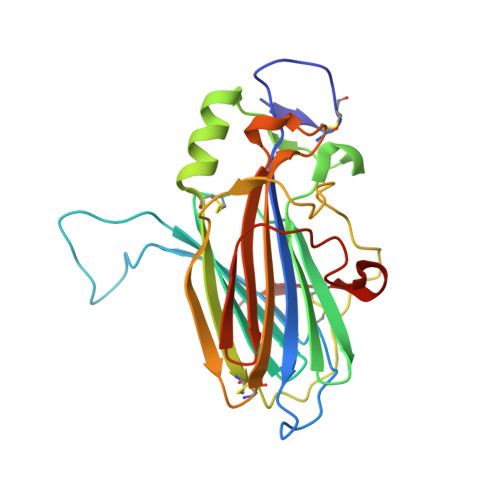
2GRK | pdb_00002grk

Crystal structure of ectromelia virus EVM1 chemokine binding protein


Experimental Data Snapshot

  • Method: X-RAY DIFFRACTION
  • Resolution: 2.60 Å
  • R-Value Free: 
    0.286 (Depositor), 0.285 (DCC) 
  • R-Value Work: 
    0.217 (Depositor), 0.215 (DCC) 
  • R-Value Observed: 
    0.217 (Depositor) 

Starting Model: experimental
View more details

wwPDB Validation 3D Report Full Report

Validation slider image for 2GRK

This is version 1.5 of the entry. See complete history

Literature

Structural determinants of chemokine binding by an ectromelia virus-encoded decoy receptor.

Arnold, P.L.Fremont, D.H.

(2006) J Virol 80: 7439-7449

  • DOI: https://doi.org/10.1128/JVI.00576-06
  • Primary Citation Related Structures: 
    2GRK

  • PubMed Abstract: 

    The EVM1 protein encoded by Ectromelia virus is a member of a highly conserved family of poxvirus chemokine binding proteins that interfere with host immune surveillance processes. EVM1 is abundantly expressed early during mousepox infection and is able to selectively bind CC chemokines and inhibit their interactions with host receptors. Here, we characterize the interaction between EVM1 and the human and murine chemokines CCL3 (MIP-1alpha), CCL2 (MCP-1), and CCL5 (RANTES). Each of these CC chemokines binds EVM1 with 1:1 stoichiometry and equilibrium dissociation constants ranging from 29 pM to 20 nM. The interactions are characterized by rapid-association kinetics between acidic EVM1 and generally basic chemokines with half-lives enduring up to 30 min. The 2.6-A crystal structure of EVM1 reveals a globular beta sandwich with a large, sequence-conserved surface patch encircled by acidic residues on one face of the protein. To determine whether this conserved cluster of residues is involved in chemokine engagement, a structure-based mutational analysis of EVM1 was employed. Mapping of the mutational results onto the surface of EVM1 reveals that a cluster of five residues (I173, S171, S134, N136, and Y69) emanating from one beta sheet is critical for CCL2 and CCL3 sequestration. Additionally, we find that the extended beta2-beta4 loop flanking this conserved cluster is also essential for high-affinity, lasting interactions with chemokines. This analysis provides insight into the mechanism of CC-chemokine inhibition employed by the poxvirus family of chemokine decoy receptors.


  • Organizational Affiliation
    • Department of Pathology and Immunology, Washington University School of Medicine, 660 S. Euclid Ave, St. Louis, MO 63110-1093, USA.

Macromolecule Content 

  • Total Structure Weight: 49.37 kDa 
  • Atom Count: 3,560 
  • Modeled Residue Count: 456 
  • Deposited Residue Count: 456 
  • Unique protein chains: 1

Macromolecules

Find similar proteins by:|  3D Structure
Entity ID: 1
MoleculeChains  Sequence LengthOrganismDetailsImage
EVM001
A, B
228Ectromelia virus MoscowMutation(s): 0 
Gene Names: EVM001
UniProt
Find proteins for Q9JFS0 (Ectromelia virus (strain Moscow))
Explore Q9JFS0 
Go to UniProtKB:  Q9JFS0
Entity Groups
Sequence Clusters30% Identity50% Identity70% Identity90% Identity95% Identity100% Identity
UniProt GroupQ9JFS0
Sequence Annotations
Expand
Reference Sequence

Experimental Data & Validation

Experimental Data

  • Method: X-RAY DIFFRACTION
  • Resolution: 2.60 Å
  • R-Value Free:  0.286 (Depositor), 0.285 (DCC) 
  • R-Value Work:  0.217 (Depositor), 0.215 (DCC) 
  • R-Value Observed: 0.217 (Depositor) 
Space Group: P 1 21 1
Unit Cell:
Length ( Å )Angle ( ˚ )
a = 49.2α = 90
b = 55.8β = 106.3
c = 85.8γ = 90
Software Package:
Software NamePurpose
DENZOdata reduction
SCALEPACKdata scaling
CNSrefinement
PDB_EXTRACTdata extraction
AMoREphasing

Structure Validation

View Full Validation Report


Entry History 

Deposition Data

Revision History  (Full details and data files)

  • Version 1.0: 2006-05-09
    Type: Initial release
  • Version 1.1: 2008-05-01
    Changes: Version format compliance
  • Version 1.2: 2011-07-13
    Changes: Source and taxonomy, Version format compliance
  • Version 1.3: 2017-10-18
    Changes: Refinement description
  • Version 1.4: 2023-08-30
    Changes: Data collection, Database references, Refinement description
  • Version 1.5: 2024-10-16
    Changes: Structure summary