Download Mendeley
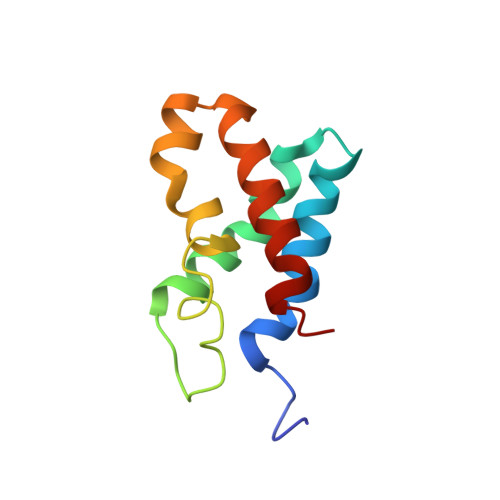
The FRB Domain of mTOR: NMR Solution Structure and Inhibitor Design.
Leone, M., Crowell, K.J., Chen, J., Jung, D., Chiang, G.G., Sareth, S., Abraham, R.T., Pellecchia, M.(2006) Biochemistry 45: 10294-10302
- PubMed: 16922504 Search on PubMed
- DOI: https://doi.org/10.1021/bi060976+
- Primary Citation Related Structures:
2GAQ - PubMed Abstract:
The mammalian target of rapamycin (mTOR) is a protein that is intricately involved in signaling pathways controlling cell growth. Rapamycin is a natural product that binds and inhibits mTOR function by interacting with its FKBP-rapamycin-binding (FRB) domain. Here we report on the NMR solution structure of FRB and on further studies aimed at the identification and characterization of novel ligands that target the rapamycin binding pocket. The biological activity of the ligands, and that of rapamycin in the absence of FKBP12, was investigated by assaying the kinase activity of mTOR. While we found that rapamycin binds the FRB domain and inhibits the kinase activity of mTOR even in the absence of FKBP12 (in the low micromolar range), our most potent ligands bind to FRB with similar binding affinity but inhibit the kinase activity of mTOR at much higher concentrations. However, we have also identified one low-affinity compound that is also capable of inhibiting mTOR. Hence, we have identified compounds that can directly mimic rapamycin or can dissociate the FRB binding from the inhibition of the catalytic activity of mTOR. As such, these ligands could be useful in deciphering the complex regulation of mTOR in the cell and in validating the FRB domain as a possible target for the development of novel therapeutic compounds.
- Cancer Research Center, Burnham Institute for Medical Research, 10901 North Torrey Pines Road, La Jolla, California 92037, USA.
Organizational Affiliation: