2FVC | pdb_00002fvc

Crystal structure of NS5B BK strain (delta 24) in complex with a 3-(1,1-Dioxo-2H-(1,2,4)-benzothiadiazin-3-yl)-4-hydroxy-2(1H)-quinolinone


Experimental Data Snapshot

  • Method: X-RAY DIFFRACTION
  • Resolution: 2.00 Å
  • R-Value Free: 
    0.243 (Depositor), 0.207 (DCC) 
  • R-Value Work: 
    0.206 (Depositor), 0.208 (DCC) 

Starting Model: experimental
View more details

wwPDB Validation 3D Report Full Report

Validation slider image for 2FVC

Ligand Structure Quality Assessment 


This is version 1.4 of the entry. See complete history. 

Literature

3-(1,1-dioxo-2H-(1,2,4)-benzothiadiazin-3-yl)-4-hydroxy-2(1H)-quinolinones, potent inhibitors of hepatitis C virus RNA-dependent RNA polymerase.

Tedesco, R., Shaw, A.N., Bambal, R., Chai, D., Concha, N.O., Darcy, M.G., Dhanak, D., Fitch, D.M., Gates, A., Gerhardt, W.G., Halegoua, D.L., Han, C., Hofmann, G.A., Johnston, V.K., Kaura, A.C., Liu, N., Keenan, R.M., Lin-Goerke, J., Sarisky, R.T., Wiggall, K.J., Zimmerman, M.N., Duffy, K.J.

(2006) J Med Chem 49: 971-983

  • DOI: https://doi.org/10.1021/jm050855s
  • Primary Citation Related Structures: 
    2FVC

  • PubMed Abstract: 

    Recently, we disclosed a new class of HCV polymerase inhibitors discovered through high-throughput screening (HTS) of the GlaxoSmithKline proprietary compound collection. This interesting class of 3-(1,1-dioxo-2H-1,2,4-benzothiadiazin-3-yl)-4-hydroxy-2(1H)-quinolinones potently inhibits HCV polymerase enzymatic activity and inhibits the ability of the subgenomic HCV replicon to replicate in Huh-7 cells. This report will focus on the structure-activity relationships (SAR) of substituents on the quinolinone ring, culminating in the discovery of 1-(2-cyclopropylethyl)-3-(1,1-dioxo-2H-1,2,4-benzothiadiazin-3-yl)-6-fluoro-4-hydroxy-2(1H)-quinolinone (130), an inhibitor with excellent potency in biochemical and cellular assays possessing attractive molecular properties for advancement as a clinical candidate. The potential for development and safety assessment profile of compound 130 will also be discussed.


  • Organizational Affiliation: 
    • Department of Medicinal Chemistry and Drug Metabolism, the Musculoskeletal, Microbial and Proliferative Diseases Center of Excellence for Drug Discovery, GlaxoSmithKline Pharmaceuticals, Collegeville, PA 19426, USA. Rosanna_2_Tedesco@gsk.com

Macromolecule Content 

  • Total Structure Weight: 125.69 kDa 
  • Atom Count: 9,456 
  • Modeled Residue Count: 1,126 
  • Deposited Residue Count: 1,126 
  • Unique protein chains: 1

Macromolecules

Find similar proteins by:|  3D Structure
Entity ID: 1
MoleculeChains  Sequence LengthOrganismDetailsImage
polyprotein
A, B
563Hepatitis C virus subtype 1bMutation(s): 0 
Gene Names: NS5B
UniProt
Find proteins for Q99AU2 (Hepatitis C virus genotype 1b)
Explore Q99AU2 
Go to UniProtKB:  Q99AU2
Entity Groups
Sequence Clusters30% Identity50% Identity70% Identity90% Identity95% Identity100% Identity
UniProt GroupQ99AU2
Sequence Annotations
Expand
Reference Sequence

Small Molecules

Ligands 1 Unique
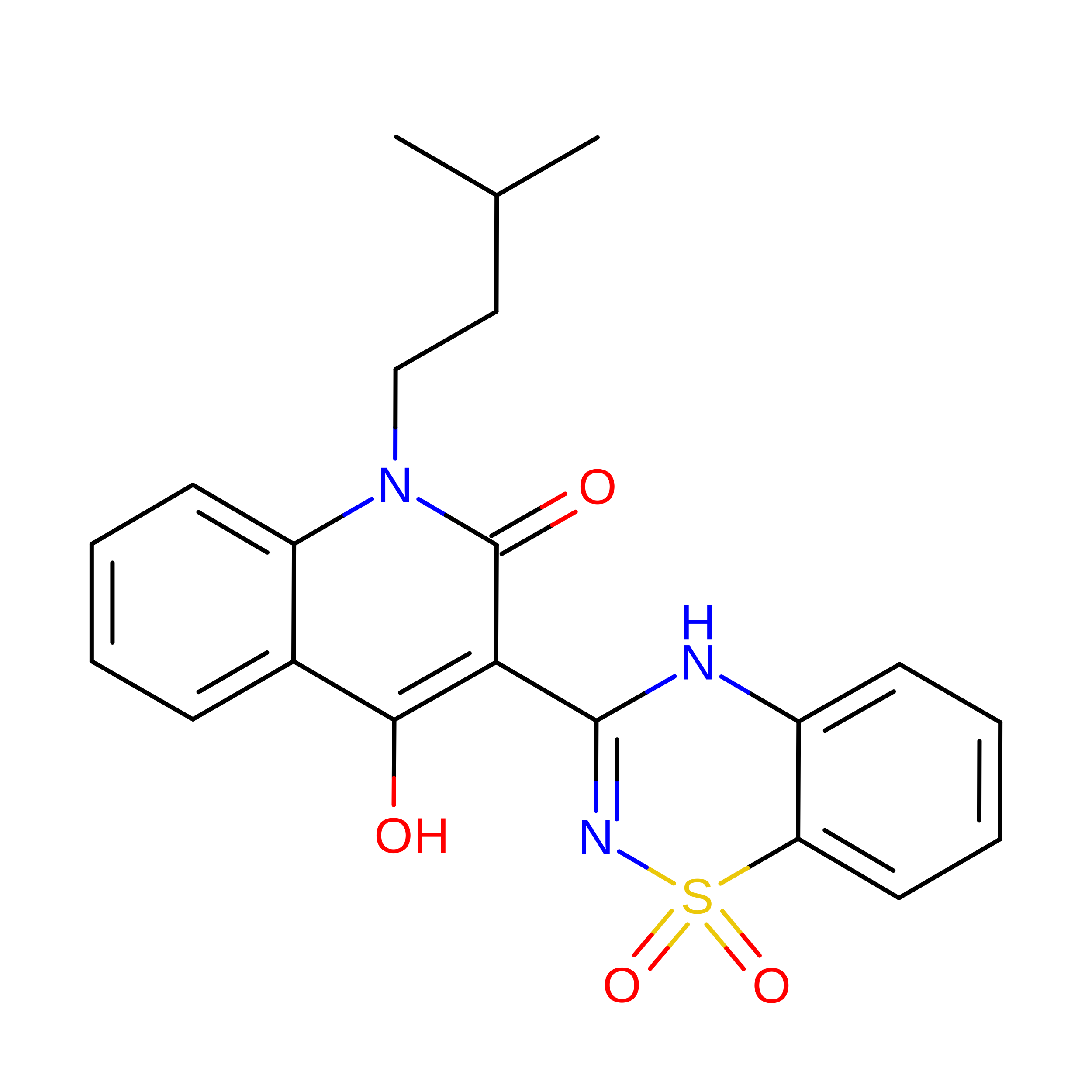
IDChains Name / Formula / InChI Key2D Diagram3D Interactions
888

Query on 888


Download:Ideal Coordinates CCD File
C [auth A],
D [auth B]
3-(1,1-dioxido-4H-1,2,4-benzothiadiazin-3-yl)-4-hydroxy-1-(3-methylbutyl)quinolin-2(1H)-one
C21 H21 N3 O4 S
MQFPIRFODWNQIO-UHFFFAOYSA-N

Experimental Data & Validation

Experimental Data

  • Method: X-RAY DIFFRACTION
  • Resolution: 2.00 Å
  • R-Value Free:  0.243 (Depositor), 0.207 (DCC) 
  • R-Value Work:  0.206 (Depositor), 0.208 (DCC) 
Space Group: P 21 21 21
Unit Cell:
Length ( Å )Angle ( ˚ )
a = 85.5α = 90
b = 105.2β = 90
c = 126.4γ = 90
Software Package:
Software NamePurpose
DENZOdata reduction
SCALEPACKdata scaling
CNSrefinement
PDB_EXTRACTdata extraction
MADNESSdata reduction
AMoREphasing

Structure Validation

View Full Validation Report


Ligand Structure Quality Assessment 


Entry History 

Deposition Data

Revision History  (Full details and data files)

  • Version 1.0: 2007-01-16
    Type: Initial release
  • Version 1.1: 2008-05-01
    Changes: Version format compliance
  • Version 1.2: 2011-07-13
    Changes: Non-polymer description, Version format compliance
  • Version 1.3: 2017-10-18
    Changes: Advisory, Refinement description
  • Version 1.4: 2023-08-30
    Changes: Advisory, Data collection, Database references, Derived calculations, Refinement description