Download Mendeley
Evolution of enzymatic activity in the tautomerase superfamily: mechanistic and structural consequences of the L8R mutation in 4-oxalocrotonate tautomerase
Poelarends, G.J., Almrud, J.J., Serrano, H., Darty, J.E., Johnson, W.H., Hackert, M.L., Whitman, C.P.(2006) Biochemistry 45: 7700-7708
- PubMed: 16784221 Search on PubMedSearch on PubMed Central
- DOI: https://doi.org/10.1021/bi0600603
- Primary Citation Related Structures:
2FM7 - PubMed Abstract:
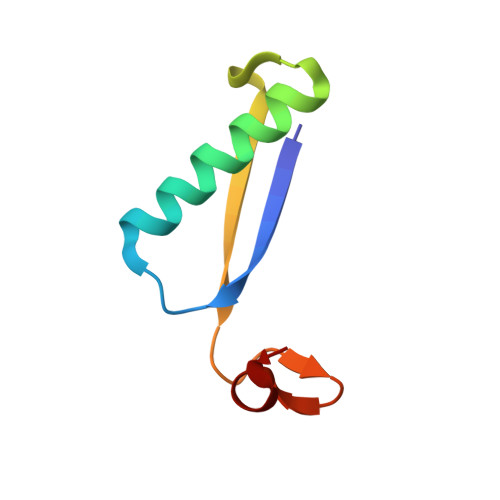
4-Oxalocrotonate tautomerase (4-OT) and trans-3-chloroacrylic acid dehalogenase (CaaD) are members of the tautomerase superfamily, a group of structurally homologous proteins that share a beta-alpha-beta fold and a catalytic amino-terminal proline. 4-OT, from Pseudomonas putida mt-2, catalyzes the conversion of 2-oxo-4-hexenedioate to 2-oxo-3-hexenedioate through the dienol intermediate 2-hydroxymuconate in a catabolic pathway for aromatic hydrocarbons. CaaD, from Pseudomonas pavonaceae 170, catalyzes the hydrolytic dehalogenation of trans-3-chloroacrylate in the trans-1,3-dichloropropene degradation pathway. Both reactions may involve an arginine-stabilized enediolate intermediate, a capability that may partially account for the low-level CaaD activity of 4-OT. Two active-site residues in 4-OT, Leu-8 and Ile-52, have now been mutated to the positionally conserved and catalytic ones in CaaD, alphaArg-8, and alphaGlu-52. The L8R and L8R/I52E mutants show improved CaaD activity (50- and 32-fold increases in k(cat)/K(m), respectively) and diminished 4-OT activity (5- and 1700-fold decreases in k(cat)/K(m), respectively). The increased efficiency of L8R-4-OT for the CaaD reaction stems primarily from an 8.8-fold increase in k(cat), whereas that of the L8R/I52E mutant is due largely to a 23-fold decrease in K(m). The presence of the additional arginine residue in the active site of L8R-4-OT does not alter the pK(a) of the Pro-1 amino group from that measured for the wild type (6.5 +/- 0.1 versus 6.4 +/- 0.2). Moreover, the crystal structure of L8R-4-OT is comparable to that of the wild type. Hence, the enhanced CaaD activity of L8R-4-OT is likely due to the additional arginine residue that can participate in substrate binding and/or stabilization of the putative enediolate intermediate. The results also suggest that the evolution of new functions within the tautomerase superfamily could be quite facile, requiring only a few strategically placed active-site mutations.
- Division of Medicinal Chemistry, College of Pharmacy, and Department of Chemistry and Biochemistry, The University of Texas, Austin, Texas 78712-1074, USA.
Organizational Affiliation: