2FJT | pdb_00002fjt

Adenylyl cyclase class iv from Yersinia pestis


Experimental Data Snapshot

  • Method: X-RAY DIFFRACTION
  • Resolution: 1.90 Å
  • R-Value Free: 
    0.273 (Depositor) 
  • R-Value Work: 
    0.212 (Depositor), 0.215 (DCC) 
  • R-Value Observed: 
    0.216 (Depositor) 

Starting Model: experimental
View more details

wwPDB Validation 3D Report Full Report

Validation slider image for 2FJT

This is version 1.4 of the entry. See complete history

Literature

Structure of the class IV adenylyl cyclase reveals a novel fold

Gallagher, D.T.Smith, N.N.Kim, S.-K.Heroux, A.Robinson, H.Reddy, P.T.

(2006) J Mol Biology 362: 114-122

  • DOI: https://doi.org/10.1016/j.jmb.2006.07.008
  • Primary Citation Related Structures: 
    2FJT

  • PubMed Abstract: 

    The crystal structure of the class IV adenylyl cyclase (AC) from Yersinia pestis (Yp) is reported at 1.9 A resolution. The class IV AC fold is distinct from the previously described folds for class II and class III ACs. The dimeric AC-IV folds into an antiparallel eight-stranded barrel whose connectivity has been seen in only three previous structures: yeast RNA triphosphatase and two proteins of unknown function from Pyrococcus furiosus and Vibrio parahaemolyticus. Eight highly conserved ionic residues E10, E12, K14, R63, K76, K111, D126, and E136 lie in the barrel core and form the likely binding sites for substrate and divalent cations. A phosphate ion is observed bound to R63, K76, K111, and R113 near the center of the conserved cluster. Unlike the AC-II and AC-III active sites that utilize two-Asp motifs for cation binding, the AC-IV active site is relatively enriched in glutamate and features an ExE motif as its most conserved element. Homologs of Y. pestis AC-IV, including human thiamine triphosphatase, span the three kingdoms of life and delineate an ancient family of phosphonucleotide processing enzymes.


  • Organizational Affiliation
    • Biochemical Science Division, National Institute of Standards and Technology, Gaithersburg, MD 20899-8310, USA. travis.gallagher@nist.gov

Macromolecule Content 

  • Total Structure Weight: 41.47 kDa 
  • Atom Count: 3,118 
  • Modeled Residue Count: 353 
  • Deposited Residue Count: 364 
  • Unique protein chains: 1

Macromolecules

Find similar proteins by:|  3D Structure
Entity ID: 1
MoleculeChains  Sequence LengthOrganismDetailsImage
Adenylyl cyclase class IV
A, B
182Yersinia pestis KIM10+Mutation(s): 1 
EC: 4.6.1.1
UniProt
Find proteins for A0A2U2H3Y1 (Yersinia pestis)
Explore A0A2U2H3Y1 
Go to UniProtKB:  A0A2U2H3Y1
Entity Groups
Sequence Clusters30% Identity50% Identity70% Identity90% Identity95% Identity100% Identity
UniProt GroupA0A2U2H3Y1
Sequence Annotations
Expand
Reference Sequence

Small Molecules

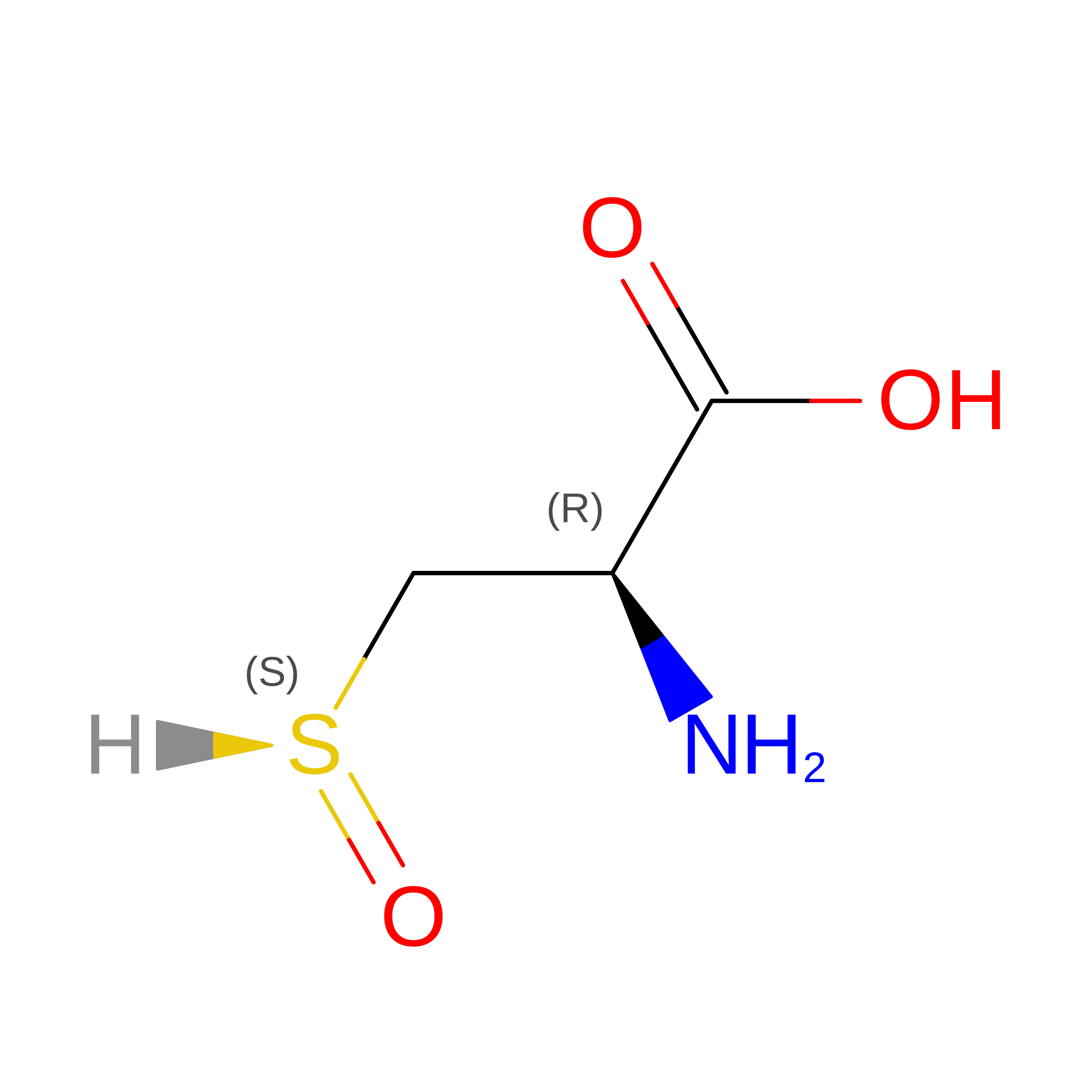
Modified Residues  1 Unique
IDChains TypeFormula2D DiagramParent
CSX
Query on CSX
A, B
L-PEPTIDE LINKINGC3 H7 N O3 SCYS

Experimental Data & Validation

Experimental Data

  • Method: X-RAY DIFFRACTION
  • Resolution: 1.90 Å
  • R-Value Free:  0.273 (Depositor) 
  • R-Value Work:  0.212 (Depositor), 0.215 (DCC) 
  • R-Value Observed: 0.216 (Depositor) 
Space Group: P 1
Unit Cell:
Length ( Å )Angle ( ˚ )
a = 33.529α = 88.89
b = 35.548β = 82.63
c = 71.985γ = 65.47
Software Package:
Software NamePurpose
CrystalCleardata collection
CrystalCleardata reduction
AMoREphasing
REFMACrefinement
CrystalCleardata scaling

Structure Validation

View Full Validation Report


Entry History 

Deposition Data

Revision History  (Full details and data files)

  • Version 1.0: 2006-11-14
    Type: Initial release
  • Version 1.1: 2008-05-01
    Changes: Version format compliance
  • Version 1.2: 2011-07-13
    Changes: Source and taxonomy, Version format compliance
  • Version 1.3: 2018-01-31
    Changes: Experimental preparation
  • Version 1.4: 2024-04-03
    Changes: Data collection, Database references, Derived calculations, Refinement description