2FG7 | pdb_00002fg7

N-succinyl-L-ornithine transcarbamylase from B. fragilis complexed with carbamoyl phosphate and N-succinyl-L-norvaline


Experimental Data Snapshot

  • Method: X-RAY DIFFRACTION
  • Resolution: 2.90 Å
  • R-Value Free: 
    0.229 (Depositor), 0.227 (DCC) 
  • R-Value Work: 
    0.204 (Depositor), 0.202 (DCC) 
  • R-Value Observed: 
    0.204 (Depositor) 

Starting Model: experimental
View more details

wwPDB Validation 3D Report Full Report

Validation slider image for 2FG7

Ligand Structure Quality Assessment 


This is version 1.6 of the entry. See complete history

Literature

Structure and catalytic mechanism of a novel N-succinyl-L-ornithine transcarbamylase in arginine biosynthesis of Bacteroides fragilis.

Shi, D.Morizono, H.Cabrera-Luque, J.Yu, X.Roth, L.Malamy, M.H.Allewell, N.M.Tuchman, M.

(2006) J Biological Chem 281: 20623-20631

  • DOI: https://doi.org/10.1074/jbc.M601229200
  • Primary Citation Related Structures: 
    2FG6, 2FG7

  • PubMed Abstract: 

    A Bacteroides fragilis gene (argF'(bf)), the disruption of which renders the bacterium auxotrophic for arginine, was expressed and its recombinant protein purified and studied. The novel protein catalyzes the carbamylation of N-succinyl-L-ornithine but not L-ornithine or N-acetyl-L-ornithine, forming N-succinyl-L-citrulline. Crystal structures of this novel transcarbamylase complexed with carbamyl phosphate and N-succinyl-L-norvaline, as well as sulfate and N-succinyl-L-norvaline have been determined and refined to 2.9 and 2.8 A resolution, respectively. They provide structural evidence that this protein is a novel N-succinyl-L-ornithine transcarbamylase. The data provided herein suggest that B. fragilis uses N-succinyl-L-ornithine rather than N-acetyl-L-ornithine for de novo arginine biosynthesis and therefore that this pathway in Bacteroides is different from the canonical arginine biosynthetic pathway of most organisms. Comparison of the structures of the new protein with those recently reported for N-acetyl-L-ornithine transcarbamylase indicates that amino acid residue 90 (B. fragilis numbering) plays an important role in conferring substrate specificity for N-succinyl-L-ornithine versus N-acetyl-L-ornithine. Movement of the 120 loop upon substrate binding occurs in N-succinyl-L-ornithine transcarbamylase, while movement of the 80 loop and significant domain closure take place as in other transcarbamylases. These findings provide new information on the putative role of succinylated intermediates in arginine biosynthesis and on the evolution of transcarbamylases.


  • Organizational Affiliation
    • Children's Research Institute, Children's National Medical Center, George Washington University, Washington, D. C. 20010, USA. dshj@cnmcresearch.org

Macromolecule Content 

  • Total Structure Weight: 234.12 kDa 
  • Atom Count: 15,889 
  • Modeled Residue Count: 1,922 
  • Deposited Residue Count: 2,028 
  • Unique protein chains: 1

Macromolecules

Find similar proteins by:|  3D Structure
Entity ID: 1
MoleculeChains  Sequence LengthOrganismDetailsImage
putative ornithine carbamoyltransferase338Bacteroides fragilis NCTC 9343Mutation(s): 1 
Gene Names: argF'
EC: 2.1.3 (PDB Primary Data), 2.1.3.11 (UniProt)
UniProt
Find proteins for Q5LI27 (Bacteroides fragilis (strain ATCC 25285 / DSM 2151 / CCUG 4856 / JCM 11019 / LMG 10263 / NCTC 9343 / Onslow / VPI 2553 / EN-2))
Explore Q5LI27 
Go to UniProtKB:  Q5LI27
Entity Groups
Sequence Clusters30% Identity50% Identity70% Identity90% Identity95% Identity100% Identity
UniProt GroupQ5LI27
Sequence Annotations
Expand
Reference Sequence

Small Molecules

Ligands 3 Unique
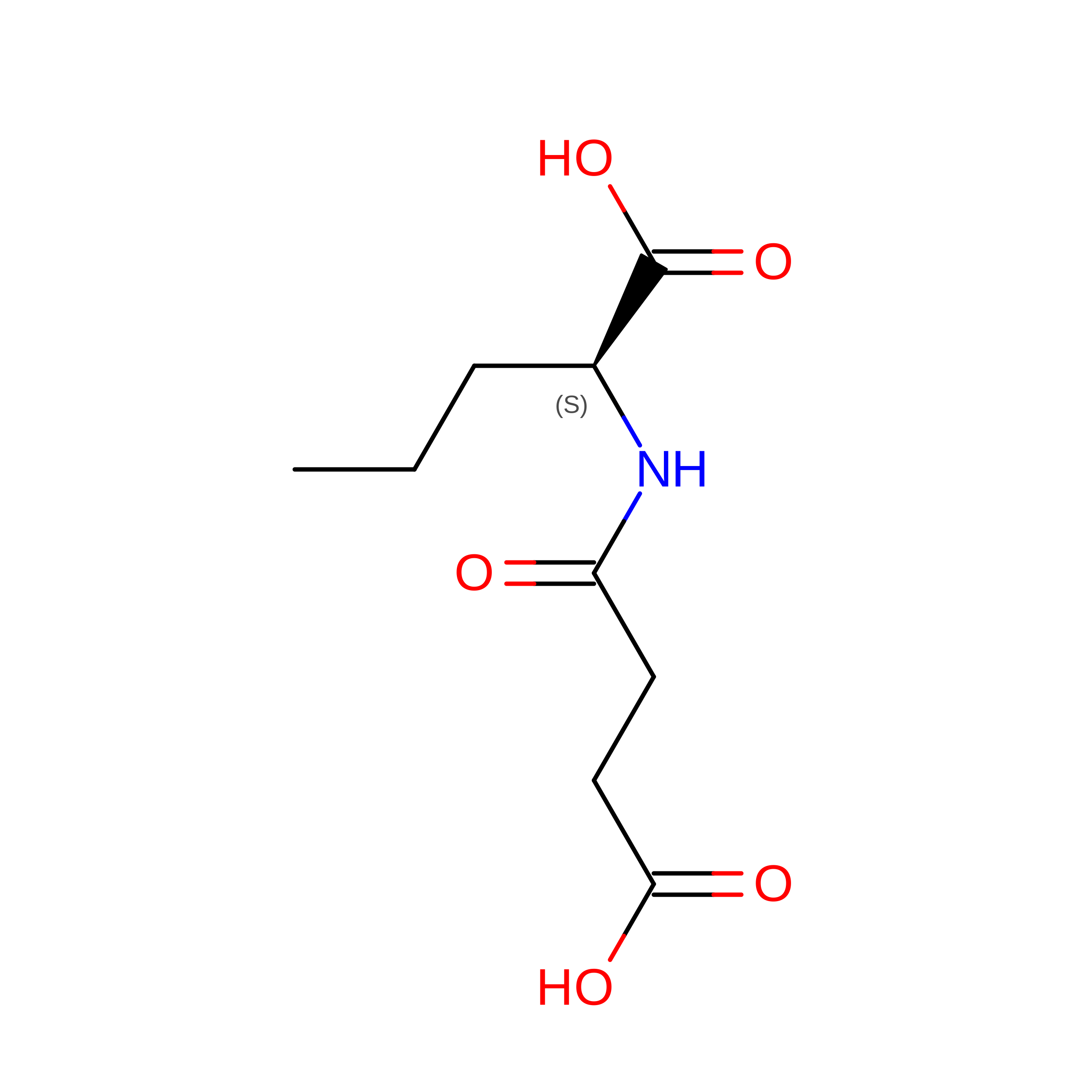
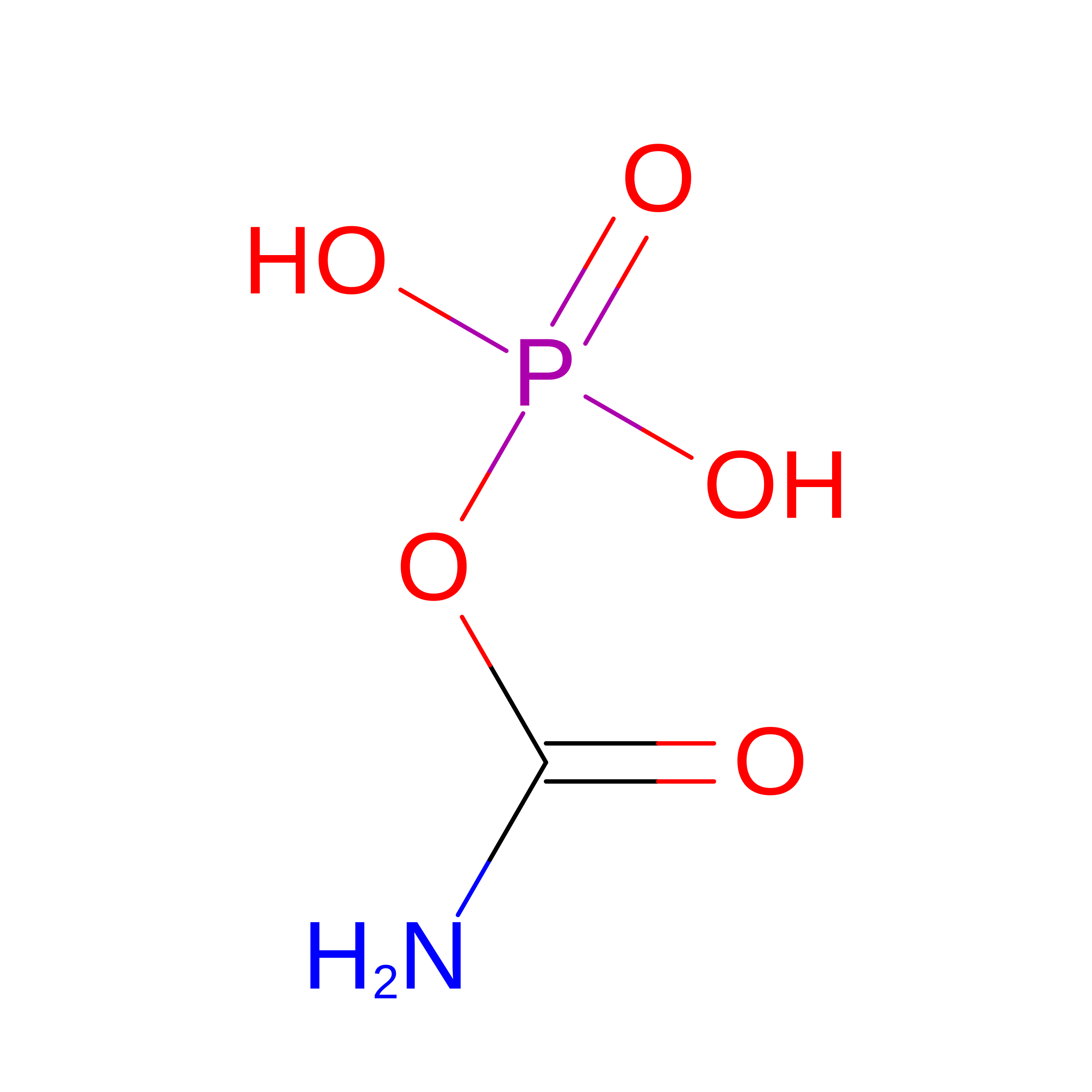
IDChains Name / Formula / InChI Key2D Diagram3D Interactions
SN0

Query on SN0


Download:Ideal Coordinates CCD File
H [auth X]
J [auth Y]
L [auth Z]
O [auth C]
Q [auth D]
H [auth X],
J [auth Y],
L [auth Z],
O [auth C],
Q [auth D],
S [auth E]
N-(3-CARBOXYPROPANOYL)-L-NORVALINE
C9 H15 N O5
HRAPDLBXHOBAKA-LURJTMIESA-N
CP

Query on CP


Download:Ideal Coordinates CCD File
I [auth X]
K [auth Y]
M [auth Z]
P [auth C]
R [auth D]
I [auth X],
K [auth Y],
M [auth Z],
P [auth C],
R [auth D],
T [auth E]
PHOSPHORIC ACID MONO(FORMAMIDE)ESTER
C H4 N O5 P
FFQKYPRQEYGKAF-UHFFFAOYSA-N
SO4

Query on SO4


Download:Ideal Coordinates CCD File
G [auth X],
N [auth C]
SULFATE ION
O4 S
QAOWNCQODCNURD-UHFFFAOYSA-L

Experimental Data & Validation

Experimental Data

  • Method: X-RAY DIFFRACTION
  • Resolution: 2.90 Å
  • R-Value Free:  0.229 (Depositor), 0.227 (DCC) 
  • R-Value Work:  0.204 (Depositor), 0.202 (DCC) 
  • R-Value Observed: 0.204 (Depositor) 
Space Group: P 43
Unit Cell:
Length ( Å )Angle ( ˚ )
a = 156.424α = 90
b = 156.424β = 90
c = 120.645γ = 90
Software Package:
Software NamePurpose
CNSrefinement
CCP4data scaling
PHASESphasing

Structure Validation

View Full Validation Report


Ligand Structure Quality Assessment 


Entry History 

Deposition Data

Revision History  (Full details and data files)

  • Version 1.0: 2006-05-23
    Type: Initial release
  • Version 1.1: 2008-05-01
    Changes: Version format compliance
  • Version 1.2: 2011-07-13
    Changes: Source and taxonomy, Version format compliance
  • Version 1.3: 2017-10-18
    Changes: Refinement description
  • Version 1.4: 2021-10-20
    Changes: Database references, Derived calculations
  • Version 1.5: 2023-08-30
    Changes: Data collection, Refinement description
  • Version 1.6: 2023-11-29
    Changes: Data collection, Database references