2FFA | pdb_00002ffa

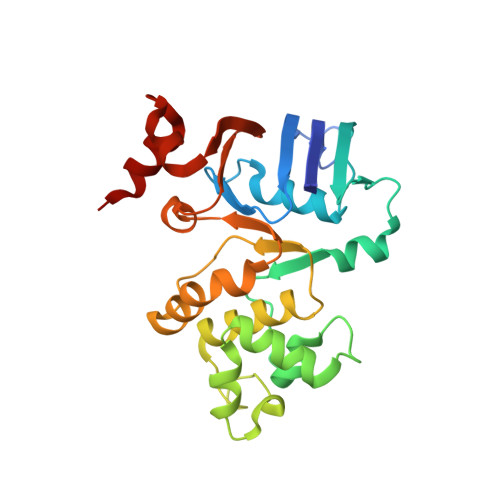
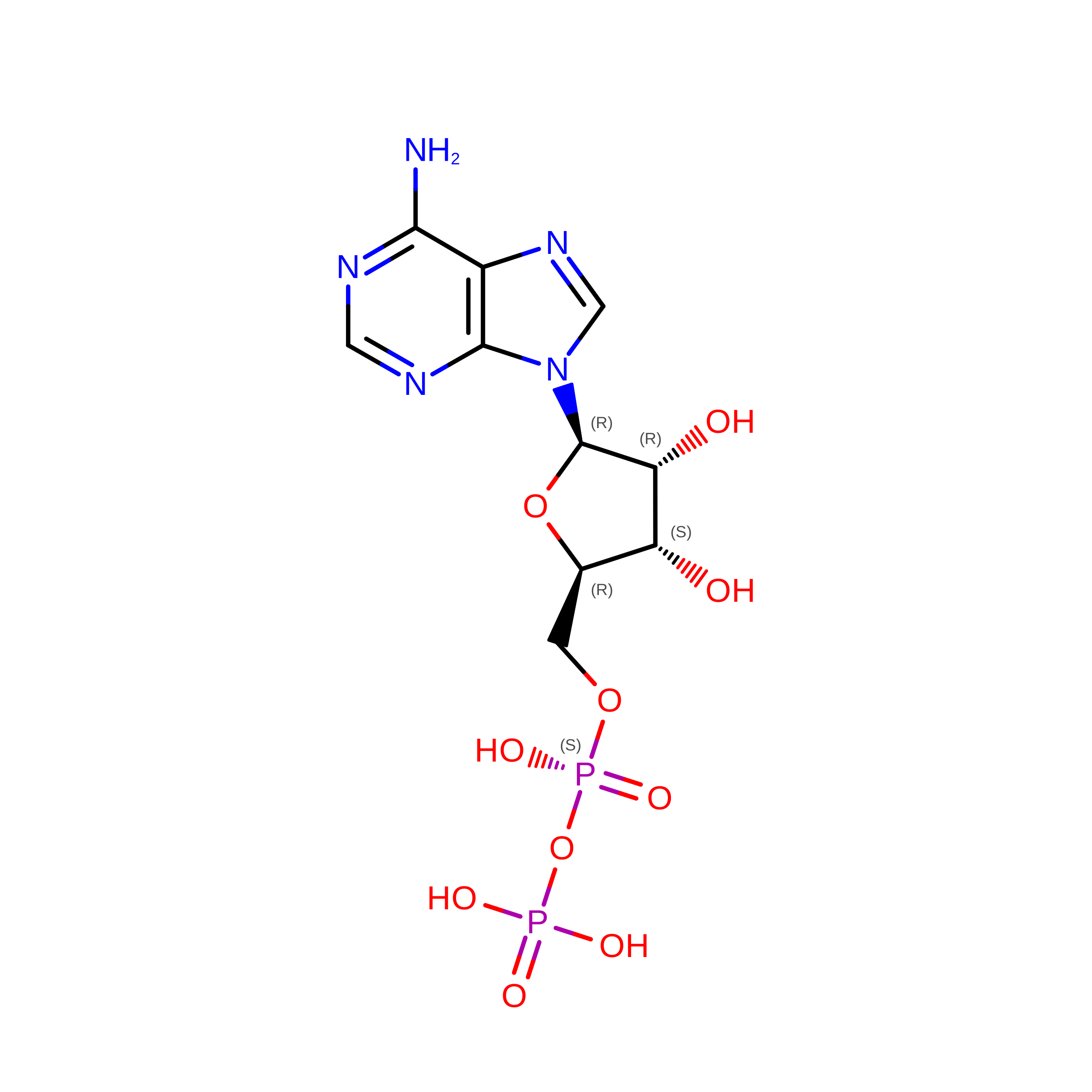
Crystal structure of ABC-ATPase H662A of the ABC-transporter HlyB in complex with ADP


Experimental Data Snapshot

  • Method: X-RAY DIFFRACTION
  • Resolution: 1.70 Å
  • R-Value Free: 
    0.240 (Depositor), 0.273 (DCC) 
  • R-Value Work: 
    0.205 (Depositor) 
  • R-Value Observed: 
    0.207 (Depositor) 

Starting Model: experimental
View more details

wwPDB Validation 3D Report Full Report

Validation slider image for 2FFA

Ligand Structure Quality Assessment 


This is version 1.4 of the entry. See complete history

Literature

A structural analysis of asymmetry required for catalytic activity of an ABC-ATPase domain dimer.

Zaitseva, J.Oswald, C.Jumpertz, T.Jenewein, S.Wiedenmann, A.Holland, I.B.Schmitt, L.

(2006) EMBO J 25: 3432-3443

  • DOI: https://doi.org/10.1038/sj.emboj.7601208
  • Primary Citation Related Structures: 
    2FF7, 2FFA, 2FFB, 2FGJ, 2FGK

  • PubMed Abstract: 

    The ATP-binding cassette (ABC)-transporter haemolysin (Hly)B, a central element of a Type I secretion machinery, acts in concert with two additional proteins in Escherichia coli to translocate the toxin HlyA directly from the cytoplasm to the exterior. The basic set of crystal structures necessary to describe the catalytic cycle of the isolated HlyB-NBD (nucleotide-binding domain) has now been completed. This allowed a detailed analysis with respect to hinge regions, functionally important key residues and potential energy storage devices that revealed many novel features. These include a structural asymmetry within the ATP dimer that was significantly enhanced in the presence of Mg2+, indicating a possible functional asymmetry in the form of one open and one closed phosphate exit tunnel. Guided by the structural analysis, we identified two amino acids, closing one tunnel by an apparent salt bridge. Mutation of these residues abolished ATP-dependent cooperativity of the NBDs. The implications of these new findings for the coupling of ATP binding and hydrolysis to functional activity are discussed.


  • Organizational Affiliation
    • Institute of Biochemistry, Heinrich Heine University Duesseldorf, Duesseldorf, Germany.

Macromolecule Content 

  • Total Structure Weight: 28.23 kDa 
  • Atom Count: 2,185 
  • Modeled Residue Count: 243 
  • Deposited Residue Count: 247 
  • Unique protein chains: 1

Macromolecules

Find similar proteins by:|  3D Structure
Entity ID: 1
MoleculeChains  Sequence LengthOrganismDetailsImage
Alpha-hemolysin translocation ATP-binding protein hlyB247Escherichia coliMutation(s): 1 
Gene Names: hlyB
UniProt
Find proteins for P08716 (Escherichia coli)
Explore P08716 
Go to UniProtKB:  P08716
Entity Groups
Sequence Clusters30% Identity50% Identity70% Identity90% Identity95% Identity100% Identity
UniProt GroupP08716
Sequence Annotations
Expand
Reference Sequence

Small Molecules

Ligands 2 Unique
IDChains Name / Formula / InChI Key2D Diagram3D Interactions
ADP

Query on ADP


Download:Ideal Coordinates CCD File
B [auth A]ADENOSINE-5'-DIPHOSPHATE
C10 H15 N5 O10 P2
XTWYTFMLZFPYCI-KQYNXXCUSA-N
MPD

Query on MPD


Download:Ideal Coordinates CCD File
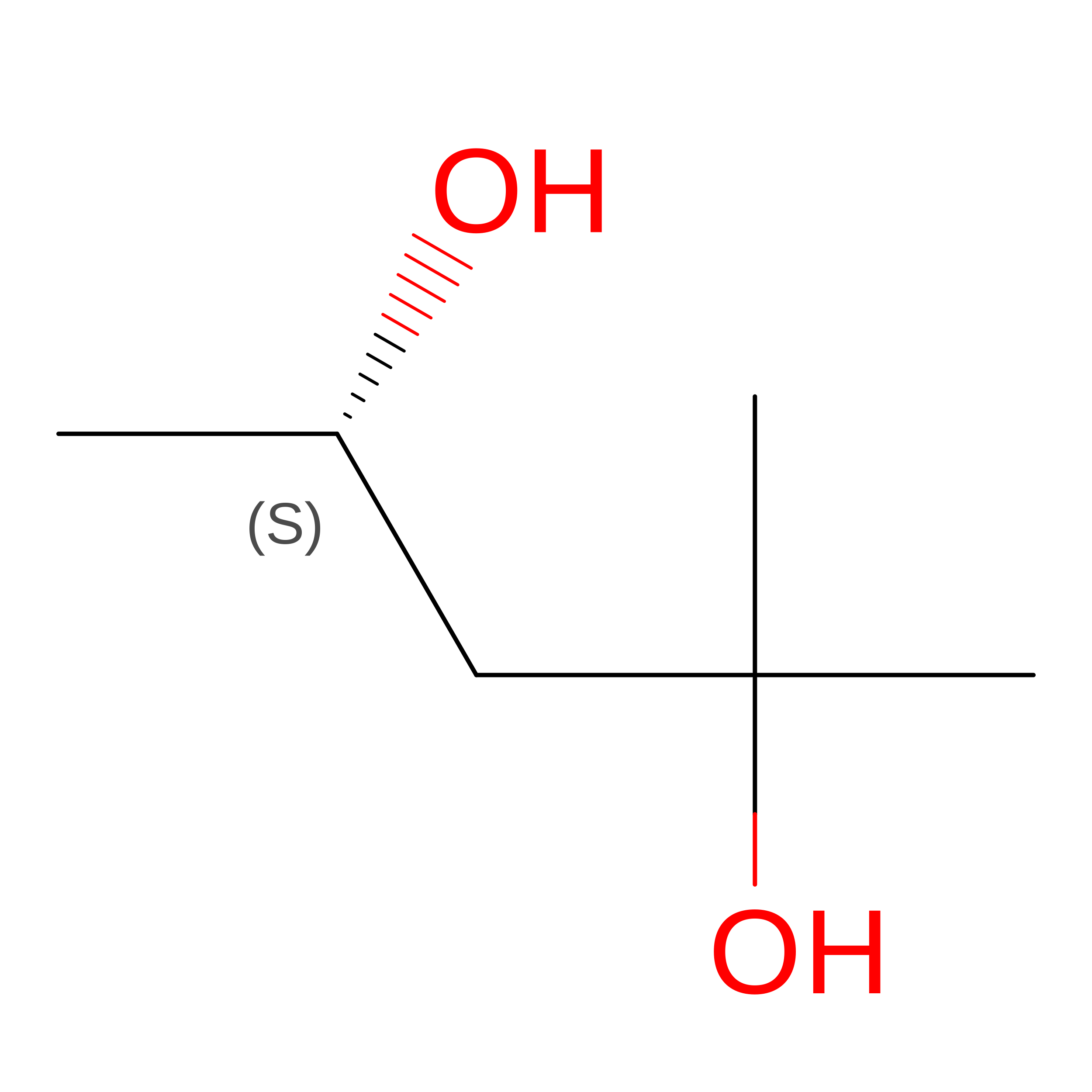
C [auth A](4S)-2-METHYL-2,4-PENTANEDIOL
C6 H14 O2
SVTBMSDMJJWYQN-YFKPBYRVSA-N

Experimental Data & Validation

Experimental Data

  • Method: X-RAY DIFFRACTION
  • Resolution: 1.70 Å
  • R-Value Free:  0.240 (Depositor), 0.273 (DCC) 
  • R-Value Work:  0.205 (Depositor) 
  • R-Value Observed: 0.207 (Depositor) 
Space Group: C 1 2 1
Unit Cell:
Length ( Å )Angle ( ˚ )
a = 180.156α = 90
b = 34.77β = 98.58
c = 38.1γ = 90
Software Package:
Software NamePurpose
REFMACrefinement
DENZOdata reduction
SCALEPACKdata scaling
AMoREphasing

Structure Validation

View Full Validation Report


Ligand Structure Quality Assessment 


Entry History 

Deposition Data

Revision History  (Full details and data files)

  • Version 1.0: 2006-08-08
    Type: Initial release
  • Version 1.1: 2008-05-01
    Changes: Version format compliance
  • Version 1.2: 2011-07-13
    Changes: Advisory, Version format compliance
  • Version 1.3: 2021-10-20
    Changes: Database references, Derived calculations
  • Version 1.4: 2023-08-30
    Changes: Data collection, Refinement description