2FF4 | pdb_00002ff4

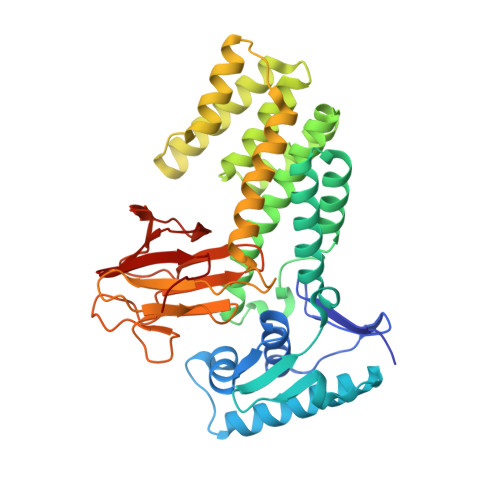
Mycobacterium tuberculosis EmbR in complex with low affinity phosphopeptide


Experimental Data Snapshot

  • Method: X-RAY DIFFRACTION
  • Resolution: 1.90 Å
  • R-Value Free: 
    0.239 (Depositor), 0.261 (DCC) 
  • R-Value Work: 
    0.215 (Depositor) 
  • R-Value Observed: 
    0.216 (Depositor) 

wwPDB Validation 3D Report Full Report

Validation slider image for 2FF4

This is version 1.3 of the entry. See complete history

Literature

Molecular structure of EmbR, a response element of Ser/Thr kinase signaling in Mycobacterium tuberculosis.

Alderwick, L.J.Molle, V.Kremer, L.Cozzone, A.J.Dafforn, T.R.Besra, G.S.Futterer, K.

(2006) Proc Natl Acad Sci U S A 103: 2558-2563

  • DOI: https://doi.org/10.1073/pnas.0507766103
  • Primary Citation Related Structures: 
    2FEZ, 2FF4

  • PubMed Abstract: 

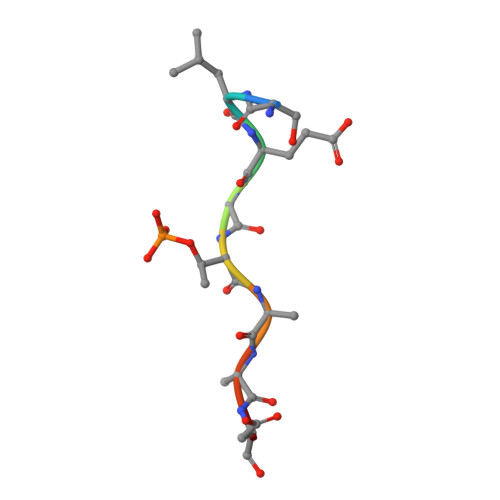
    Ser/Thr phosphorylation has emerged as a critical regulatory mechanism in a number of bacteria, including Mycobacterium tuberculosis. This problematic pathogen encodes 11 eukaryotic-like Ser/Thr kinases, yet few substrates or signaling targets have been characterized. Here, we report the structure of EmbR (2.0 A), a putative transcriptional regulator of key arabinosyltransferases (EmbC, -A, and -B), and an endogenous substrate of the Ser/Thr-kinase PknH. EmbR presents a unique domain architecture: the N-terminal winged-helix DNA-binding domain forms an extensive interface with the all-helical central bacterial transcriptional activation domain and is positioned adjacent to the regulatory C-terminal forkhead-associated (FHA) domain, which mediates binding to a Thr-phosphorylated site in PknH. The structure in complex with a phospho-peptide (1.9 A) reveals a conserved mode of phospho-threonine recognition by the FHA domain and evidence for specific recognition of the cognate kinase. The present structures suggest hypotheses as to how EmbR might propagate the phospho-relay signal from its cognate kinase, while serving as a template for the structurally uncharacterized Streptomyces antibiotic regulatory protein family of transcription factors.


  • Organizational Affiliation
    • School of Biosciences, University of Birmingham, Edgbaston, Birmingham B15 2TT, United Kingdom.

Macromolecule Content 

  • Total Structure Weight: 86.06 kDa 
  • Atom Count: 6,377 
  • Modeled Residue Count: 766 
  • Deposited Residue Count: 794 
  • Unique protein chains: 2

Macromolecules

Find similar proteins by:|  3D Structure
Entity ID: 1
MoleculeChains  Sequence LengthOrganismDetailsImage
Probable regulatory protein embR
A, B
388Mycobacterium tuberculosis H37RvMutation(s): 0 
Gene Names: embR
UniProt
Find proteins for P9WGJ9 (Mycobacterium tuberculosis (strain ATCC 25618 / H37Rv))
Explore P9WGJ9 
Go to UniProtKB:  P9WGJ9
Entity Groups
Sequence Clusters30% Identity50% Identity70% Identity90% Identity95% Identity100% Identity
UniProt GroupP9WGJ9
Sequence Annotations
Expand
Reference Sequence
Find similar proteins by:  Sequence   |   3D Structure  
Entity ID: 2
MoleculeChains  Sequence LengthOrganismDetailsImage
DNA repair protein RAD9C [auth E],
D [auth F]
9N/AMutation(s): 1 
UniProt
Find proteins for P14737 (Saccharomyces cerevisiae (strain ATCC 204508 / S288c))
Explore P14737 
Go to UniProtKB:  P14737
Entity Groups
UniProt GroupP14737
Sequence Annotations
Expand
Reference Sequence

Small Molecules

Modified Residues  1 Unique
IDChains TypeFormula2D DiagramParent
TPO
Query on TPO
C [auth E],
D [auth F]
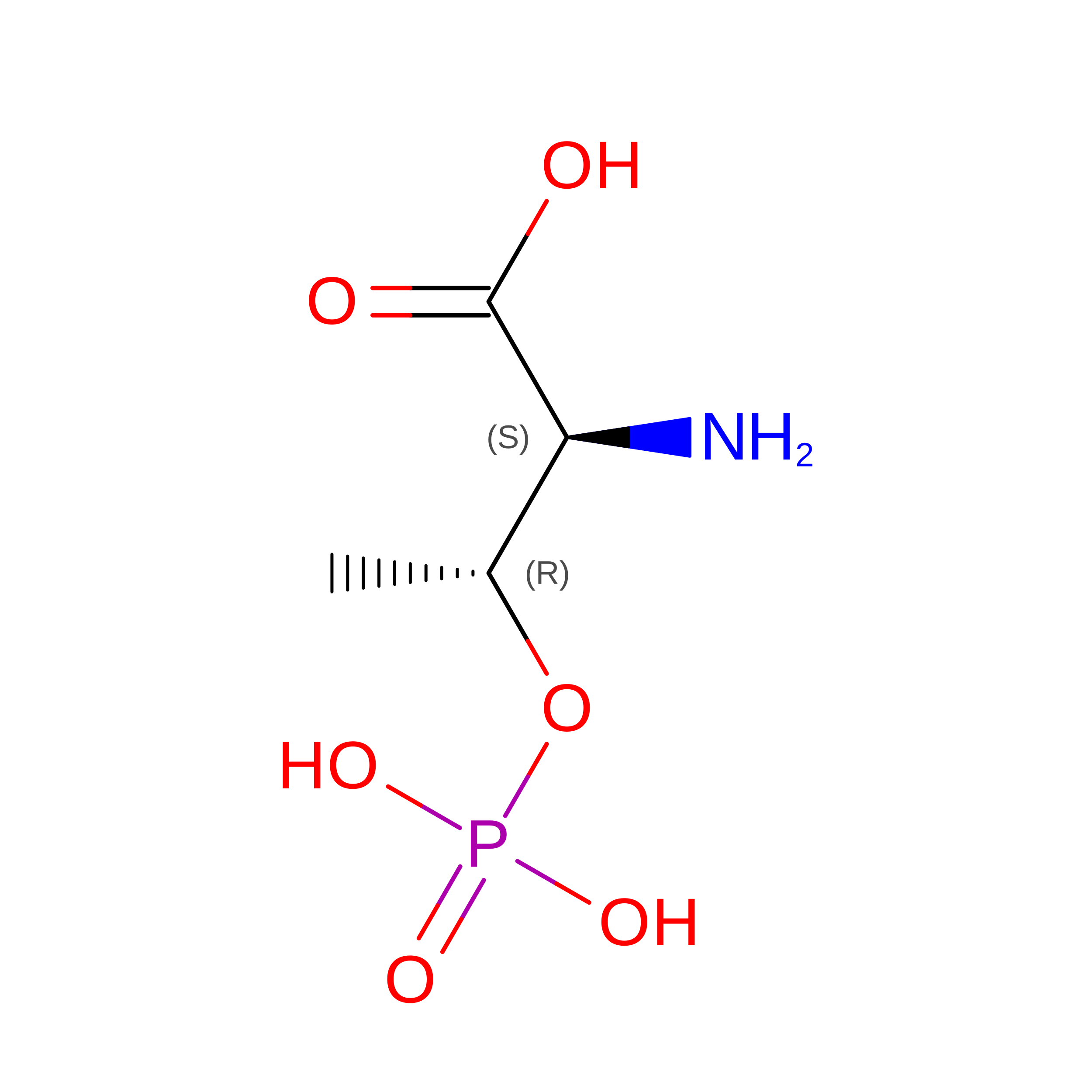
L-PEPTIDE LINKINGC4 H10 N O6 PTHR

Experimental Data & Validation

Experimental Data

  • Method: X-RAY DIFFRACTION
  • Resolution: 1.90 Å
  • R-Value Free:  0.239 (Depositor), 0.261 (DCC) 
  • R-Value Work:  0.215 (Depositor) 
  • R-Value Observed: 0.216 (Depositor) 
Space Group: C 1 2 1
Unit Cell:
Length ( Å )Angle ( ˚ )
a = 162.39α = 90
b = 82.04β = 115.37
c = 81.08γ = 90
Software Package:
Software NamePurpose
REFMACrefinement
XDSdata reduction
XDSdata scaling
PHASERphasing

Structure Validation

View Full Validation Report


Entry History 

Deposition Data

Revision History  (Full details and data files)

  • Version 1.0: 2006-01-24
    Type: Initial release
  • Version 1.1: 2008-05-01
    Changes: Version format compliance
  • Version 1.2: 2011-07-13
    Changes: Advisory, Source and taxonomy, Version format compliance
  • Version 1.3: 2024-11-13
    Changes: Data collection, Database references, Derived calculations, Structure summary