2E0N | pdb_00002e0n

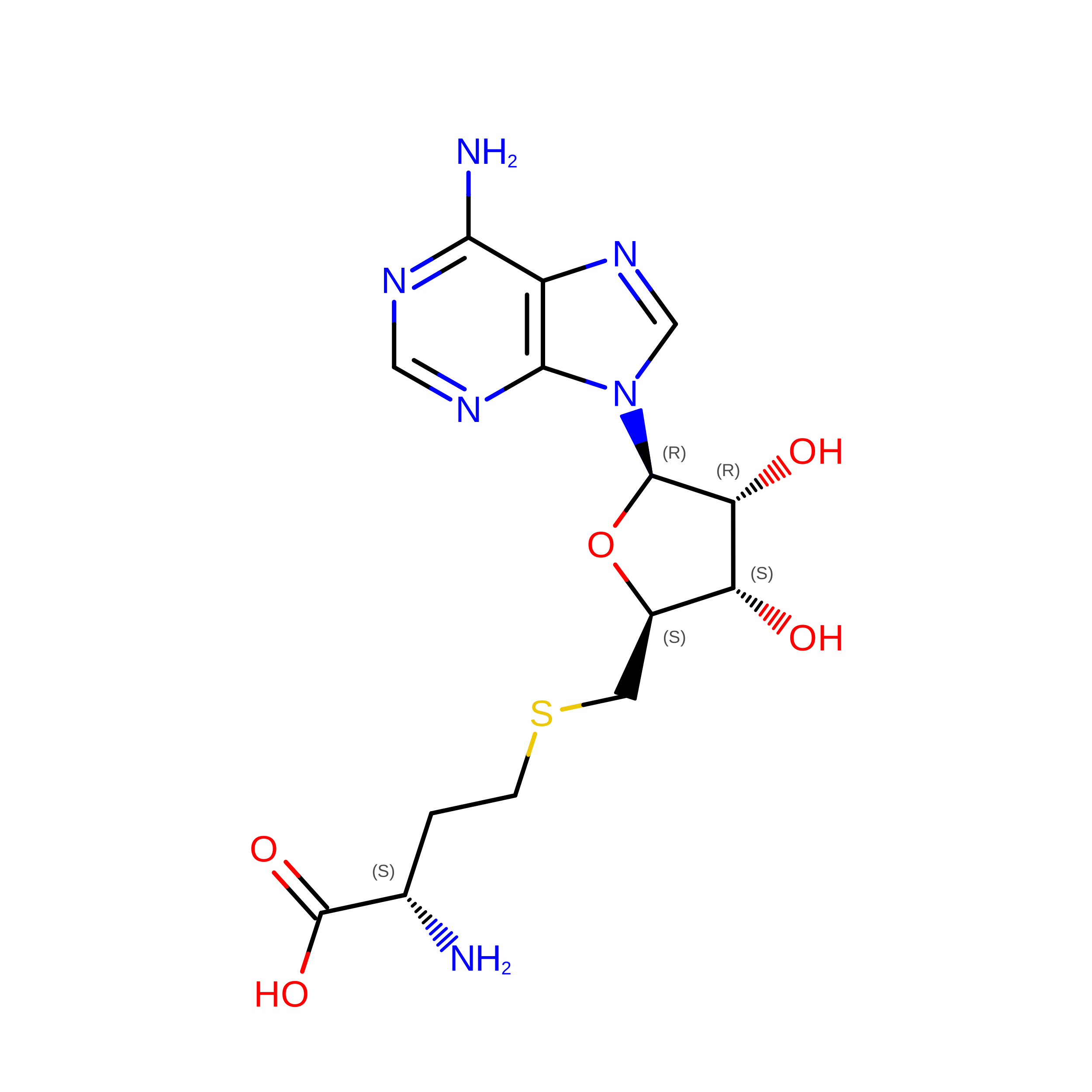
Crystal structure of CbiL in complex with S-adenosylhomocysteine, a methyltransferase involved in anaerobic vitamin B12 biosynthesis


Experimental Data Snapshot

  • Method: X-RAY DIFFRACTION
  • Resolution: 2.00 Å
  • R-Value Free: 
    0.266 (Depositor), 0.262 (DCC) 
  • R-Value Work: 
    0.223 (Depositor), 0.218 (DCC) 
  • R-Value Observed: 
    0.225 (Depositor) 

Starting Model: experimental
View more details

wwPDB Validation 3D Report Full Report

Validation slider image for 2E0N

Ligand Structure Quality Assessment 


This is version 1.3 of the entry. See complete history

Literature

Crystal structures of CbiL, a methyltransferase involved in anaerobic vitamin B biosynthesis, and CbiL in complex with S-adenosylhomocysteine--implications for the reaction mechanism.

Wada, K.Harada, J.Yaeda, Y.Tamiaki, H.Oh-Oka, H.Fukuyama, K.

(2007) FEBS J 274: 563-573

  • DOI: https://doi.org/10.1111/j.1742-4658.2006.05611.x
  • Primary Citation Related Structures: 
    2E0K, 2E0N

  • PubMed Abstract: 

    During anaerobic cobalamin (vitamin B12) biosynthesis, CbiL catalyzes methylation at the C-20 position of a cyclic tetrapyrrole ring using S-adenosylmethionine as a methyl group source. This methylation is a key modification for the ring contraction process, by which a porphyrin-type tetrapyrrole ring is converted to a corrin ring through elimination of the modified C-20 and direct bonding of C-1 to C-19. We have determined the crystal structures of Chlorobium tepidum CbiL and CbiL in complex with S-adenosylhomocysteine (the S-demethyl form of S-adenosylmethionine). CbiL forms a dimer in the crystal, and each subunit consists of N-terminal and C-terminal domains. S-Adenosylhomocysteine binds to a cleft between the two domains, where it is specifically recognized by extensive hydrogen bonding and van der Waals interactions. The orientation of the cobalt-factor II substrate was modeled by simulation, and the predicted model suggests that the hydroxy group of Tyr226 is located in close proximity to the C-20 atom as well as the C-1 and C-19 atoms of the tetrapyrrole ring. These configurations allow us to propose a catalytic mechanism: the conserved Tyr226 residue in CbiL catalyzes the direct transfer of a methyl group from S-adenosylmethionine to the substrate through an S(N)2-like mechanism. Furthermore, the structural model of CbiL binding to its substrate suggests the axial residue coordinated to the central cobalt of cobalt-factor II.


  • Organizational Affiliation
    • Department of Biological Sciences, Graduate School of Science, Osaka University, Toyonaka, Japan. keiwada@bio.sci.osaka-u.ac.jp

Macromolecule Content 

  • Total Structure Weight: 55.96 kDa 
  • Atom Count: 3,688 
  • Modeled Residue Count: 467 
  • Deposited Residue Count: 518 
  • Unique protein chains: 1

Macromolecules

Find similar proteins by:|  3D Structure
Entity ID: 1
MoleculeChains  Sequence LengthOrganismDetailsImage
Precorrin-2 C20-methyltransferase
A, B
259Chlorobaculum tepidumMutation(s): 0 
Gene Names: cbiL
EC: 2.1.1.130
UniProt
Find proteins for Q8KFD9 (Chlorobaculum tepidum (strain ATCC 49652 / DSM 12025 / NBRC 103806 / TLS))
Explore Q8KFD9 
Go to UniProtKB:  Q8KFD9
Entity Groups
Sequence Clusters30% Identity50% Identity70% Identity90% Identity95% Identity100% Identity
UniProt GroupQ8KFD9
Sequence Annotations
Expand
Reference Sequence

Experimental Data & Validation

Experimental Data

  • Method: X-RAY DIFFRACTION
  • Resolution: 2.00 Å
  • R-Value Free:  0.266 (Depositor), 0.262 (DCC) 
  • R-Value Work:  0.223 (Depositor), 0.218 (DCC) 
  • R-Value Observed: 0.225 (Depositor) 
Space Group: P 43 21 2
Unit Cell:
Length ( Å )Angle ( ˚ )
a = 87.822α = 90
b = 87.822β = 90
c = 123.562γ = 90
Software Package:
Software NamePurpose
REFMACrefinement
BSSdata collection
HKL-2000data reduction
HKL-2000data scaling
MOLREPphasing

Structure Validation

View Full Validation Report


Ligand Structure Quality Assessment 


Entry History 

Deposition Data

Revision History  (Full details and data files)

  • Version 1.0: 2007-01-16
    Type: Initial release
  • Version 1.1: 2008-04-30
    Changes: Version format compliance
  • Version 1.2: 2011-07-13
    Changes: Advisory, Version format compliance
  • Version 1.3: 2023-10-25
    Changes: Data collection, Database references, Derived calculations, Refinement description