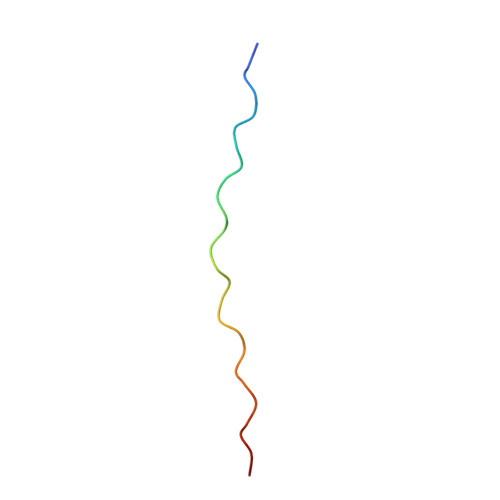
2CUO | pdb_00002cuo

Collagen model peptide (PRO-PRO-GLY)9


Experimental Data Snapshot

  • Method: X-RAY DIFFRACTION
  • Resolution: 1.33 Å
  • R-Value Free: 
    0.229 (Depositor) 
  • R-Value Work: 
    0.182 (Depositor) 
  • R-Value Observed: 
    0.184 (Depositor) 

Starting Model: experimental
View more details

wwPDB Validation 3D Report Full Report

Validation slider image for 2CUO

This is version 1.3 of the entry. See complete history

Literature

Repetitive interactions observed in the crystal structure of a collagen-model peptide, [(Pro-Pro-Gly)9]3

Hongo, C.Noguchi, K.Okuyama, K.Tanaka, Y.Nishino, N.

(2005) J Biochem 138: 135-144

  • DOI: https://doi.org/10.1093/jb/mvi108
  • Primary Citation Related Structures: 
    2CUO

  • PubMed Abstract: 

    The crystal structure of a collagen-model peptide [(Pro-Pro-Gly)(9)](3) has been determined at 1.33 A resolution. Diffraction data were collected at 100 K using synchrotron radiation, which led to the first structural study of [(Pro-Pro-Gly)(n)](3) under cryogenic conditions. The crystals belong to the P2(1) space group with cell parameters of a = 25.95, b = 26.56, c = 80.14 Angstroms and beta = 90.0 degrees. The overall molecular conformation was consistent with the left-handed 7/2-helical model with an axial repeat of 20 A for native collagen. A total of 332 water molecules were found in an asymmetric unit. Proline residues in adjacent triple-helices exhibited three types of hydrophobic interactions. Furthermore, three types of hydrogen-bonding networks mediated by water molecules were observed between adjacent triple-helices. These hydrophobic interactions and hydrogen-bonding networks occurred at intervals of 20 Angstroms along the c-axis based on the previous sub-cell structures [(Pro-Pro-Gly)(n)](3) (n = 9, 10), which were also seen in the full-cell structure of [(Pro-Pro-Gly)(10)](3). Five proline residues at the Y position in the X-Y-Gly triplet were found in a down-puckering conformation, this being inconsistent with the recently proposed propensity-based hypothesis. These proline residues were forced to adopt opposing puckering because of the prevailing hydrophobic interaction between triple-helices compared with the Pro:Pro stacking interaction within a triple-helix.


  • Organizational Affiliation
    • Faculty of Technology, Tokyo University of Agriculture & Technology, Koganei.

Macromolecule Content 

  • Total Structure Weight: 13.68 kDa 
  • Atom Count: 1,290 
  • Modeled Residue Count: 158 
  • Deposited Residue Count: 162 
  • Unique protein chains: 1

Macromolecules

Find similar proteins by:|  3D Structure
Entity ID: 1
MoleculeChains  Sequence LengthOrganismDetailsImage
COLLAGEN MODEL PEPTIDE (PRO-PRO-GLY)9
A, B, C, D, E
A, B, C, D, E, F
27N/AMutation(s): 0 
UniProt
Find proteins for Q80BK4 (Saimiriine herpesvirus 2)
Explore Q80BK4 
Go to UniProtKB:  Q80BK4
Entity Groups
Sequence Clusters30% Identity50% Identity70% Identity90% Identity95% Identity100% Identity
UniProt GroupQ80BK4
Sequence Annotations
Expand
Reference Sequence

Experimental Data & Validation

Experimental Data

  • Method: X-RAY DIFFRACTION
  • Resolution: 1.33 Å
  • R-Value Free:  0.229 (Depositor) 
  • R-Value Work:  0.182 (Depositor) 
  • R-Value Observed: 0.184 (Depositor) 
Space Group: P 1 21 1
Unit Cell:
Length ( Å )Angle ( ˚ )
a = 25.946α = 90
b = 26.563β = 90
c = 80.14γ = 90
Software Package:
Software NamePurpose
CrystalCleardata collection
CrystalCleardata reduction
SHELXmodel building
SHELXL-97refinement
CrystalCleardata scaling
X-PLORphasing

Structure Validation

View Full Validation Report


Entry History 

Deposition Data

Revision History  (Full details and data files)

  • Version 1.0: 2005-06-14
    Type: Initial release
  • Version 1.1: 2008-04-30
    Changes: Version format compliance
  • Version 1.2: 2011-07-13
    Changes: Version format compliance
  • Version 1.3: 2023-10-25
    Changes: Data collection, Database references, Refinement description