2BZN | pdb_00002bzn

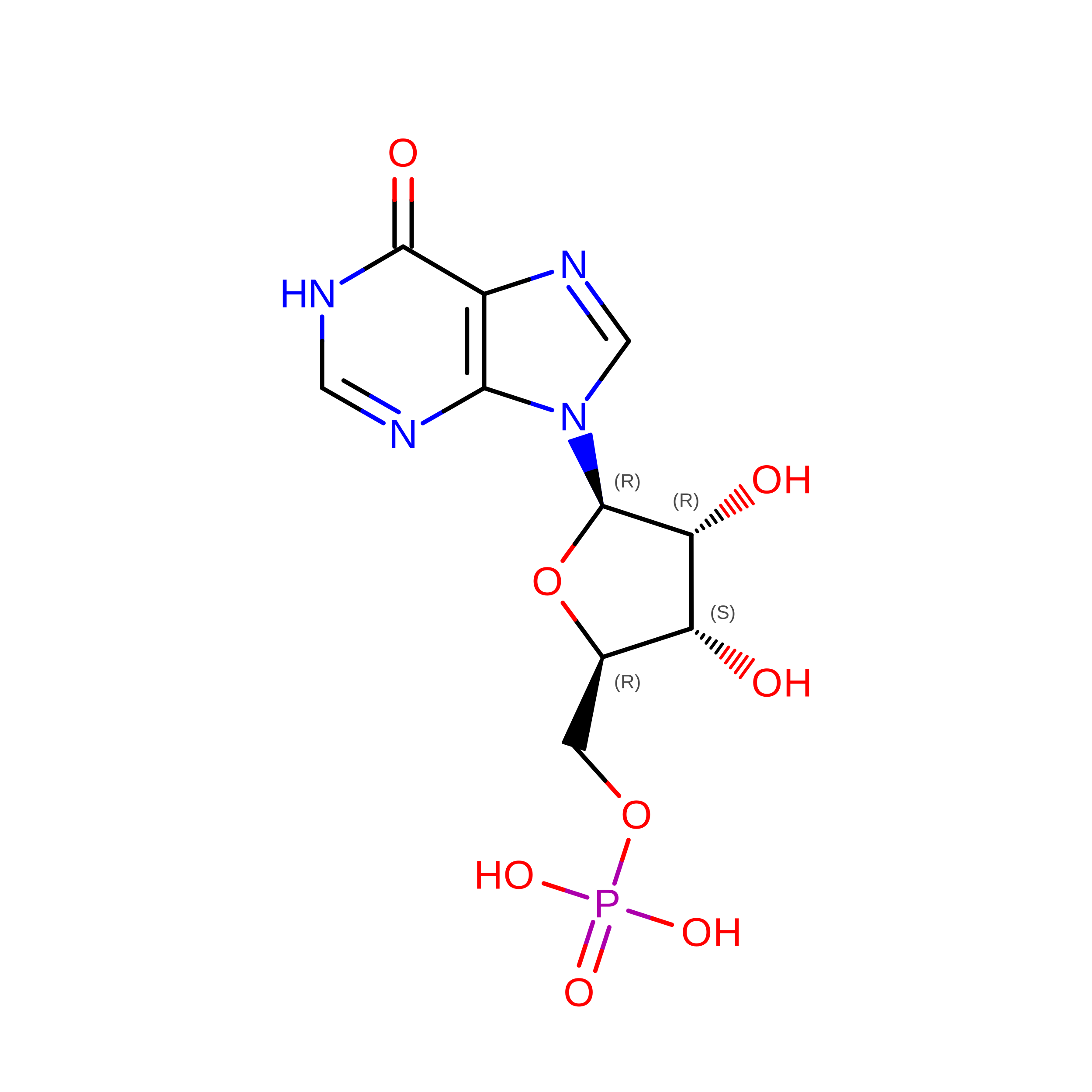
Crystal structure of human guanosine monophosphate reductase 2 GMPR2 in complex with IMP


Experimental Data Snapshot

  • Method: X-RAY DIFFRACTION
  • Resolution: 2.15 Å
  • R-Value Free: 
    0.210 (Depositor), 0.217 (DCC) 
  • R-Value Work: 
    0.158 (Depositor), 0.167 (DCC) 
  • R-Value Observed: 
    0.161 (Depositor) 

Starting Model: experimental
View more details

wwPDB Validation 3D Report Full Report

Validation slider image for 2BZN

Ligand Structure Quality Assessment 


This is version 1.2 of the entry. See complete history

Literature

Cofactor Mobility Determines Reaction Outcome in the Impdh and Gmpr (Beta-Alpha)(8) Barrel Enzymes.

Patton, G.C.Stenmark, P.Gollapalli, D.R.Sevastik, R.Kursula, P.Flodin, S.Schuler, H.Swales, C.T.Eklund, H.Himo, F.Nordlund, P.Hedstrom, L.

(2011) Nat Chem Biol 7: 950

  • DOI: https://doi.org/10.1038/nchembio.693
  • Primary Citation Related Structures: 
    2BZN, 2C6Q

  • PubMed Abstract: 

    Inosine monophosphate dehydrogenase (IMPDH) and guanosine monophosphate reductase (GMPR) belong to the same structural family, share a common set of catalytic residues and bind the same ligands. The structural and mechanistic features that determine reaction outcome in the IMPDH and GMPR family have not been identified. Here we show that the GMPR reaction uses the same intermediate E-XMP* as IMPDH, but in this reaction the intermediate reacts with ammonia instead of water. A single crystal structure of human GMPR type 2 with IMP and NADPH fortuitously captures three different states, each of which mimics a distinct step in the catalytic cycle of GMPR. The cofactor is found in two conformations: an 'in' conformation poised for hydride transfer and an 'out' conformation in which the cofactor is 6 Å from IMP. Mutagenesis along with substrate and cofactor analog experiments demonstrate that the out conformation is required for the deamination of GMP. Remarkably, the cofactor is part of the catalytic machinery that activates ammonia.


  • Organizational Affiliation
    • Department of Biology, Brandeis University, Waltham, Massachusetts, USA.

Macromolecule Content 

  • Total Structure Weight: 308.05 kDa 
  • Atom Count: 21,516 
  • Modeled Residue Count: 2,548 
  • Deposited Residue Count: 2,808 
  • Unique protein chains: 1

Macromolecules

Find similar proteins by:|  3D Structure
Entity ID: 1
MoleculeChains  Sequence LengthOrganismDetailsImage
GMP REDUCTASE 2
A, B, C, D, E
A, B, C, D, E, F, G, H
351Homo sapiensMutation(s): 0 
EC: 1.7.1.7
UniProt & NIH Common Fund Data Resources
Find proteins for Q9P2T1 (Homo sapiens)
Explore Q9P2T1 
Go to UniProtKB:  Q9P2T1
PHAROS:  Q9P2T1
GTEx:  ENSG00000100938 
Entity Groups
Sequence Clusters30% Identity50% Identity70% Identity90% Identity95% Identity100% Identity
UniProt GroupQ9P2T1
Sequence Annotations
Expand
Reference Sequence

Experimental Data & Validation

Experimental Data

  • Method: X-RAY DIFFRACTION
  • Resolution: 2.15 Å
  • R-Value Free:  0.210 (Depositor), 0.217 (DCC) 
  • R-Value Work:  0.158 (Depositor), 0.167 (DCC) 
  • R-Value Observed: 0.161 (Depositor) 
Space Group: P 21 21 21
Unit Cell:
Length ( Å )Angle ( ˚ )
a = 131.291α = 90
b = 141.35β = 90
c = 164.895γ = 90
Software Package:
Software NamePurpose
REFMACrefinement
MOSFLMdata reduction
SCALAdata scaling
MOLREPphasing

Structure Validation

View Full Validation Report


Ligand Structure Quality Assessment 


Entry History 

Revision History  (Full details and data files)

  • Version 1.0: 2005-09-02
    Type: Initial release
  • Version 1.1: 2011-11-30
    Changes: Database references, Derived calculations, Non-polymer description, Other, Version format compliance
  • Version 1.2: 2023-12-13
    Changes: Data collection, Database references, Derived calculations, Other, Refinement description