2BV6 | pdb_00002bv6

Crystal structure of MgrA, a global regulator and major virulence determinant in Staphylococcus aureus


Experimental Data Snapshot

  • Method: X-RAY DIFFRACTION
  • Resolution: 2.80 Å
  • R-Value Free: 
    0.292 (Depositor), 0.289 (DCC) 
  • R-Value Work: 
    0.250 (Depositor), 0.243 (DCC) 
  • R-Value Observed: 
    0.250 (Depositor) 

wwPDB Validation 3D Report Full Report

Validation slider image for 2BV6

This is version 1.3 of the entry. See complete history

Literature

An Oxidation-Sensing Mechanism is Used by the Global Regulator Mgra in Staphylococcus Aureus.

Chen, P.R.Bae, T.Williams, W.A.Duguid, E.M.Rice, P.A.Schneewind, O.He, C.

(2006) Nat Chem Biol 2: 591

  • DOI: https://doi.org/10.1038/nchembio820
  • Primary Citation Related Structures: 
    2BV6

  • PubMed Abstract: 

    Staphylococcus aureus is a human pathogen responsible for most wound and hospital-acquired infections. The protein MgrA is both an important virulence determinant during infection and a regulator of antibiotic resistance in S. aureus. The crystal structure of the MgrA homodimer, solved at 2.86 A, indicates the presence of a unique cysteine residue located at the interface of the protein dimer. We discovered that this cysteine residue can be oxidized by various reactive oxygen species, such as hydrogen peroxide and organic hydroperoxide. Cysteine oxidation leads to dissociation of MgrA from DNA and initiation of signaling pathways that turn on antibiotic resistance in S. aureus. The oxidation-sensing mechanism is typically used by bacteria to counter challenges of reactive oxygen and nitrogen species. Our study reveals that in S. aureus, MgrA adopts a similar mechanism but uses it to globally regulate different defensive pathways.


  • Organizational Affiliation
    • Department of Chemistry, The University of Chicago, 5735 South Ellis Avenue, Chicago, Illinois 60637, USA.

Macromolecule Content 

  • Total Structure Weight: 16.63 kDa 
  • Atom Count: 1,132 
  • Modeled Residue Count: 137 
  • Deposited Residue Count: 142 
  • Unique protein chains: 1

Macromolecules

Find similar proteins by:|  3D Structure
Entity ID: 1
MoleculeChains  Sequence LengthOrganismDetailsImage
HTH-TYPE TRANSCRIPTIONAL REGULATOR MGRA142Staphylococcus aureusMutation(s): 0 
UniProt
Find proteins for P0C1S0 (Staphylococcus aureus)
Explore P0C1S0 
Go to UniProtKB:  P0C1S0
Entity Groups
Sequence Clusters30% Identity50% Identity70% Identity90% Identity95% Identity100% Identity
UniProt GroupP0C1S0
Sequence Annotations
Expand
Reference Sequence

Small Molecules

Ligands 1 Unique
IDChains Name / Formula / InChI Key2D Diagram3D Interactions
SO4

Query on SO4


Download:Ideal Coordinates CCD File
B [auth A]SULFATE ION
O4 S
QAOWNCQODCNURD-UHFFFAOYSA-L
Modified Residues  1 Unique
IDChains TypeFormula2D DiagramParent
MSE
Query on MSE
A
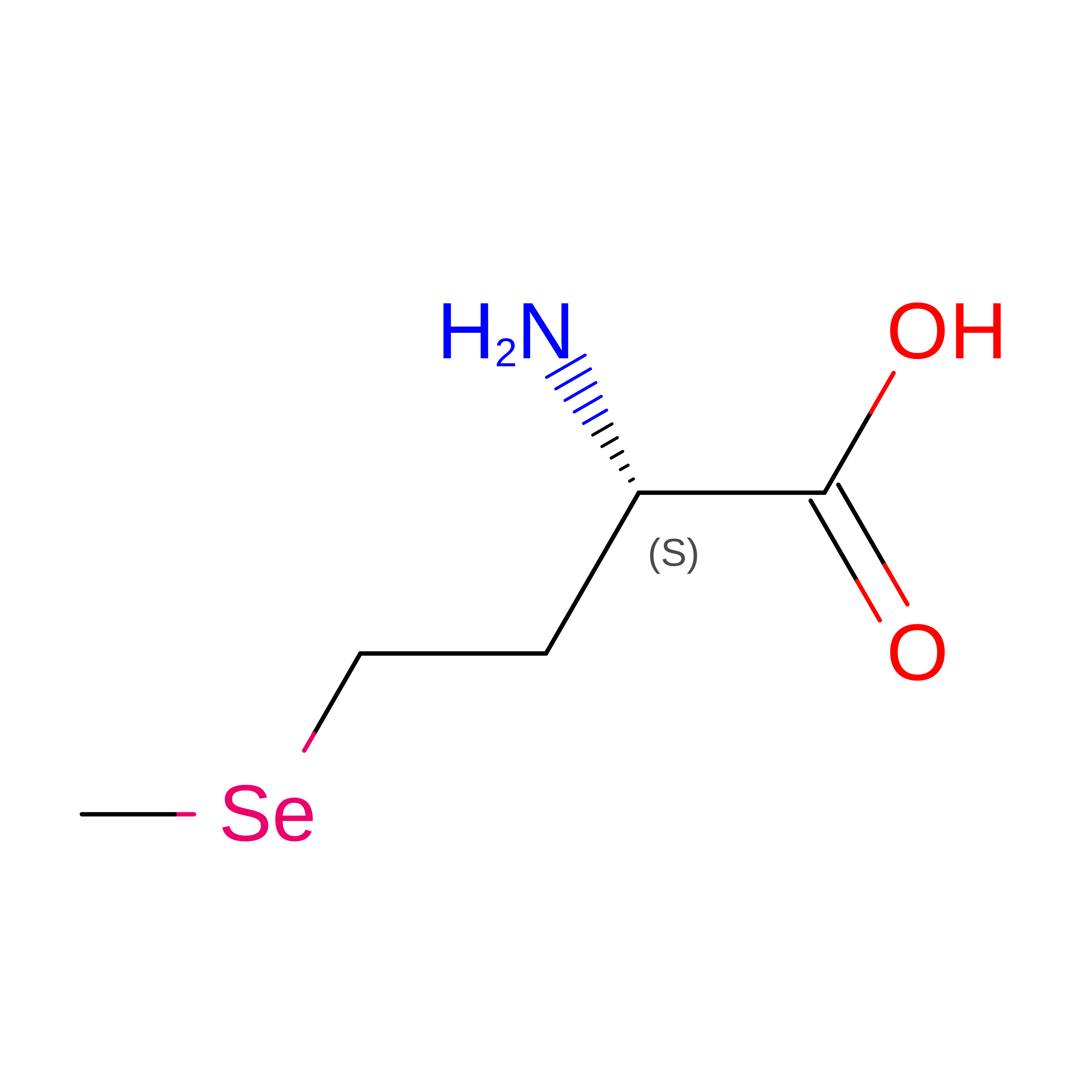
L-PEPTIDE LINKINGC5 H11 N O2 SeMET

Experimental Data & Validation

Experimental Data

  • Method: X-RAY DIFFRACTION
  • Resolution: 2.80 Å
  • R-Value Free:  0.292 (Depositor), 0.289 (DCC) 
  • R-Value Work:  0.250 (Depositor), 0.243 (DCC) 
  • R-Value Observed: 0.250 (Depositor) 
Space Group: P 61 2 2
Unit Cell:
Length ( Å )Angle ( ˚ )
a = 119.8α = 90
b = 119.8β = 90
c = 62.3γ = 120
Software Package:
Software NamePurpose
CNSrefinement
MOSFLMdata reduction
SCALEPACKdata scaling
SOLVEphasing

Structure Validation

View Full Validation Report


Entry History 

Deposition Data

Revision History  (Full details and data files)

  • Version 1.0: 2006-09-20
    Type: Initial release
  • Version 1.1: 2011-05-08
    Changes: Version format compliance
  • Version 1.2: 2011-07-13
    Changes: Version format compliance
  • Version 1.3: 2024-11-13
    Changes: Data collection, Database references, Derived calculations, Other, Structure summary