2BS7 | pdb_00002bs7

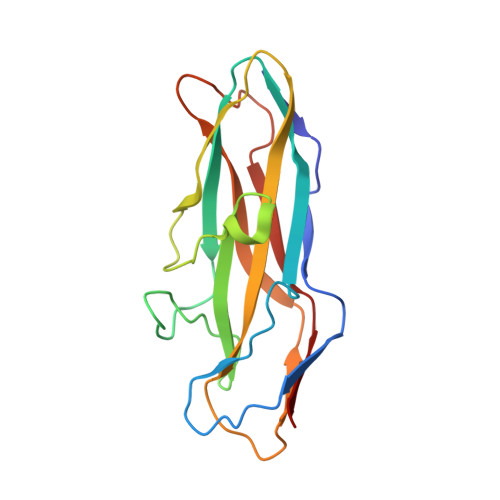
Crystal structure of F17b-G in complex with chitobiose


Experimental Data Snapshot

  • Method: X-RAY DIFFRACTION
  • Resolution: 2.10 Å
  • R-Value Free: 
    0.268 (Depositor), 0.267 (DCC) 
  • R-Value Work: 
    0.216 (Depositor), 0.224 (DCC) 
  • R-Value Observed: 
    0.216 (Depositor) 

Starting Model: experimental
View more details

wwPDB Validation 3D Report Full Report

Validation slider image for 2BS7

This is version 2.1 of the entry. See complete history

Literature

Impact of Natural Variation in Bacterial F17G Adhesins on Crystallization Behaviour.

Buts, L.Wellens, A.Van Molle, I.Wyns, L.Loris, R.Lahmann, M.Oscarson, S.De Greve, H.Bouckaert, J.

(2005) Acta Crystallogr D Biol Crystallogr 61: 1149

  • DOI: https://doi.org/10.1107/S0907444905017038
  • Primary Citation Related Structures: 
    1ZK5, 1ZPL, 2BS7, 2BS8, 2BSB, 2BSC

  • PubMed Abstract: 

    Since the introduction of structural genomics, the protein has been recognized as the most important variable in crystallization. Recent strategies to modify a protein to improve crystal quality have included rationally engineered point mutations, truncations, deletions and fusions. Five naturally occurring variants, differing in 1-18 amino acids, of the 177-residue lectin domain of the F17G fimbrial adhesin were expressed and purified in identical ways. For four out of the five variants crystals were obtained, mostly in non-isomorphous space groups, with diffraction limits ranging between 2.4 and 1.1 A resolution. A comparative analysis of the crystal-packing contacts revealed that the variable amino acids are often involved in lattice contacts and a single amino-acid substitution can suffice to radically change crystal packing. A statistical approach proved reliable to estimate the compatibilities of the variant sequences with the observed crystal forms. In conclusion, natural variation, universally present within prokaryotic species, is a valuable genetic resource that can be favourably employed to enhance the crystallization success rate with considerably less effort than other strategies.


  • Organizational Affiliation
    • Laboratorium voor Ultrastructuur, Vlaams Interuniversitair Instituut voor Biotechnologie and Vrije Universiteit Brussel, Pleinlaan 2, B-1050 Brussel, Belgium.

Macromolecule Content 

  • Total Structure Weight: 19.31 kDa 
  • Atom Count: 1,474 
  • Modeled Residue Count: 176 
  • Deposited Residue Count: 176 
  • Unique protein chains: 1

Macromolecules

Find similar proteins by:|  3D Structure
Entity ID: 1
MoleculeChains  Sequence LengthOrganismDetailsImage
F17BG LECTINA [auth 1]176Escherichia coliMutation(s): 0 
UniProt
Find proteins for Q47200 (Escherichia coli)
Explore Q47200 
Go to UniProtKB:  Q47200
Entity Groups
Sequence Clusters30% Identity50% Identity70% Identity90% Identity95% Identity100% Identity
UniProt GroupQ47200
Sequence Annotations
Expand
Reference Sequence

Oligosaccharides

Help  
Entity ID: 2
MoleculeChains Length2D Diagram GlycosylationD Interactions
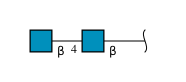
2-acetamido-2-deoxy-beta-D-glucopyranose-(1-4)-2-acetamido-2-deoxy-beta-D-glucopyranoseB [auth A]2N/A
Glycosylation Resources
GlyTouCan: G42666HT
GlyCosmos: G42666HT
GlyGen: G42666HT

Experimental Data & Validation

Experimental Data

  • Method: X-RAY DIFFRACTION
  • Resolution: 2.10 Å
  • R-Value Free:  0.268 (Depositor), 0.267 (DCC) 
  • R-Value Work:  0.216 (Depositor), 0.224 (DCC) 
  • R-Value Observed: 0.216 (Depositor) 
Space Group: P 62
Unit Cell:
Length ( Å )Angle ( ˚ )
a = 86.698α = 90
b = 86.698β = 90
c = 57.043γ = 120
Software Package:
Software NamePurpose
CNSrefinement
DENZOdata reduction
SCALEPACKdata scaling
PHASERphasing

Structure Validation

View Full Validation Report


Entry History 

Deposition Data

Revision History  (Full details and data files)

  • Version 1.0: 2006-05-24
    Type: Initial release
  • Version 1.1: 2011-05-08
    Changes: Version format compliance
  • Version 1.2: 2011-07-13
    Changes: Version format compliance
  • Version 1.3: 2019-05-08
    Changes: Data collection, Experimental preparation, Other
  • Version 1.4: 2019-07-24
    Changes: Data collection
  • Version 2.0: 2020-07-29
    Type: Remediation
    Reason: Carbohydrate remediation
    Changes: Atomic model, Data collection, Derived calculations, Non-polymer description, Other, Structure summary
  • Version 2.1: 2023-12-13
    Changes: Data collection, Database references, Refinement description, Structure summary