2BOV | pdb_00002bov

Molecular recognition of an ADP-ribosylating Clostridium botulinum C3 exoenzyme by RalA GTPase


Experimental Data Snapshot

  • Method: X-RAY DIFFRACTION
  • Resolution: 2.66 Å
  • R-Value Free: 
    0.274 (Depositor) 
  • R-Value Work: 
    0.206 (Depositor), 0.190 (DCC) 
  • R-Value Observed: 
    0.206 (Depositor) 

Starting Models: experimental
View more details

wwPDB Validation 3D Report Full Report

Validation slider image for 2BOV

Ligand Structure Quality Assessment 


This is version 1.3 of the entry. See complete history

Literature

Molecular Recognition of an Adp-Ribosylating Clostridium Botulinum C3 Exoenzyme by Rala Gtpase

Holbourn, K.P.Sutton, J.M.Evans, H.R.Shone, C.C.Acharya, K.R.

(2005) Proc Natl Acad Sci U S A 102: 5357

  • DOI: https://doi.org/10.1073/pnas.0501525102
  • Primary Citation Related Structures: 
    2BOV

  • PubMed Abstract: 

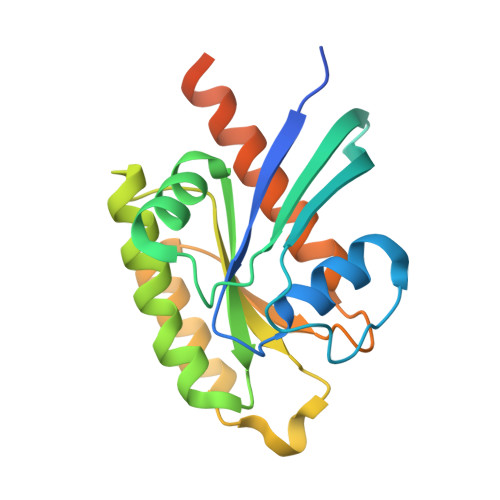
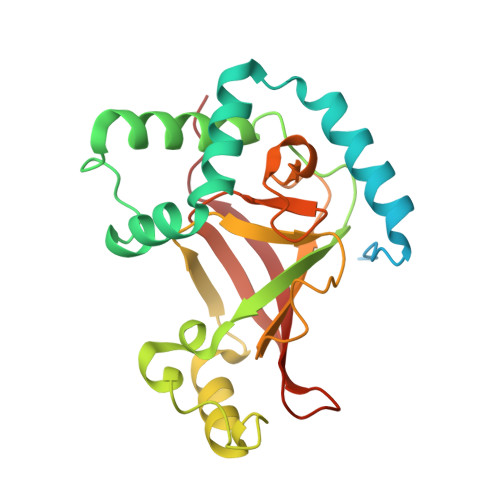
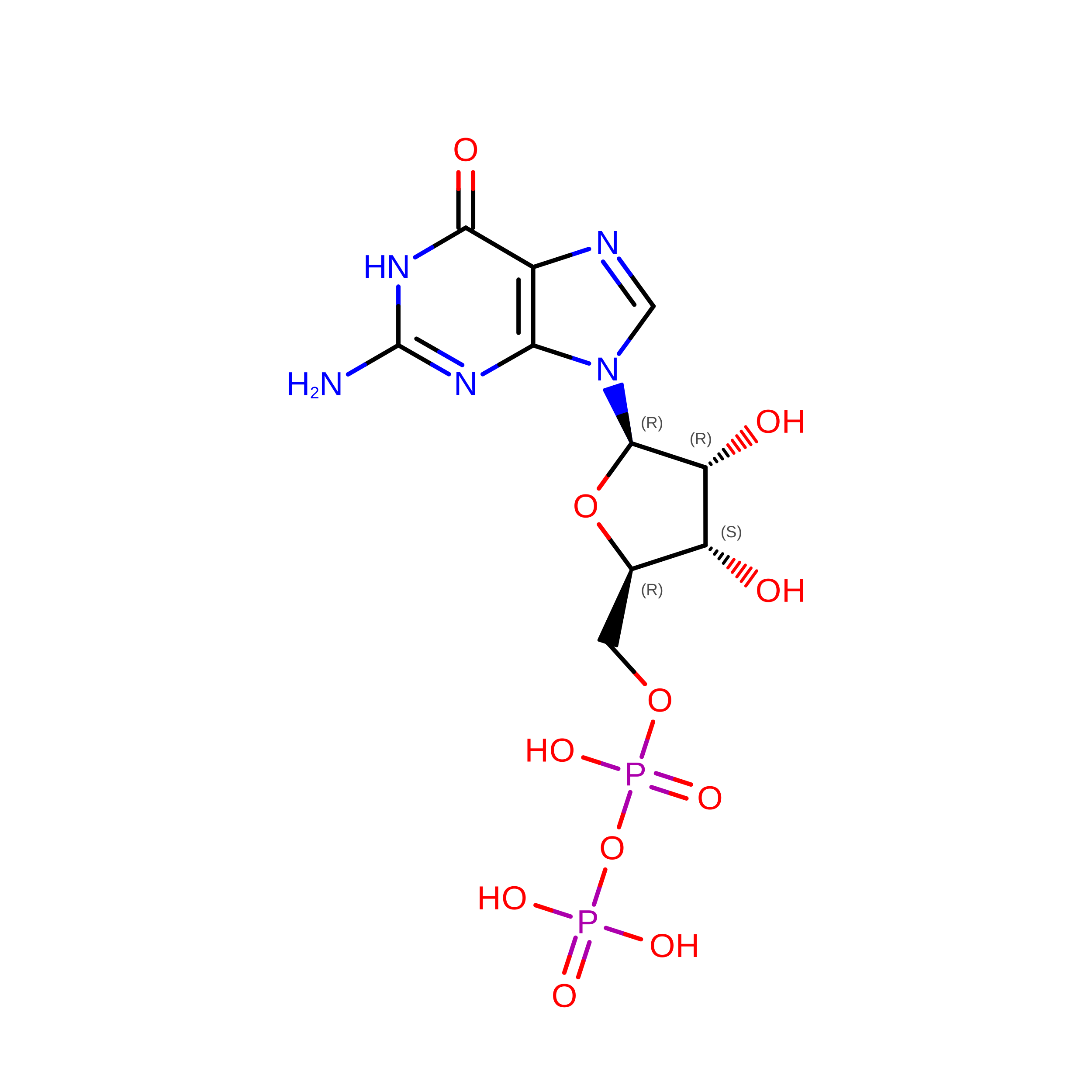
    C3 exoenzymes (members of the ADP-ribosyltranferase family) are produced by Clostridium botulinum (C3bot1 and -2), Clostridium limosum (C3lim), Bacillus cereus (C3cer), and Staphylococcus aureus (C3stau1-3). These exoenzymes lack a translocation domain but are known to specifically inactivate Rho GTPases in host target cells. Here, we report the crystal structure of C3bot1 in complex with RalA (a GTPase of the Ras subfamily) and GDP at a resolution of 2.66 A. RalA is not ADP-ribosylated by C3 exoenzymes but inhibits ADP-ribosylation of RhoA by C3bot1, C3lim, and C3cer to different extents. The structure provides an insight into the molecular interactions between C3bot1 and RalA involving the catalytic ADP-ribosylating turn-turn (ARTT) loop from C3bot1 and helix alpha4 and strand beta6 (which are not part of the GDP-binding pocket) from RalA. The structure also suggests a molecular explanation for the different levels of C3-exoenzyme inhibition by RalA and why RhoA does not bind C3bot1 in this manner.


  • Organizational Affiliation
    • Department of Biology and Biochemistry, University of Bath, Claverton Down, Bath BA2 7AY, United Kingdom.

Macromolecule Content 

  • Total Structure Weight: 51.95 kDa 
  • Atom Count: 3,314 
  • Modeled Residue Count: 382 
  • Deposited Residue Count: 457 
  • Unique protein chains: 2

Macromolecules

Find similar proteins by:|  3D Structure
Entity ID: 1
MoleculeChains  Sequence LengthOrganismDetailsImage
RAS-RELATED PROTEIN RAL-A206Homo sapiensMutation(s): 0 
EC: 3.6.5.2
UniProt & NIH Common Fund Data Resources
Find proteins for P11233 (Homo sapiens)
Explore P11233 
Go to UniProtKB:  P11233
PHAROS:  P11233
GTEx:  ENSG00000006451 
Entity Groups
Sequence Clusters30% Identity50% Identity70% Identity90% Identity95% Identity100% Identity
UniProt GroupP11233
Sequence Annotations
Expand
Reference Sequence
Find similar proteins by:|  3D Structure
Entity ID: 2
MoleculeChains  Sequence LengthOrganismDetailsImage
MONO-ADP-RIBOSYLTRANSFERASE C3251Clostridium botulinumMutation(s): 0 
EC: 2.4.2
UniProt
Find proteins for P15879 (Clostridium botulinum D phage)
Explore P15879 
Go to UniProtKB:  P15879
Entity Groups
Sequence Clusters30% Identity50% Identity70% Identity90% Identity95% Identity100% Identity
UniProt GroupP15879
Sequence Annotations
Expand
Reference Sequence

Small Molecules

Experimental Data & Validation

Experimental Data

  • Method: X-RAY DIFFRACTION
  • Resolution: 2.66 Å
  • R-Value Free:  0.274 (Depositor) 
  • R-Value Work:  0.206 (Depositor), 0.190 (DCC) 
  • R-Value Observed: 0.206 (Depositor) 
Space Group: P 21 21 21
Unit Cell:
Length ( Å )Angle ( ˚ )
a = 56.629α = 90
b = 90.836β = 90
c = 100.4γ = 90
Software Package:
Software NamePurpose
CNSrefinement
HKL-2000data scaling
MOLREPphasing

Structure Validation

View Full Validation Report


Ligand Structure Quality Assessment 


Entry History 

Deposition Data

Revision History  (Full details and data files)

  • Version 1.0: 2005-04-15
    Type: Initial release
  • Version 1.1: 2011-05-08
    Changes: Version format compliance
  • Version 1.2: 2011-07-13
    Changes: Version format compliance
  • Version 1.3: 2023-12-13
    Changes: Data collection, Database references, Derived calculations, Other, Refinement description