2BNJ | pdb_00002bnj

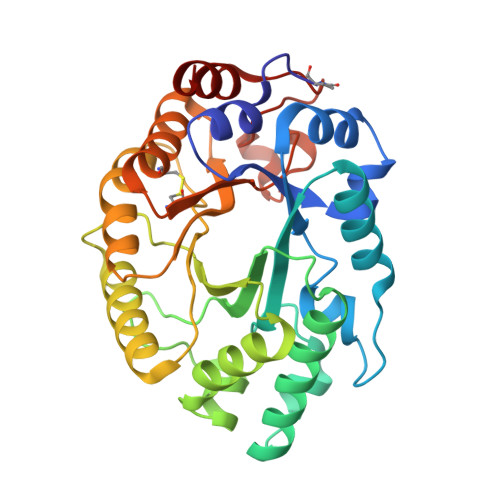
The xylanase TA from Thermoascus aurantiacus utilizes arabinose decorations of xylan as significant substrate specificity determinants.


Experimental Data Snapshot

  • Method: X-RAY DIFFRACTION
  • Resolution: 1.60 Å
  • R-Value Free: 
    0.147 (Depositor) 
  • R-Value Work: 
    0.115 (Depositor) 
  • R-Value Observed: 
    0.117 (Depositor) 

Starting Model: experimental
View more details

wwPDB Validation 3D Report Full Report

Validation slider image for 2BNJ

Ligand Structure Quality Assessment 


This is version 3.2 of the entry. See complete history

Literature

A Family 10 Thermoascus Aurantiacus Xylanase Utilizes Arabinose Decorations of Xylan as Significant Substrate Specificity Determinants.

Vardakou, M.Flint, J.Christakopoulos, P.Lewis, R.J.Gilbert, H.J.Murray, J.W.

(2005) J Mol Biology 352: 1060

  • DOI: https://doi.org/10.1016/j.jmb.2005.07.051
  • Primary Citation Related Structures: 
    2BNJ

  • PubMed Abstract: 

    Xylan, which is a key component of the plant cell wall, consists of a backbone of beta-1,4-linked xylose residues that are decorated with arabinofuranose, acetyl, 4-O-methyl d-glucuronic acid and ferulate. The backbone of xylan is hydrolysed by endo-beta1,4-xylanases (xylanases); however, it is unclear whether the various side-chains of the polysaccharide are utilized by these enzymes as significant substrate specificity determinants. To address this question we have determined the crystal structure of a family 10 xylanase from Thermoascus aurantiacus, in complex with xylobiose containing an arabinofuranosyl-ferulate side-chain. We show that the distal glycone subsite of the enzyme makes extensive direct and indirect interactions with the arabinose side-chain, while the ferulate moiety is solvent-exposed. Consistent with the 3D structural data, the xylanase displays fourfold more activity against xylotriose in which the non-reducing moiety is linked to an arabinose side-chain, compared to the undecorated form of the oligosacchairde. These data indicate that the sugar decorations of xylans in the T.aurantiacus family 10 xylanase, rather than simply being accommodated, can be significant substrate specificity determinants.


  • Organizational Affiliation
    • Biotechnology Laboratory, Chemical Engineering Department, National Technical University of Athens, 5 Iroon Polytechniou Str, Zografou Campus, 15780, Athens, Greece.

Macromolecule Content 

  • Total Structure Weight: 33.46 kDa 
  • Atom Count: 2,958 
  • Modeled Residue Count: 302 
  • Deposited Residue Count: 303 
  • Unique protein chains: 1

Macromolecules

Find similar proteins by:|  3D Structure
Entity ID: 1
MoleculeChains  Sequence LengthOrganismDetailsImage
ENDO-1,4-BETA-XYLANASE303Thermoascus aurantiacusMutation(s): 0 
EC: 3.2.1.8
UniProt
Find proteins for P23360 (Thermoascus aurantiacus)
Explore P23360 
Go to UniProtKB:  P23360
Entity Groups
Sequence Clusters30% Identity50% Identity70% Identity90% Identity95% Identity100% Identity
UniProt GroupP23360
Sequence Annotations
Expand
Reference Sequence

Oligosaccharides

Help  
Entity ID: 2
MoleculeChains Length2D Diagram GlycosylationD Interactions
alpha-L-arabinofuranose-(1-3)-beta-D-xylopyranose-(1-4)-beta-D-xylopyranose
B
3N/A
Glycosylation Resources
GlyTouCan: G96828DL
GlyCosmos: G96828DL

Small Molecules

Ligands 1 Unique
IDChains Name / Formula / InChI Key2D Diagram3D Interactions
FER

Query on FER


Download:Ideal Coordinates CCD File
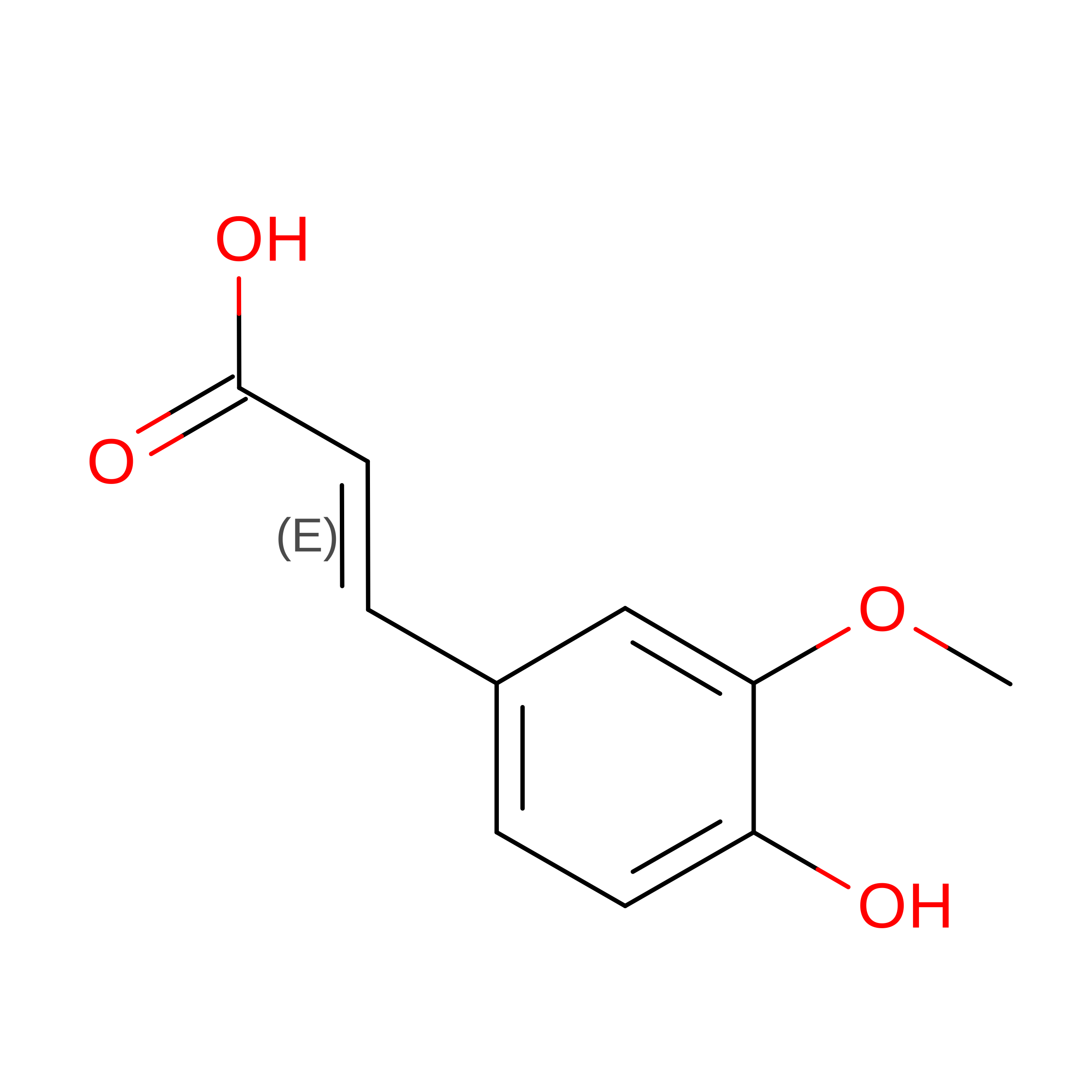
C [auth A]3-(4-HYDROXY-3-METHOXYPHENYL)-2-PROPENOIC ACID
C10 H10 O4
KSEBMYQBYZTDHS-HWKANZROSA-N
Modified Residues  1 Unique
IDChains TypeFormula2D DiagramParent
PCA
Query on PCA
A
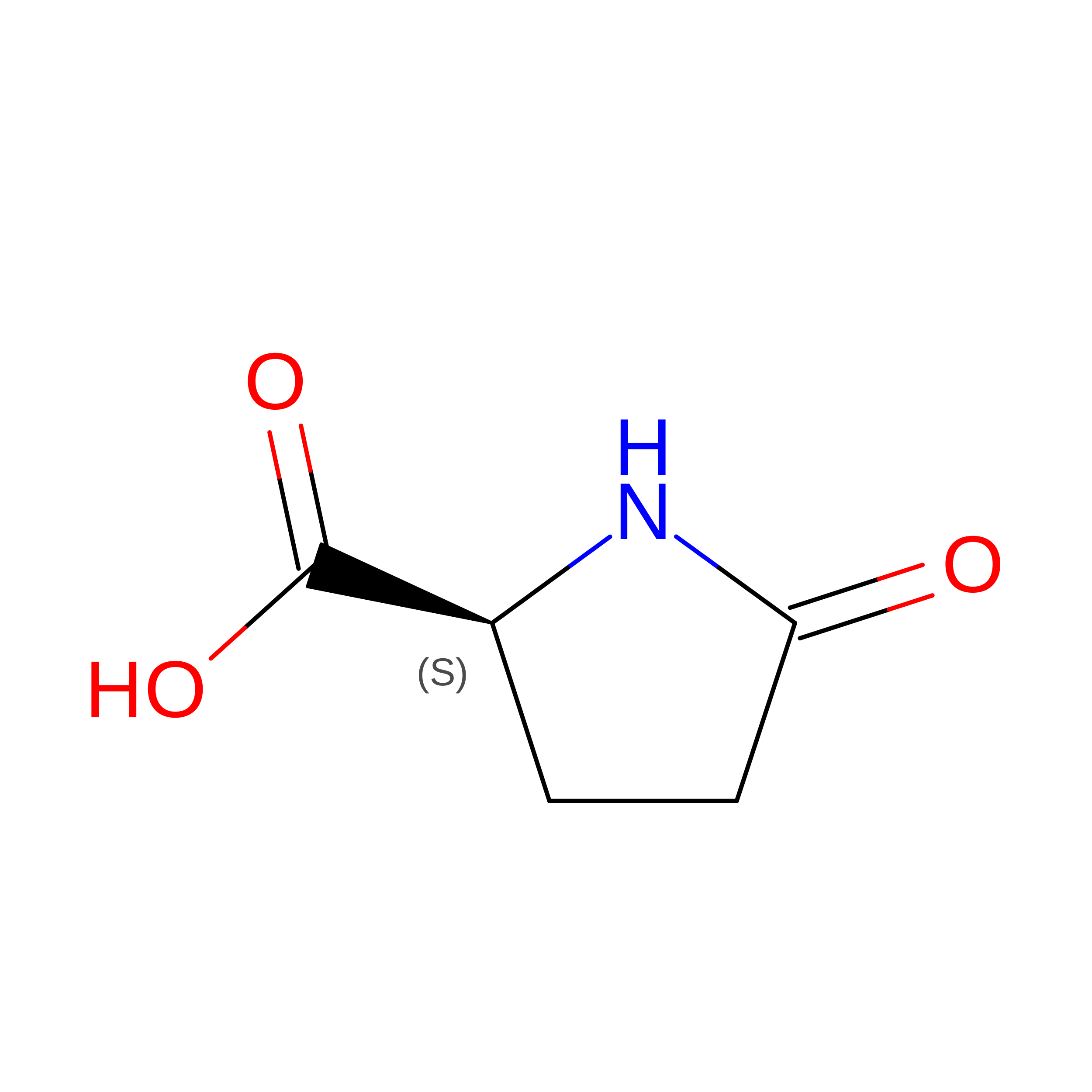
L-PEPTIDE LINKINGC5 H7 N O3GLN

Experimental Data & Validation

Experimental Data

  • Method: X-RAY DIFFRACTION
  • Resolution: 1.60 Å
  • R-Value Free:  0.147 (Depositor) 
  • R-Value Work:  0.115 (Depositor) 
  • R-Value Observed: 0.117 (Depositor) 
Space Group: C 1 2 1
Unit Cell:
Length ( Å )Angle ( ˚ )
a = 88.224α = 90
b = 49.462β = 125.38
c = 77.384γ = 90
Software Package:
Software NamePurpose
REFMACrefinement
MOSFLMdata reduction
SCALAdata scaling
MOLREPphasing

Structure Validation

View Full Validation Report


Ligand Structure Quality Assessment 


Entry History 

Deposition Data

Revision History  (Full details and data files)

  • Version 1.0: 2005-09-07
    Type: Initial release
  • Version 1.1: 2011-05-08
    Changes: Version format compliance
  • Version 1.2: 2011-07-13
    Changes: Version format compliance
  • Version 2.0: 2020-03-11
    Changes: Data collection, Derived calculations, Other, Polymer sequence
  • Version 3.0: 2020-07-29
    Type: Remediation
    Reason: Carbohydrate remediation
    Changes: Atomic model, Data collection, Derived calculations, Structure summary
  • Version 3.1: 2023-12-13
    Changes: Data collection, Database references, Refinement description, Structure summary
  • Version 3.2: 2024-11-13
    Changes: Structure summary