2BFN | pdb_00002bfn

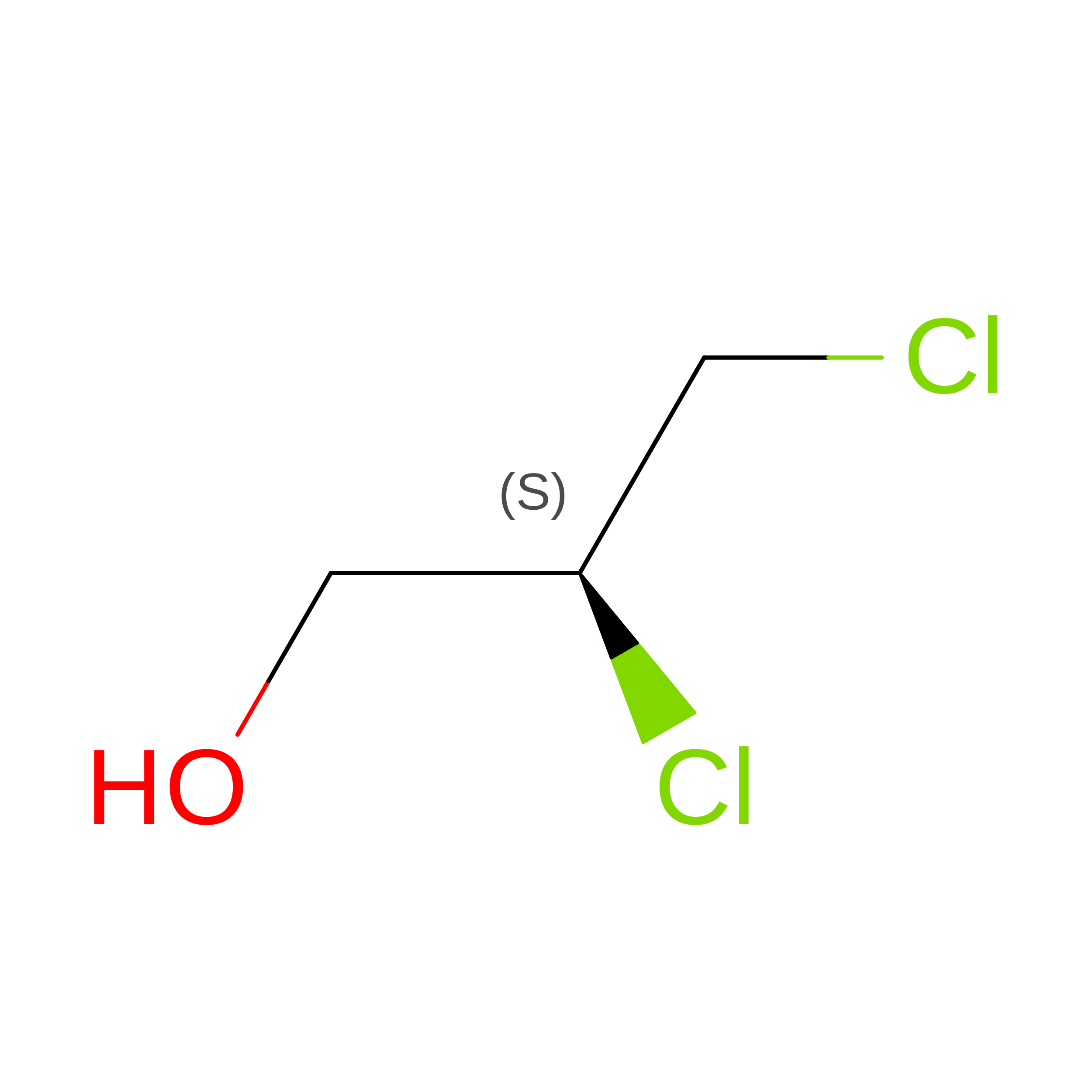
The crystal structure of the complex of the haloalkane dehalogenase LinB with the product of dehalogenation reaction 1,2-dichloropropane.


Experimental Data Snapshot

  • Method: X-RAY DIFFRACTION
  • Resolution: 1.60 Å
  • R-Value Free: 
    0.171 (Depositor) 
  • R-Value Work: 
    0.149 (Depositor), 0.378 (DCC) 
  • R-Value Observed: 
    0.150 (Depositor) 

Starting Model: experimental
View more details

wwPDB Validation 3D Report Full Report

Validation slider image for 2BFN

This is version 1.3 of the entry. See complete history

Literature

Weak Activity of Haloalkane Dehalogenase Linb with 1,2,3-Trichloropropane Revealed by X-Ray Crystallography and Microcalorimetry

Minincova, M.Prokop, Z.Vevodova, J.Nagata, Y.Damborsky, J.

(2007) Appl Environ Microbiol 73: 2005

  • DOI: https://doi.org/10.1128/AEM.02416-06
  • Primary Citation Related Structures: 
    2BFN

  • PubMed Abstract: 

    1,2,3-Trichloropropane (TCP) is a highly toxic and recalcitrant compound. Haloalkane dehalogenases are bacterial enzymes that catalyze the cleavage of a carbon-halogen bond in a wide range of organic halogenated compounds. Haloalkane dehalogenase LinB from Sphingobium japonicum UT26 has, for a long time, been considered inactive with TCP, since the reaction cannot be easily detected by conventional analytical methods. Here we demonstrate detection of the weak activity (k(cat) = 0.005 s(-1)) of LinB with TCP using X-ray crystallography and microcalorimetry. This observation makes LinB a useful starting material for the development of a new biocatalyst toward TCP by protein engineering. Microcalorimetry is proposed to be a universal method for the detection of weak enzymatic activities. Detection of these activities is becoming increasingly important for engineering novel biocatalysts using the scaffolds of proteins with promiscuous activities.


  • Organizational Affiliation
    • Loschmidt Laboratories, Masaryk University, Kamenice 5/A4, 625 00 Brno, Czech Republic.

Macromolecule Content 

  • Total Structure Weight: 33.43 kDa 
  • Atom Count: 2,743 
  • Modeled Residue Count: 294 
  • Deposited Residue Count: 296 
  • Unique protein chains: 1

Macromolecules

Find similar proteins by:|  3D Structure
Entity ID: 1
MoleculeChains  Sequence LengthOrganismDetailsImage
HALOGENALKANE DEHALOGENASE296Sphingomonas paucimobilisMutation(s): 0 
EC: 3.8.1.5
UniProt
Find proteins for D4Z2G1 (Sphingobium indicum (strain DSM 16413 / CCM 7287 / MTCC 6362 / UT26 / NBRC 101211 / UT26S))
Explore D4Z2G1 
Go to UniProtKB:  D4Z2G1
Entity Groups
Sequence Clusters30% Identity50% Identity70% Identity90% Identity95% Identity100% Identity
UniProt GroupD4Z2G1
Sequence Annotations
Expand
Reference Sequence

Experimental Data & Validation

Experimental Data

  • Method: X-RAY DIFFRACTION
  • Resolution: 1.60 Å
  • R-Value Free:  0.171 (Depositor) 
  • R-Value Work:  0.149 (Depositor), 0.378 (DCC) 
  • R-Value Observed: 0.150 (Depositor) 
Space Group: P 21 21 21
Unit Cell:
Length ( Å )Angle ( ˚ )
a = 50.571α = 90
b = 72.142β = 90
c = 73.311γ = 90
Software Package:
Software NamePurpose
REFMACrefinement
DENZOdata reduction
SCALEPACKdata scaling

Structure Validation

View Full Validation Report


Entry History 

Deposition Data

Revision History  (Full details and data files)

  • Version 1.0: 2006-06-26
    Type: Initial release
  • Version 1.1: 2011-05-08
    Changes: Version format compliance
  • Version 1.2: 2011-07-13
    Changes: Version format compliance
  • Version 1.3: 2023-12-13
    Changes: Data collection, Database references, Derived calculations, Other, Refinement description