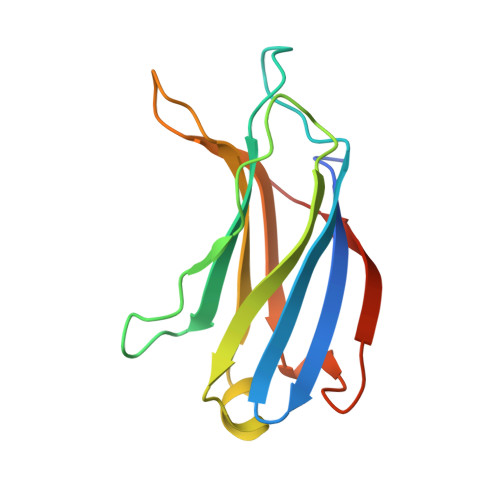
2B3R | pdb_00002b3r

Crystal structure of the C2 domain of class II phosphatidylinositide 3-kinase C2


Experimental Data Snapshot

  • Method: X-RAY DIFFRACTION
  • Resolution: 2.30 Å
  • R-Value Free: 
    0.232 (Depositor) 
  • R-Value Work: 
    0.197 (Depositor) 
  • R-Value Observed: 
    0.197 (Depositor) 

wwPDB Validation 3D Report Full Report

Validation slider image for 2B3R

This is version 1.3 of the entry. See complete history

Literature

Crystal structure of the C2 domain of class II phosphatidylinositide 3-kinase C2alpha.

Liu, L.Song, X.He, D.Komma, C.Kita, A.Virbasius, J.V.Huang, G.Bellamy, H.D.Miki, K.Czech, M.P.Zhou, G.W.

(2006) J Biological Chem 281: 4254-4260

  • DOI: https://doi.org/10.1074/jbc.M510791200
  • Primary Citation Related Structures: 
    2B3R

  • PubMed Abstract: 

    Phosphatidylinositide (PtdIns) 3-kinase catalyzes the addition of a phosphate group to the 3'-position of phosphatidyl inositol. Accumulated evidence shows that PtdIns 3-kinase can provide a critical signal for cell proliferation, cell survival, membrane trafficking, glucose transport, and membrane ruffling. Mammalian PtdIns 3-kinases are divided into three classes based on structure and substrate specificity. A unique characteristic of class II PtdIns 3-kinases is the presence of both a phox homolog domain and a C2 domain at the C terminus. The biological function of the C2 domain of the class II PtdIns 3-kinases remains to be determined. We have determined the crystal structure of the mCPK-C2 domain, which is the first three-dimensional structural model of a C2 domain of class II PtdIns 3-kinases. Structural studies reveal that the mCPK-C2 domain has a typical anti-parallel beta-sandwich fold. Scrutiny of the surface of this C2 domain has identified three small, shallow sulfate-binding sites. On the basis of the structural features of these sulfate-binding sites, we have studied the lipid binding properties of the mCPK-C2 domain by site-directed mutagenesis. Our results show that this C2 domain binds specifically to PtdIns(3,4)P(2) and PtdIns(4,5)P(2) and that three lysine residues at SBS I site, Lys-1420, Lys-1432, and Lys-1434, are responsible for the phospholipid binding affinity.


  • Organizational Affiliation
    • Department of Biological Sciences, Louisiana State University, Baton Rouge, 70803, USA.

Macromolecule Content 

  • Total Structure Weight: 31.5 kDa 
  • Atom Count: 2,252 
  • Modeled Residue Count: 248 
  • Deposited Residue Count: 268 
  • Unique protein chains: 1

Macromolecules

Find similar proteins by:|  3D Structure
Entity ID: 1
MoleculeChains  Sequence LengthOrganismDetailsImage
Phosphatidylinositol-4-phosphate 3-kinase C2 domain-containing alpha polypeptide
A, B
134Mus musculusMutation(s): 0 
Gene Names: Pik3c2aCpk
EC: 2.7.1.154 (PDB Primary Data), 2.7.1.137 (UniProt), 2.7.1.153 (UniProt)
Membrane Entity: Yes 
UniProt & NIH Common Fund Data Resources
Find proteins for Q61194 (Mus musculus)
Explore Q61194 
Go to UniProtKB:  Q61194
IMPC:  MGI:1203729
Entity Groups
Sequence Clusters30% Identity50% Identity70% Identity90% Identity95% Identity100% Identity
UniProt GroupQ61194
Sequence Annotations
Expand
Reference Sequence

Experimental Data & Validation

Experimental Data

  • Method: X-RAY DIFFRACTION
  • Resolution: 2.30 Å
  • R-Value Free:  0.232 (Depositor) 
  • R-Value Work:  0.197 (Depositor) 
  • R-Value Observed: 0.197 (Depositor) 
Space Group: P 41 21 2
Unit Cell:
Length ( Å )Angle ( ˚ )
a = 53.365α = 90
b = 53.365β = 90
c = 200.11γ = 90
Software Package:
Software NamePurpose
DENZOdata reduction
SCALEPACKdata scaling
AMoREphasing
CNSrefinement

Structure Validation

View Full Validation Report


Entry History 

Deposition Data

Revision History  (Full details and data files)

  • Version 1.0: 2005-12-13
    Type: Initial release
  • Version 1.1: 2008-05-01
    Changes: Version format compliance
  • Version 1.2: 2011-07-13
    Changes: Derived calculations, Version format compliance
  • Version 1.3: 2024-02-14
    Changes: Data collection, Database references, Derived calculations