Download Mendeley
Sequence-encoded hexagonal lattices in multichannel peptide nanofibrils.
Gacanin, J., Mazzotta, F., Baptista, L.A., Stoyanov, N., Schmidt, M., Alleva, N., Thummaraj, T., Bonnicel, F., Zhou, C., Gao, L., Munch, J., Bonn, M., Fandrich, M., Lieberwirth, I., Cortes-Huerto, R., Landfester, K., Weil, T.(2026) Nature 657: 935-943
- PubMed: 42778700 Search on PubMedSearch on PubMed Central
- DOI: https://doi.org/10.1038/s41586-026-11016-2
- Primary Citation Related Structures:
28XG, 28XH - PubMed Abstract:
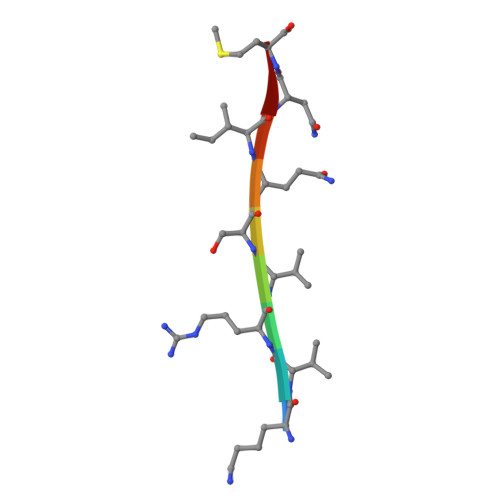
Structural complexity in biological matter arises from molecular information that encodes supramolecular assembly across length scales 1-3 . Here we show that minimal nine-residue peptides can encode discrete lateral interaction motifs that direct supramolecular organization. These motifs generate hexagonal pores and hierarchically tile into multichannel nanofibrils with defined topology. Sequence-encoded amphiphilicity combines a cross-β-dimer, an inversion point and a trimeric junction to create complementary interfaces that couple lateral growth to axial stacking, yielding honeycomb lattices with continuous approximately 5-nm solvent-accessible nanochannels. Cryo-electron microscopy resolves the supramolecular architecture and shows that lattice symmetry and pore geometry are preserved across variants. Systematic perturbations establish sequence-structure rules linking residue position to supramolecular symmetry, lattice propagation and channel topology. Molecular dynamics simulations and vibrational spectroscopy show that the channels remain water accessible and show sequence-tunable hydration. These findings establish that a minimal, sequence-encoded interaction hierarchy can programme long-range supramolecular order, providing a general framework for how short peptides can encode complex, symmetry-defined architectures 4-12 .
- Max Planck Institute for Polymer Research, Mainz, Germany.
Organizational Affiliation: