Download Mendeley
Structural insights into the early transcription factors of the African swine fever virus.
Yang, Y., Xin, Y., Liu, C., Zhang, O., Rao, Z., Li, X., Chen, Y.(2026) Int J Biol Macromol 384: 154747-154747
- PubMed: 42833331 Search on PubMed
- DOI: https://doi.org/10.1016/j.ijbiomac.2026.154747
- Primary Citation Related Structures:
27ZK, 27ZR - PubMed Abstract:
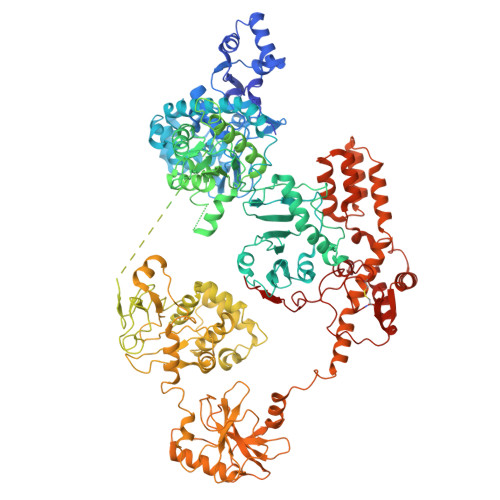
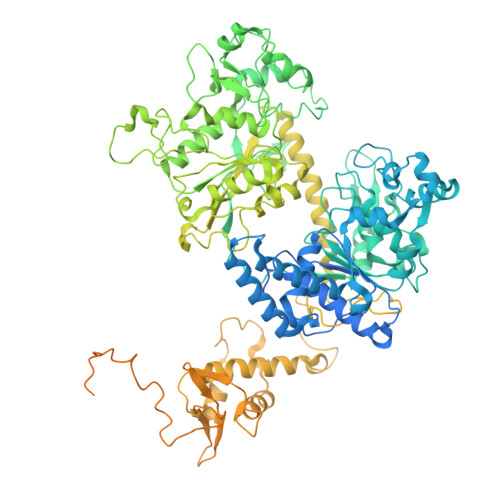
African swine fever virus (ASFV) relies on a virus-encoded transcription machinery to initiate gene expression within cytoplasmic viral factories. The viral early transcription factor (VETF), a heterodimer composed of pD1133L and pG1340L, is required for early transcription and viral replication, yet its structural organization and regulation remain poorly understood. Here, we present cryo-EM structures of ASFV VETF in five distinct conformations. The complex adopts an unusual chair-like architecture stabilized by an extensive buried interfacial area. The small subunit, pD1133L, contains a conserved SF2 ATPase core and mutational analyses confirm the functional importance of its catalytic motifs. A positively charged surface channel in pD1133L is consistent with a potential DNA-binding site, supported by the DNA-binding activity of both pD1133L and the VETF heterodimer. In the apo structures, this channel is positioned against the N-terminal domain (NTD) of pG1340L suggesting that NTD rearrangement may modulate DNA accessibility. The five reconstructions further reveal substantial mobility of the pG1340L NTD and Domain 4, while Domain 3 remains conformationally flexible. Comparison and modeling with the ASFV transcription machinery indicate that the observed apo arrangement is unfavorable for formation of a PIC-like complex. Together, these findings define the architecture and conformational landscape of ASFV VETF and provide a structural framework for understanding how its conformational rearrangements may contribute to promoter recognition and transcription initiation. These findings may also support the development of antiviral strategies targeting VETF activation.
- State Key Laboratory of Biomacromolecules, Institute of Biophysics, Chinese Academy of Sciences, Beijing, China; University of Chinese Academy of Sciences, Beijing, China.
Organizational Affiliation: