Download Mendeley
Structural Basis of Shiga Toxin Neutralization by Human Antibodies Targeting Canonical Receptor-Binding and Non-Canonical Assembly Sites.
Ke, J., Li, X., Wang, X., Huang, Z., Xue, S., Liu, Y., Pan, J., Hu, G., Wang, Y., Wang, C., Chen, S.(2026) Adv Sci (Weinh) : e77402-e77402
- PubMed: 42669652 Search on PubMedSearch on PubMed Central
- DOI: https://doi.org/10.1002/advs.77402
- Primary Citation Related Structures:
25RG, 25SB - PubMed Abstract:
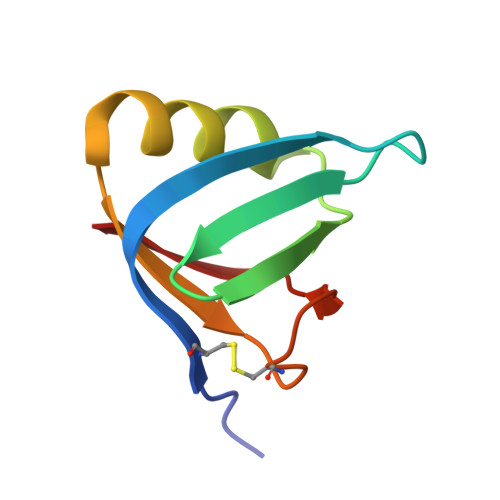
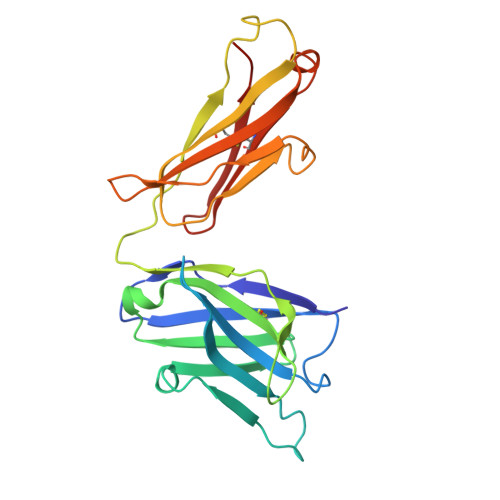
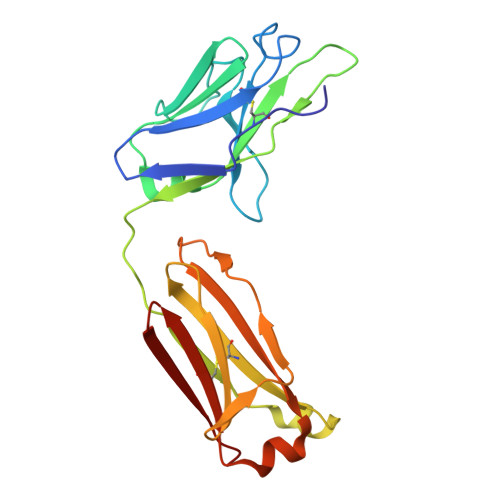
Shiga toxin-producing Escherichia coli (STEC) infections cause severe systemic complications, yet targeted antitoxin therapeutics remain an unmet clinical need. Here, we isolated a panel of human monoclonal antibodies (mAbs) targeted at STEC toxin and characterized two potent neutralizing candidates, RDS045 and RDS059. The cryo-electron microscopy structure of the human mAb RDS059 in complex with the Shiga toxin 1a B subunit (Stx1aB) reveals that RDS059 recognizes the surface-exposed loop of Stx1aB, whereby it directly competes with the host glycolipid globotriaosylceramide (Gb3) to block toxin-cell engagement. In contrast, RDS045 binds a non-canonical quaternary epitope at the pentameric interface of Stx1aB, acting as an interprotomer clamp via an extensive hydrogen-bonding and cation-π interaction network. Both antibodies confer robust protection in cellular assays and an in vivo murine Stx1a challenge model. Collectively, this work defines two distinct molecular blueprints for Shiga toxin receptor blockade and assembly interference, establishing mechanistic frameworks for the development of STEC therapeutics.
- Division of Nephrology, Department of Medicine, The Fifth Affiliated Hospital, Sun Yat-sen University, Zhuhai, Guangdong, People's Republic of China.
Organizational Affiliation: