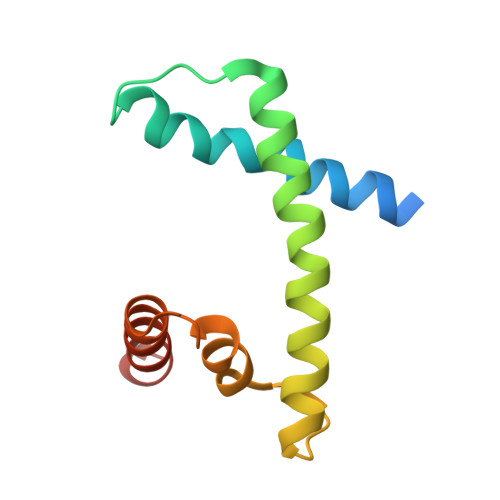
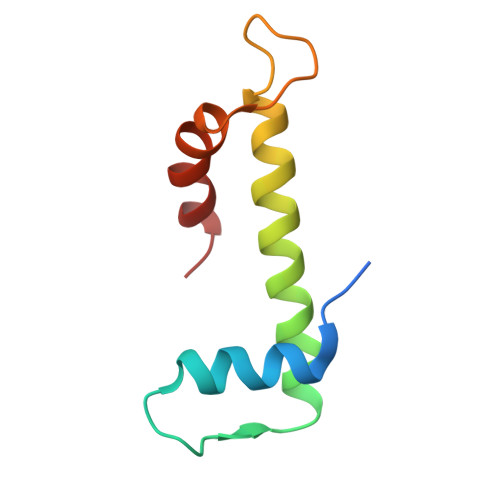
24PV | pdb_000024pv

The crystal structure of the chicken MHF1-MHF2(L77C) disulfide-crosslinked complex


Experimental Data Snapshot

  • Method: X-RAY DIFFRACTION
  • Resolution: 4.00 Å
  • R-Value Free: 
    0.338 (Depositor), 0.340 (DCC) 
  • R-Value Work: 
    0.253 (Depositor), 0.295 (DCC) 
  • R-Value Observed: 
    0.262 (Depositor) 

Starting Model: experimental
View more details

wwPDB Validation 3D Report Full Report

Validation slider image for 24PV

This is version 1.0 of the entry. See complete history. 

Literature

Disulfide engineering of the FANCM-MHF complex reveals constraints on crosslink design in symmetric oligomers.

Ito, S., Nishino, T.

(2026) Protein Sci 35: e70761-e70761

  • DOI: https://doi.org/10.1002/pro.70761
  • Primary Citation Related Structures: 
    24PU, 24PV

  • PubMed Abstract: 

    The Fanconi anemia complementation group M protein (FANCM)-MHF complex is required for branched DNA recognition in the Fanconi anemia pathway, but structural analysis of the intact complex has been hindered by dissociation of FANCM from the FANCM-associated histone fold (MHF) heterotetramer under crystallization conditions. Here, we used structure-guided disulfide engineering to stabilize the FANCM-MHF interface and test whether local geometry is sufficient to predict crosslinking specificity in a symmetric oligomeric assembly. Using endogenous FANCM Cys759 as an anchor, we designed two MHF2 variants, Q74C and L77C. Both supported oxidation-dependent crosslinking in the context of the FANCM-MHF complex, but with distinct outcomes. Q74C formed the intended FANCM-MHF2 disulfide, enabled crystallization of the intact heteropentamer, and preserved DNA-binding behavior under the tested conditions. In contrast, L77C favored a competing MHF2-MHF2 disulfide and yielded only the MHF heterotetramer after FANCM dissociation. Structural analysis further showed distinct crosslinking states for the two MHF tetramers in the asymmetric unit, consistent with local conformational heterogeneity at the MHF dimer-dimer interface. These results show that geometric plausibility alone does not predict crosslinking specificity in symmetric oligomers. Instead, symmetry-related competing pathways can redirect the reaction toward an alternative assembly state. This study provides a practical route to stabilizing FANCM-MHF and reveals a key design constraint for engineered disulfides in symmetric multimeric assemblies.


  • Organizational Affiliation: 
    • Faculty of Advanced Engineering, Tokyo University of Science, Tokyo, Japan.

Macromolecule Content 

  • Total Structure Weight: 85.31 kDa 
  • Atom Count: 5,467 
  • Modeled Residue Count: 686 
  • Deposited Residue Count: 756 
  • Unique protein chains: 2

Macromolecules

Find similar proteins by:|  3D Structure
Entity ID: 1
MoleculeChains  Sequence LengthOrganismDetailsImage
Centromere protein S
A, C, E, G
108Gallus gallusMutation(s): 3 
Gene Names: CENPS, APITD1
UniProt
Find proteins for E1BSW7 (Gallus gallus)
Explore E1BSW7 
Go to UniProtKB:  E1BSW7
Entity Groups
Sequence Clusters30% Identity50% Identity70% Identity90% Identity95% Identity100% Identity
UniProt GroupE1BSW7
Sequence Annotations
Expand
Reference Sequence
Find similar proteins by:|  3D Structure
Entity ID: 2
MoleculeChains  Sequence LengthOrganismDetailsImage
Centromere protein X
B, D, F, H
81Gallus gallusMutation(s): 1 
Gene Names: CENPX, STRA13
UniProt
Find proteins for P0DJH7 (Gallus gallus)
Explore P0DJH7 
Go to UniProtKB:  P0DJH7
Entity Groups
Sequence Clusters30% Identity50% Identity70% Identity90% Identity95% Identity100% Identity
UniProt GroupP0DJH7
Sequence Annotations
Expand
Reference Sequence

Experimental Data & Validation

Experimental Data

  • Method: X-RAY DIFFRACTION
  • Resolution: 4.00 Å
  • R-Value Free:  0.338 (Depositor), 0.340 (DCC) 
  • R-Value Work:  0.253 (Depositor), 0.295 (DCC) 
  • R-Value Observed: 0.262 (Depositor) 
Space Group: C 2 2 21
Unit Cell:
Length ( Å )Angle ( ˚ )
a = 80.794α = 90
b = 86.583β = 90
c = 221.329γ = 90
Software Package:
Software NamePurpose
PHENIXrefinement
XDSdata reduction
Aimlessdata scaling
PHENIXphasing

Structure Validation

View Full Validation Report


Entry History 

& Funding Information

Deposition Data


Funding OrganizationLocationGrant Number
Japan Society for the Promotion of Science (JSPS)Japan20K06512
Japan Society for the Promotion of Science (JSPS)Japan23K05671

Revision History  (Full details and data files)

  • Version 1.0: 2026-09-23
    Type: Initial release