Download Mendeley
Structural basis for substrate specificity switching revealed by the FlhA(A489E) suppressor mutation.
Sakai, M., Kinoshita, M., Takekawa, N., Namba, K., Imada, K., Minamino, T.(2026) Biophys Physicobiol 23: e230030-e230030
- PubMed: 42840504 Search on PubMedSearch on PubMed Central
- DOI: https://doi.org/10.2142/biophysico.bppb-v23.0030
- Primary Citation Related Structures:
23TK, 23TM - PubMed Abstract:
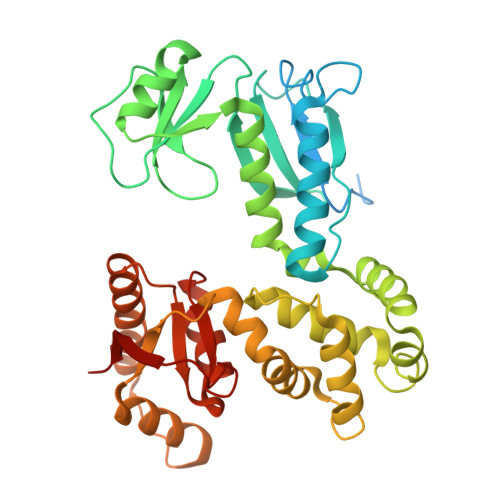
The flagellar type III secretion system (fT3SS) switches its substrate specificity from hook-type to filament-type upon completion of hook assembly. This process is regulated by the coordinated actions of FliK, FlhB, and FlhA, but the structural mechanism underlying substrate specificity switching remains unclear. Here, we determined the crystal structures of the C-terminal cytoplasmic domain of FlhA(FlhA C ) carrying the A489E substitution, which partially restores motility of the cleavage-defective flhB (P270A) mutant. The structures were solved in two distinct conformational states: an open form at 3.28 Å resolution and a semi-closed form at 2.90 Å resolution. In parallel, AlphaFold3-based structural predictions suggested that the flexible C-terminal cytoplasmic tail of FlhB (FlhB CCT ) binds to a groove formed between the α2 helix and β2 strand of FlhA C , overlapping with the intersubunit linker-binding site within the FlhA C ring. Structural analyses further revealed that the A489E substitution rearranges a local salt-bridge network involving Arg-386 and Glu-483, leading to subtle positional shifts of the α2 helix and remodeling of the predicted FlhB CCT -binding surface. These structural changes may alter the predicted interaction between FlhA C and FlhB CCT , thereby lowering the energetic barrier associated with conformational remodeling of the FlhA C ring during substrate specificity switching. Together, our results provide structural insight into how local electrostatic remodeling modulates conformational dynamics of FlhA C and regulates substrate specificity switching in the fT3SS.
- Department of Macromolecular Science, Graduate School of Science, The University of Osaka, Toyonaka, Osaka 560-0043, Japan.
Organizational Affiliation: