Download Mendeley
Mapping the Slow Propagation of Disorder across a Photoreceptor's Tertiary Structure with Time-Resolved Crystallography.
Caramello, N., Hosokawa, Y., Yang, K.C., Wang, P.H., Engilberge, S., Liu, P.J., Chang, Y.C., Giraud, T., Tsai, M.D., Yamamoto, J., Essen, L.O., Royant, A., Maestre-Reyna, M.(2026) J Am Chem Soc
- PubMed: 43024072 Search on PubMed
- DOI: https://doi.org/10.1021/jacs.6c20043
- Primary Citation Related Structures:
22YO, 22YW, 22ZB - PubMed Abstract:
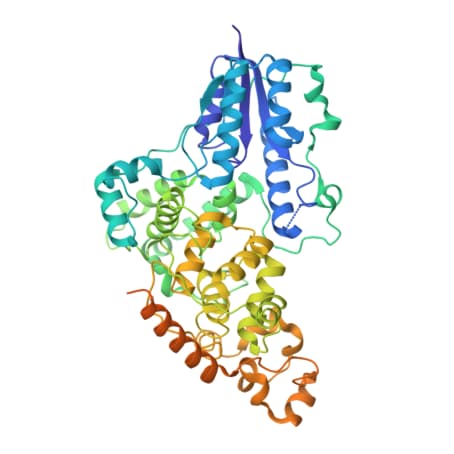
Order-disorder transitions allow many proteins to shift between compact and flexible/unfolded states, thereby acting as structural switches that regulate catalysis, signaling, recognition, and allostery. We applied time-resolved serial oscillation crystallography to establish the structural kinetics of the light-triggered order-disorder transition of an animal-like cryptochrome as a six-second-long molecular movie with near-atomic all-residue spatial resolution and millisecond temporal resolution. Our 29 structural snapshots mapped the propagation of disorder across the tertiary structure motifs of a cryptochrome's C-terminal region, triggered by a single broken D321-R492 salt bridge. The order-disorder transition followed a nucleation-propagation mechanism reminiscent of helix-coil dynamics and proceeded over up to five seconds, with regions distal to the D321-R492 trigger initially undergoing slow zero-order disordering before switching to first-order unfolding kinetics. Our per-residue density analysis provides a detailed structural-kinetic basis for understanding how order-disorder transitions emerge through directional propagation across protein tertiary structures, as occurring in signaling and many other biological systems.
- Department of Chemistry, National Taiwan University, 1, Roosevelt Rd. Sec. 4, Taipei106, Taiwan.
Organizational Affiliation: