Download Mendeley
De novo design of miniproteins targeting GPCRs.
Muratspahic, E., Feldman, D., Kim, D.E., Qu, X., Bratovianu, A.M., Rivera-Sanchez, P., Voss, J.H., Hertz, E.P.T., Jeppesen, M., Dimitri, F., Sakamoto, K., Nallathambi, A., Peceli, P., Cao, J., Cary, B.P., Belousoff, M.J., Keov, P., Trinh, P.N.H., Chen, Q., Ren, Y., Fine, J., Mishra, S., Dalal, A., Sinha, S., Banerjee, R., Ganguly, M., Karuppusamy, K.V., Sappington, I., Schlichthaerle, T., Zhang, J.Z., Pillai, A., Coventry, B., Mihaljevic, L., Bauer, M.S., Torres, S.V., Motmaen, A., Lee, G.R., Tran, L., Wang, X., Goreshnik, I., Vafeados, D.K., Svendsen, J.E., Hosseinzadeh, P., Lindegaard, N., Brandt, M., Waltenspuhl, Y., Deibler, K., Deweid, L., Bennett, A., Schoppe, J., Dong, T., Yan, X., Oostdyk, L., Cao, W., Anantharaman, L., Weisser, J.J., Bastlund, J.F., Bundgaard, C., Asuni, A.A., English, J.G., Stewart, L.J., Halloran, L., Spangler, J.B., Lieber, A., Shukla, A.K., Sexton, P.M., Roth, B.L., Krumm, B.E., Wootten, D., Tate, C.G., Norn, C., Baker, D.(2026) Nature 656: 1044-1053
- PubMed: 42168559 Search on PubMed
- DOI: https://doi.org/10.1038/s41586-026-10656-8
- Primary Citation Related Structures:
22XC, 9MM5 - PubMed Abstract:
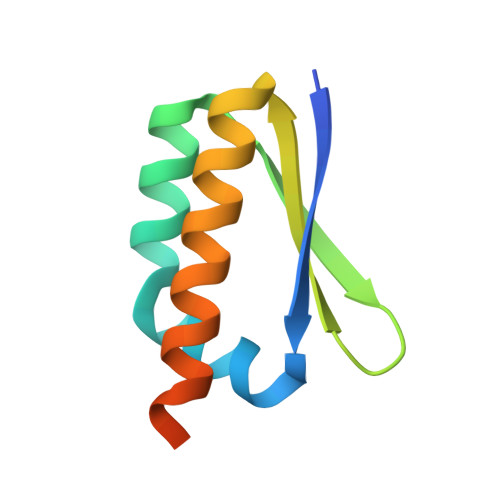
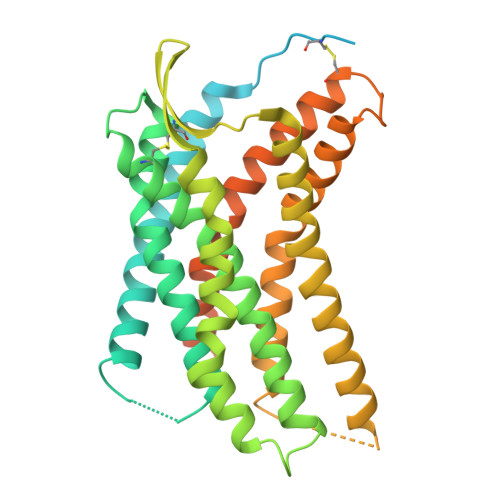
G protein-coupled receptors (GPCRs) play key roles in physiology and are central targets for drug discovery and development 1,2 , but the design of protein agonists and antagonists has been challenging as GPCRs are integral membrane proteins and conformationally dynamic 3-6 . Here we describe computational de novo design methods and a high-throughput "receptor diversion" microscopy-based screen for generating GPCR binding miniproteins with high affinity, potency and selectivity. We design miniprotein agonists that activate receptors involved in itch and pain, as well as antagonists that inhibit receptors implicated in cancer, metabolic disorders such as diabetes and obesity, and migraine. Cryo-electron microscopy (cryo-EM) structures of five receptor-bound designs are close to the computational design models. A designed chemokine receptor antagonist mobilizes hematopoietic stem and progenitor cells in vivo at a level comparable to a clinically used drug, with fewer adverse effects.
- Department of Biochemistry, University of Washington, Seattle, WA, USA. edinm2@uw.edu.
Organizational Affiliation: