Download Mendeley
Butyrophilin-like 3 and 8 tetramers clamp V gamma 4V delta 1 T cell receptors for antigen-independent activation.
Dong, D., Li, H., Zhu, Y., Lu, Z., Zhu, J., Tian, X., Huang, Z.(2026) Immunity
- PubMed: 42546693 Search on PubMed
- DOI: https://doi.org/10.1016/j.immuni.2026.07.004
- Primary Citation Related Structures:
22KK - PubMed Abstract:
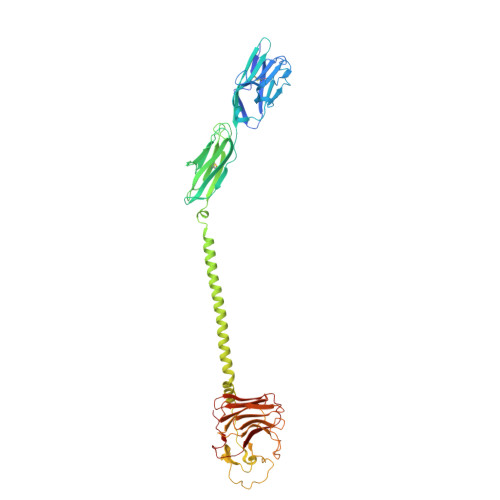
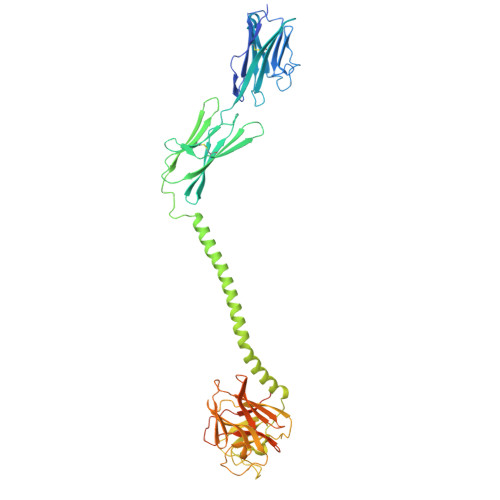
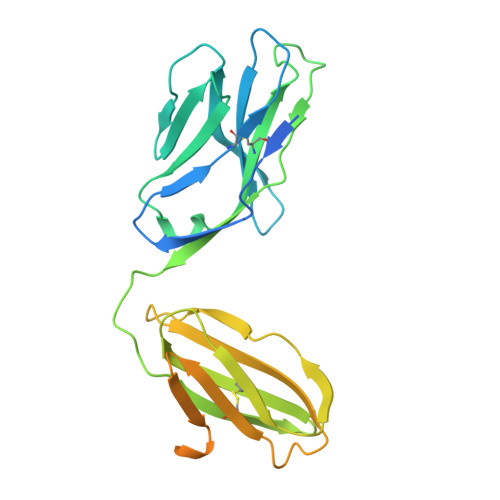
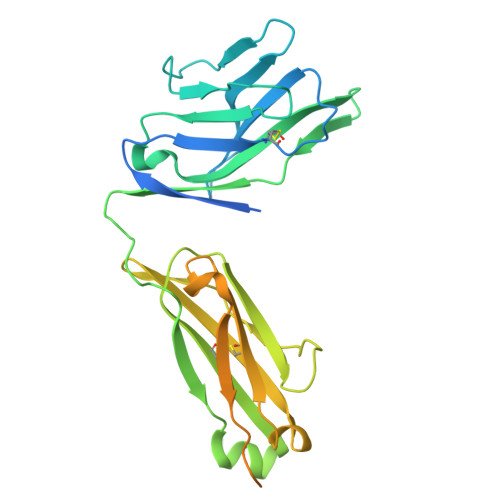
BTNL3 and BTNL8, butyrophilin-like (BTNL) family receptors, are predominantly expressed on intestinal epithelial cells. The BTNL3-BTNL8 complex selectively activates human Vγ4⁺ T cells, which play critical roles in intestinal immune homeostasis and tissue damage repair. Here, we report the structure of the BTNL3-BTNL8-Vγ4Vδ1 T cell receptor (TCR) complex. The structure reveals that BTNL3-BTNL8 forms an antigen-independent tetramer, in contrast to the phosphoantigen-driven association of BTN2A1-BTN3A1. Two BTNL3-BTNL8 heterodimers clamp a head-to-head TCR homodimer to form a 2:2:2 BTNL3:BTNL8:Vγ4Vδ1 TCR complex, with the Vγ4 HV4 and CDR2 loops jointly engaging BTNL3. Structural alignment indicates that the CD1d binding site on TCR overlaps spatially with one monomer within a TCR dimer, suggesting that TCR dimerization sterically precludes simultaneous engagement of CD1d molecules. Together, our results elucidate the structural mechanism of BTNL3-BTNL8-mediated engagement and activation of Vγ4Vδ1 TCR, offering insights into γδ TCR signaling initiation.
- HIT Center for Life Sciences, School of Life Science and Technology, Harbin Institute of Technology, Harbin 150001, China; Westlake Center for Genome Editing, Westlake Laboratory of Life Sciences and Biomedicine, School of Life Sciences, Westlake University, Hangzhou 310024, Zhejiang, China.
Organizational Affiliation: