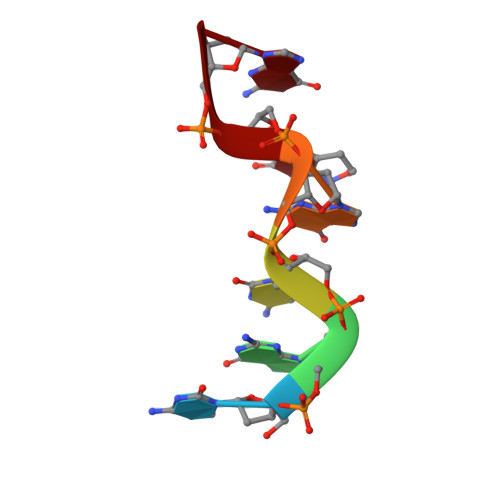
223D | pdb_0000223d

DIRECT OBSERVATION OF TWO BASE-PAIRING MODES OF A CYTOSINE-THYMINE ANALOGUE WITH GUANINE IN A DNA Z-FORM DUPLEX: SIGNIFICANCE FOR BASE ANALOGUE MUTAGENESIS


Experimental Data Snapshot

  • Method: X-RAY DIFFRACTION
  • Resolution: 1.70 Å
  • R-Value Observed: 
    0.179 (Depositor) 

Starting Model: experimental
View more details

wwPDB Validation 3D Report Full Report

Validation slider image for 223D

This is version 1.5 of the entry. See complete history

Literature

Direct observation of two base-pairing modes of a cytosine-thymine analogue with guanine in a DNA Z-form duplex: significance for base analogue mutagenesis.

Moore, M.H.Van Meervelt, L.Salisbury, S.A.Lin, P.K.Brown, D.M.

(1995) J Mol Biology 251: 665-673

  • DOI: https://doi.org/10.1006/jmbi.1995.0463
  • Primary Citation Related Structures: 
    223D

  • PubMed Abstract: 

    The pyrimidine nucleobase analogue 6H,8H-3,4-dihydropyrimido[4,5-c]- [1,2]oxazin-7-one (P) is a mimic both of cytosine and thymine, since it can form stable hydrogen-bonded base-pairs with either guanine or adenine. To investigate the geometric properties of pairing with guanine in a DNA double helix, the structure of d(CGCGPG)2 has been determined by single crystal X-ray analysis. The oligonucleotide crystallised as a left-handed Z-DNA duplex in the orthorhombic space group P2(1)2(1)2(1) with cell dimensions a = 18.23 A, b = 30.63 A, c = 43.78 A. Refinement using NUCLSQ with 51 water molecules included in the final model converged at R = 0.179 (Rw = 0.159) for 2798 reflections (F > 2 sigma (F)) in the range 8 A to 1.7 A. Remarkably, the two P.G pairs in the hexamer duplex are different: Watson-Crick and wobble types separately illustrate both cytosine-like and thymine-like behaviour. The result suggests that mutagenesis experiments involving P and other analogues which display pronounced base-pairing ambivalence can be used to examine the structural basis of substrate discrimination by polymerases that is essential to accurate genetic replication.


  • Organizational Affiliation
    • Department of Chemistry, York University, Heslington, UK.

Macromolecule Content 

  • Total Structure Weight: 3.7 kDa 
  • Atom Count: 297 
  • Modeled Residue Count: 12 
  • Deposited Residue Count: 12 
  • Unique nucleic acid chains: 1

Macromolecules

Find similar nucleic acids by:  Sequence
Entity ID: 1
MoleculeChains LengthOrganismImage
DNA (5'-D(*CP*GP*CP*GP*(C46)P*G)-3')
A, B
6N/A
Sequence Annotations
Expand
Reference Sequence

Experimental Data & Validation

Experimental Data

  • Method: X-RAY DIFFRACTION
  • Resolution: 1.70 Å
  • R-Value Observed: 0.179 (Depositor) 
Space Group: P 21 21 21
Unit Cell:
Length ( Å )Angle ( ˚ )
a = 18.23α = 90
b = 30.63β = 90
c = 43.78γ = 90
Software Package:
Software NamePurpose
MERLOTphasing
NUCLSQrefinement

Structure Validation

View Full Validation Report


Entry History 

Deposition Data

Revision History  (Full details and data files)

  • Version 1.0: 1995-12-09
    Type: Initial release
  • Version 1.1: 2008-05-22
    Changes: Version format compliance
  • Version 1.2: 2011-07-13
    Changes: Version format compliance
  • Version 1.3: 2018-04-04
    Changes: Data collection
  • Version 1.4: 2024-02-14
    Changes: Data collection, Database references, Derived calculations
  • Version 1.5: 2024-04-03
    Changes: Refinement description