21FY | pdb_000021fy

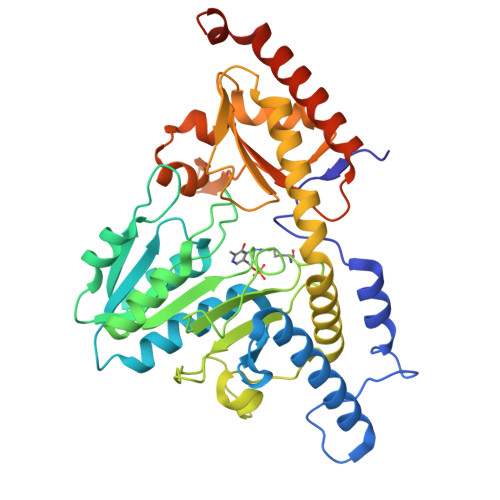
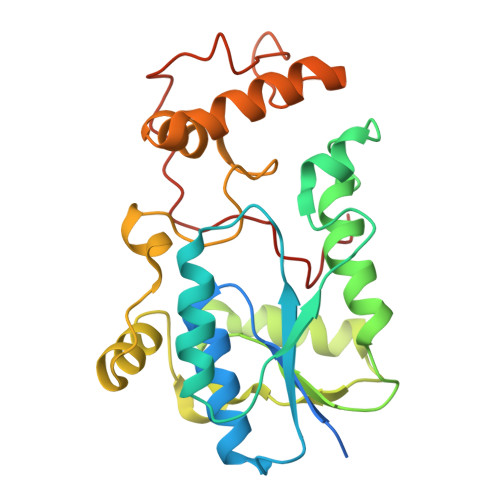
The cryo-EM structure of IscS-PptA complex


Experimental Data Snapshot

  • Method: ELECTRON MICROSCOPY
  • Resolution: 2.85 Å
  • Aggregation State: PARTICLE 
  • Reconstruction Method: SINGLE PARTICLE 

wwPDB Validation 3D Report Full Report

Validation slider image for 21FY

This is version 1.2 of the entry. See complete history

Literature

Phage hijacks host phosphorothioate DNA modification machinery to circumvent bacterial Ssp defences.

Wang, Y.Yang, H.Jiang, L.Ge, Y.Zhong, Y.Chu, H.Zhang, K.Kuerban, K.Nong, Y.Gao, H.Xu, C.Li, X.Chen, S.Wang, L.

(2026) Nat Microbiol 11: 2187-2200

  • DOI: https://doi.org/10.1038/s41564-026-02387-3
  • Primary Citation Related Structures: 
    21FY

  • PubMed Abstract: 

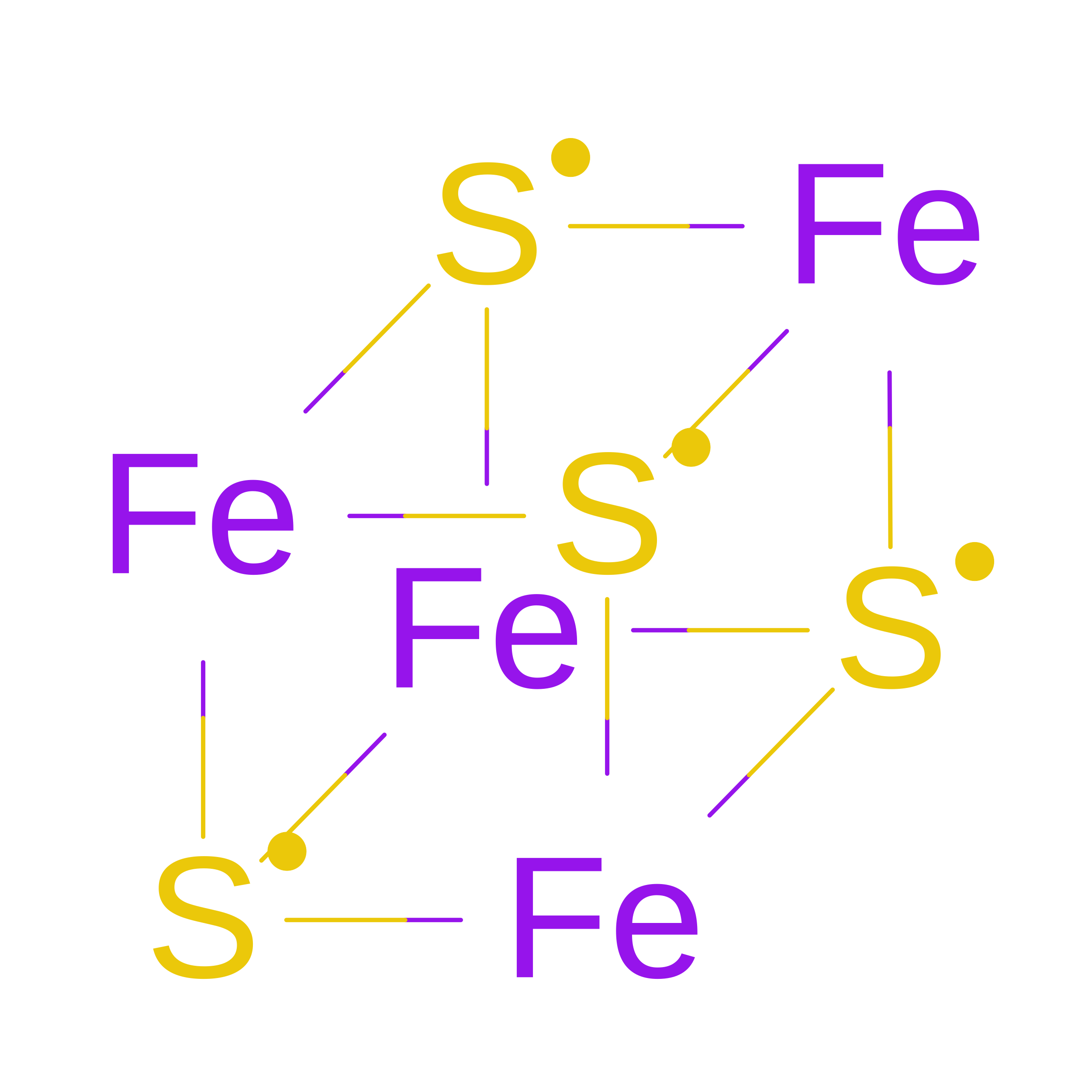
    The bacterial Ssp defence system discriminates self from non-self by introducing sequence-specific phosphorothioate (PT) modifications in host DNA (via SspABCD) and cleaving unmodified foreign DNA (via SspFGH or SspE). Here we report PptA, a phage-encoded [4Fe-4S] cluster-containing protein, which hijacks cognate host cysteine desulfurase IscS homologues to assemble a streamlined PT modification machinery. Integrated biochemical and structural data delineate a model for intermolecular sulfur transfer within the IscS-PptA complex. Upon infection, robust expression of PptA, not merely its presence, drives sufficient PT incorporation into the phage genome, enabling molecular mimicry of host PT patterns. By masquerading as 'self', the modified phage DNA evades recognition and cleavage by SspFGH/SspE. Notably, PptA can reprogramme the Ssp-sensitive λ phage into an immune-evasive variant. These results reveal a co-evolutionary strategy used by phages to overcome PT-based bacterial immunity and provide a foundation for engineering therapeutic phages that bypass this widespread defence system.


  • Organizational Affiliation
    • Department of Gastroenterology, Hubei Clinical Center and Key Laboratory of Intestinal and Colorectal Disease, Ministry of Education Key Laboratory of Combinatorial Biosynthesis and Drug Discovery, Zhongnan Hospital of Wuhan University, School of Pharmaceutical Sciences, Wuhan University, Wuhan, China.

Macromolecule Content 

  • Total Structure Weight: 152 kDa 
  • Atom Count: 9,912 
  • Modeled Residue Count: 1,258 
  • Deposited Residue Count: 1,348 
  • Unique protein chains: 2

Macromolecules

Find similar proteins by:|  3D Structure
Entity ID: 1
MoleculeChains  Sequence LengthOrganismDetailsImage
Cysteine desulfurase IscS
A, B
404Escherichia coli K-12Mutation(s): 0 
Gene Names: iscSnuvCyfhOyzzOb2530JW2514
EC: 2.8.1.7
UniProt
Find proteins for P0A6B7 (Escherichia coli (strain K12))
Explore P0A6B7 
Go to UniProtKB:  P0A6B7
Entity Groups
Sequence Clusters30% Identity50% Identity70% Identity90% Identity95% Identity100% Identity
UniProt GroupP0A6B7
Sequence Annotations
Expand
Reference Sequence
Find similar proteins by:|  3D Structure
Entity ID: 2
MoleculeChains  Sequence LengthOrganismDetailsImage
PptA
C, D
270Psychrobacter phage vB_PmaS_Y8AMutation(s): 0 
UniProt
Find proteins for A0A5Q2WBY0 (Vibrio phage vB_VhaP_VH-5)
Explore A0A5Q2WBY0 
Go to UniProtKB:  A0A5Q2WBY0
Entity Groups
Sequence Clusters30% Identity50% Identity70% Identity90% Identity95% Identity100% Identity
UniProt GroupA0A5Q2WBY0
Sequence Annotations
Expand
Reference Sequence

Small Molecules

Modified Residues  1 Unique
IDChains TypeFormula2D DiagramParent
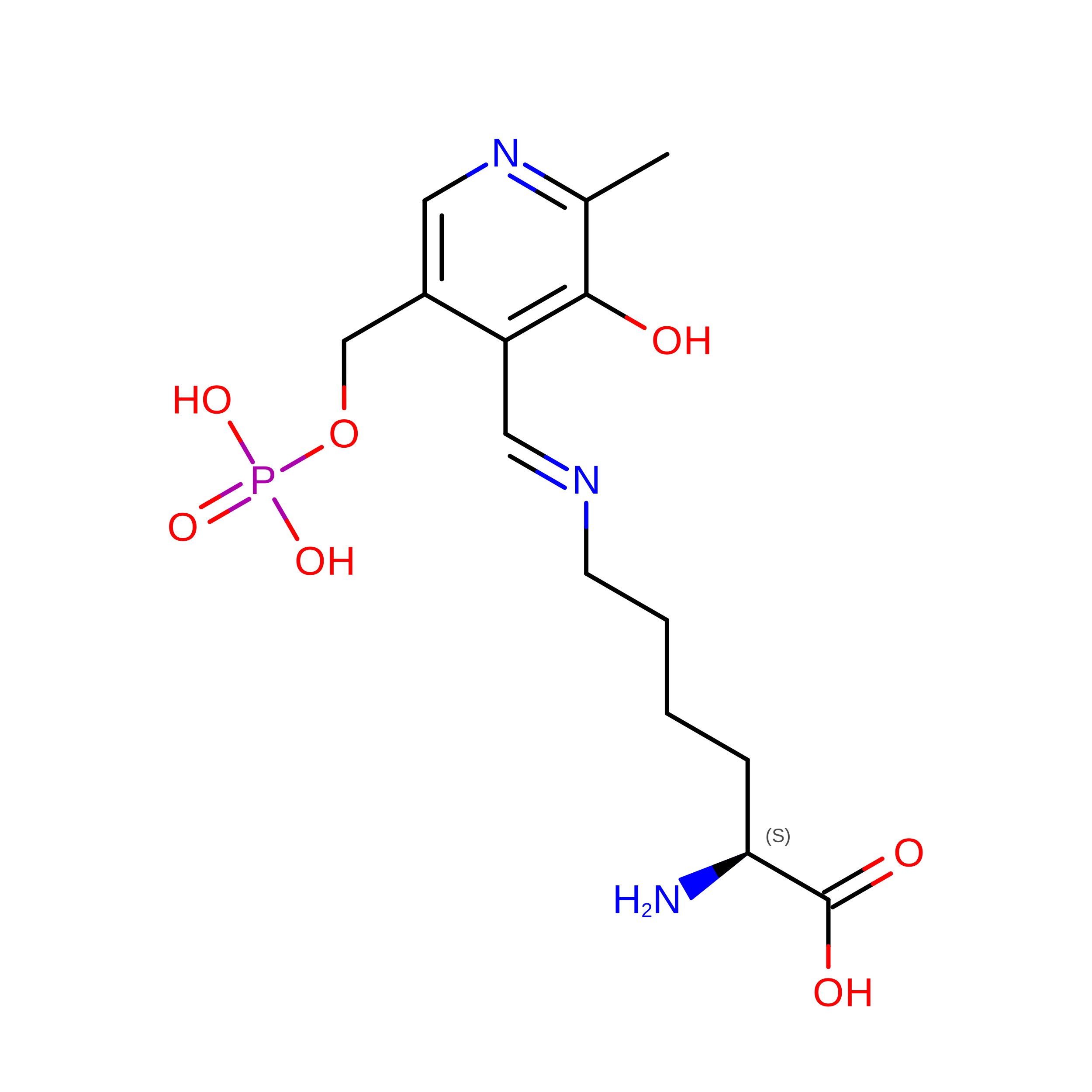
LLP
Query on LLP
A, B
L-PEPTIDE LINKINGC14 H22 N3 O7 PLYS

Experimental Data & Validation

Experimental Data

  • Method: ELECTRON MICROSCOPY
  • Resolution: 2.85 Å
  • Aggregation State: PARTICLE 
  • Reconstruction Method: SINGLE PARTICLE 
EM Software:
TaskSoftware PackageVersion
RECONSTRUCTIONcryoSPARC

Structure Validation

View Full Validation Report


Entry History 

& Funding Information

Deposition Data

  • Released Date: 2026-04-15 
  • Deposition Author(s): Wang, Y.

Funding OrganizationLocationGrant Number
National Natural Science Foundation of China (NSFC)China--

Revision History  (Full details and data files)

  • Version 1.0: 2026-04-15
    Type: Initial release
  • Version 1.1: 2026-08-12
    Type: Remediation
    Reason: Metalloprotein remediation
    Changes: Data collection, Derived calculations, Structure summary
  • Version 1.2: 2026-08-19
    Changes: Data collection, Database references