21FO | pdb_000021fo

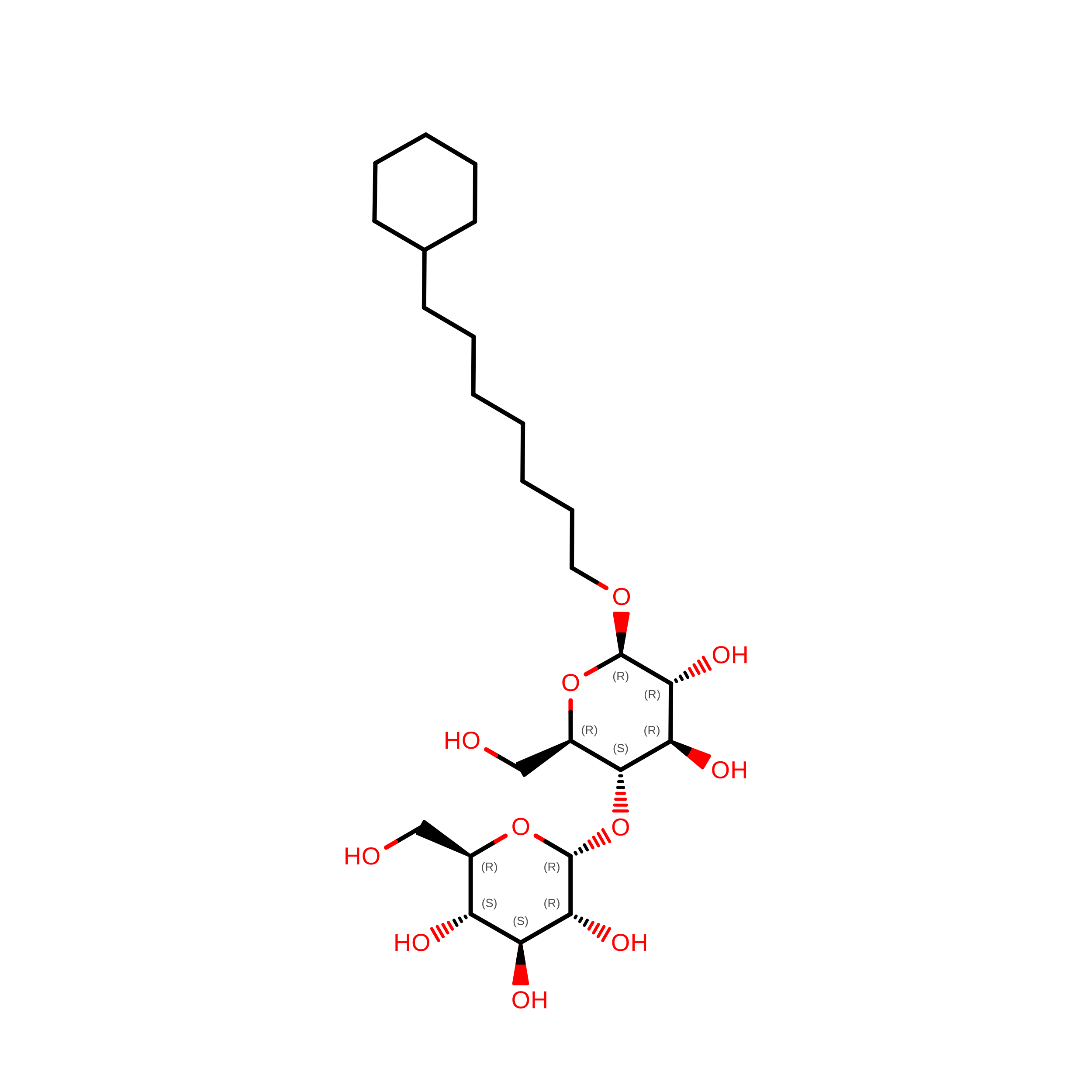
CYMAL-7-bound MexB


Experimental Data Snapshot

  • Method: X-RAY DIFFRACTION
  • Resolution: 2.30 Å
  • R-Value Free: 
    0.255 (Depositor), 0.256 (DCC) 
  • R-Value Work: 
    0.221 (Depositor), 0.221 (DCC) 
  • R-Value Observed: 
    0.222 (Depositor) 

Starting Model: experimental
View more details

wwPDB Validation 3D Report Full Report

Validation slider image for 21FO

Ligand Structure Quality Assessment 


This is version 1.0 of the entry. See complete history

Literature

Structure of chloramphenicol-bound MexB reveals residues in the distal binding pocket that are critical for substrate recognition.

Ueda, Y.Yonehara, R.Ishizaka-Ikeda, E.Nakagawa, A.Yamashita, E.

(2026) J Biochem 

  • DOI: https://doi.org/10.1093/jb/mvag012
  • Primary Citation Related Structures: 
    21FO, 21FP

  • PubMed Abstract: 

    Multidrug resistance in Pseudomonas aeruginosa is strongly promoted by the resistance-nodulation-division (RND) family tripartite efflux pump MexAB-OprM, whose inner-membrane transporter MexB plays a central role in recognizing and extruding a broad spectrum of antibiotics and detergents. Although crystal structures of MexB have been determined, no structure of MexB bound to an antibiotic has previously been reported. Here, we report crystal structures of drug-free MexB and chloramphenicol-bound MexB crystallized under mildly basic conditions. In the chloramphenicol-bound structure, chloramphenicol binds at the deep end of the distal binding pocket (DBP) groove in the Binding protomer. Based on this structure, we identified DBP residues (Q125, R128, F178, G179, S180, and Q273) that contact chloramphenicol and evaluated their contributions using in vitro chloramphenicol resistance assays of single-substitution MexB variants. Substitutions at these positions reduced cell growth in the presence of chloramphenicol, minocycline, levofloxacin, and the detergent CYMAL-7. These findings identify a MexB-specific recognition subsite within the DBP groove and provide a structural basis for understanding how MexB recognizes chloramphenicol and other chemically diverse substrates.


  • Organizational Affiliation
    • Institute for Protein Research, the University of Osaka, 3-2 Yamadaoka, Suita, Osaka 565-0871, Japan.

Macromolecule Content 

  • Total Structure Weight: 342.89 kDa 
  • Atom Count: 23,460 
  • Modeled Residue Count: 3,084 
  • Deposited Residue Count: 3,162 
  • Unique protein chains: 1

Macromolecules

Find similar proteins by:|  3D Structure
Entity ID: 1
MoleculeChains  Sequence LengthOrganismDetailsImage
Multidrug resistance protein MexB
A, B, C
1,054Pseudomonas aeruginosaMutation(s): 0 
Gene Names: mexBPA0426
UniProt
Find proteins for P52002 (Pseudomonas aeruginosa (strain ATCC 15692 / DSM 22644 / CIP 104116 / JCM 14847 / LMG 12228 / 1C / PRS 101 / PAO1))
Explore P52002 
Go to UniProtKB:  P52002
Entity Groups
Sequence Clusters30% Identity50% Identity70% Identity90% Identity95% Identity100% Identity
UniProt GroupP52002
Sequence Annotations
Expand
Reference Sequence

Small Molecules

Experimental Data & Validation

Experimental Data

  • Method: X-RAY DIFFRACTION
  • Resolution: 2.30 Å
  • R-Value Free:  0.255 (Depositor), 0.256 (DCC) 
  • R-Value Work:  0.221 (Depositor), 0.221 (DCC) 
  • R-Value Observed: 0.222 (Depositor) 
Space Group: C 1 2 1
Unit Cell:
Length ( Å )Angle ( ˚ )
a = 207.041α = 90
b = 168.871β = 102.226
c = 172.21γ = 90
Software Package:
Software NamePurpose
PHENIXrefinement
HKL-2000data reduction
HKL-2000data scaling
PHASERphasing

Structure Validation

View Full Validation Report


Ligand Structure Quality Assessment 


Entry History 

& Funding Information

Deposition Data


Funding OrganizationLocationGrant Number
Japan Society for the Promotion of Science (JSPS)Japan19H03167
Japan Society for the Promotion of Science (JSPS)Japan25291014

Revision History  (Full details and data files)

  • Version 1.0: 2026-05-06
    Type: Initial release