Download Mendeley
SspE-mediated immune defense: GTP hydrolysis as an allosteric switch coupling phosphorothioate recognition to DNA cleavage.
Zhou, Y., Zhang, K., He, Y., Gao, H., Zhong, Y., Wang, X., Wang, M., Wang, L., Chen, S.(2026) mBio 17: e0035926-e0035926
- PubMed: 42117685 Search on PubMed
- DOI: https://doi.org/10.1128/mbio.00359-26
- Primary Citation Related Structures:
20YV, 20YW - PubMed Abstract:
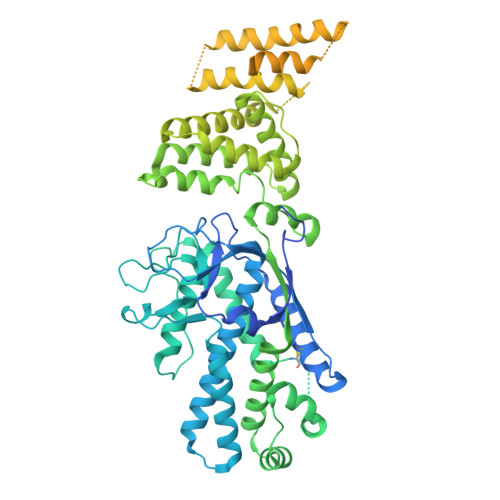
DNA phosphorothioate (PT) modification is an epigenetic mark that enables bacteria to discriminate self from non-self DNA, directing restriction effectors to cleave unmodified foreign DNA. In the PT-dependent Ssp system, SspE acts as the restriction effector that recognizes PT marks to block phage propagation. While the mechanism of the Streptomyces homolog (StSspE) is known, the basis for the exceptional potency of Escherichia coli ( E. coli ) 3234/A SspE (EcSspE) remained unclear. Here, we combine cryo-electron microscopy (cryo-EM), biochemistry, and functional assays in vivo to define its mechanism. The cryo-EM structure reveals that EcSspE forms a dynamic homotetramer with a side-by-side assembly, featuring a substantially reduced inter-subunit interface compared to the intertwined StSspE tetramer. A hydrophobic cavity harboring Y63 specifically recognizes the 5'-C PS CA-3' PT motif. This recognition triggers GTP hydrolysis via the essential residue R133. Hydrolysis, in turn, drives an asymmetric allosteric rearrangement that licenses the flexible C-terminal HNH nuclease domain for DNA cleavage. Disrupting PT sensing (Y63A), GTP hydrolysis (R133A), or nuclease activity (N724A) completely abolishes anti-phage defense, confirming strict functional coupling. Our work establishes a conserved "recognize-hydrolyze-activate" paradigm for SspE proteins, wherein PT-stimulated GTPase activity licenses the nuclease via an allosteric switch. The distinct tetrameric architecture of EcSspE likely underlies its enhanced activity by facilitating conformational dynamics. This study elucidates the precise molecular logic of a potent bacterial immune system and provides a framework for engineering phage resistance.IMPORTANCEBacterial antiphage defense systems must precisely destroy invaders while avoiding self-harm. This study provides a high-resolution molecular blueprint of the exceptionally potent PT-dependent Ssp system from E. coli 3234/A. We elucidate its conserved "recognize-hydrolyze-activate" mechanism: the effector EcSspE integrates PT recognition, GTP hydrolysis, and allosteric signaling to license DNA cleavage. Beyond this paradigm, we reveal that subtle evolutionary refinements in its quaternary architecture-a streamlined, side-by-side assembly with a reduced interface-amplify defensive output by enhancing conformational dynamics. This insight bridges structural biophysics and immunity. The system's strict PT-dependence ensures biosafety, and its defined mechanistic logic and key molecular switches (Y63, R133, N724) establish a framework for engineering programmable phage resistance, advancing both our understanding of host-virus conflict and our ability to harness it.
- Department of Gastroenterology, Ministry of Education Key Laboratory of Combinatorial Biosynthesis and Drug Discovery, Hubei Clinical Center and Key Laboratory of Intestinal and Colorectal Disease, Zhongnan Hospital of Wuhan University, School of Pharmaceutical Sciences, Wuhan University, Wuhan, Hubei, China.
Organizational Affiliation: