Download Mendeley
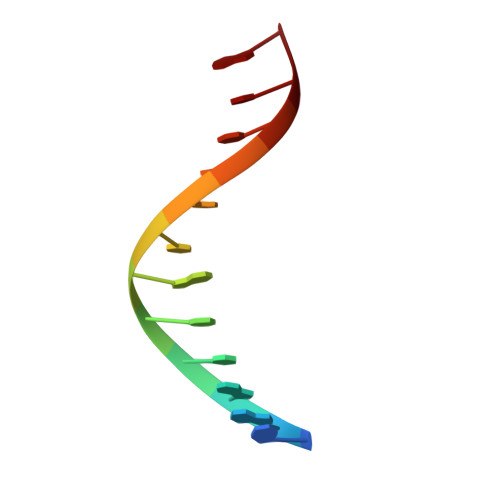
Structural and dynamic basis of a supercoiling-responsive DNA element
Bae, S.H., Yun, S.H., Sun, D., Lim, H.M., Choi, B.S.(2006) Nucleic Acids Res 34: 254-261
- PubMed: 16414956 Search on PubMedSearch on PubMed Central
- DOI: https://doi.org/10.1093/nar/gkj428
- Primary Citation Related Structures:
1ZYF, 1ZYG, 1ZYH - PubMed Abstract:
In both eukaryotes and prokaryotes, negative supercoiling of chromosomal DNA acts locally to regulate a variety of cellular processes, such as transcription, replication, recombination and response to environmental stresses. While studying the interaction between the Hin recombinase and mutated versions of its cognate DNA-binding site, we identified a mutated DNA site that binds Hin only when the DNA is supercoiled. To understand the mechanism of this supercoiling-responsive DNA site, we used NMR spectroscopy and fluorescence resonance energy transfer to determine the solution structures and dynamics of three related DNA oligonucleotides. The supercoiling-responsive DNA site formed a partially unwound and stretched helix and showed significant flexibility and base pair opening kinetics. The single CAG/CTG triplet contained in this DNA sequence displayed the same characteristics as do multiple CAG/CTG repeats, which are associated with several hereditary neuromuscular diseases. It is known that short DNA sequence motifs that have either very high or low bending flexibility occur preferentially at supercoiling-sensitive bacterial and eukaryotic promoters. From our results and these previous data, we propose a model in which supercoiling utilizes the intrinsic flexibility of a short DNA site to switch the local DNA structure from an inefficient conformation for protein binding to an efficient one, or vice versa.
- Department of Chemistry, KAIST 373-1 Guseong-dong, Yuseong-gu, Daejeon 305-701, Republic of Korea.
Organizational Affiliation: