1ZH4 | pdb_00001zh4

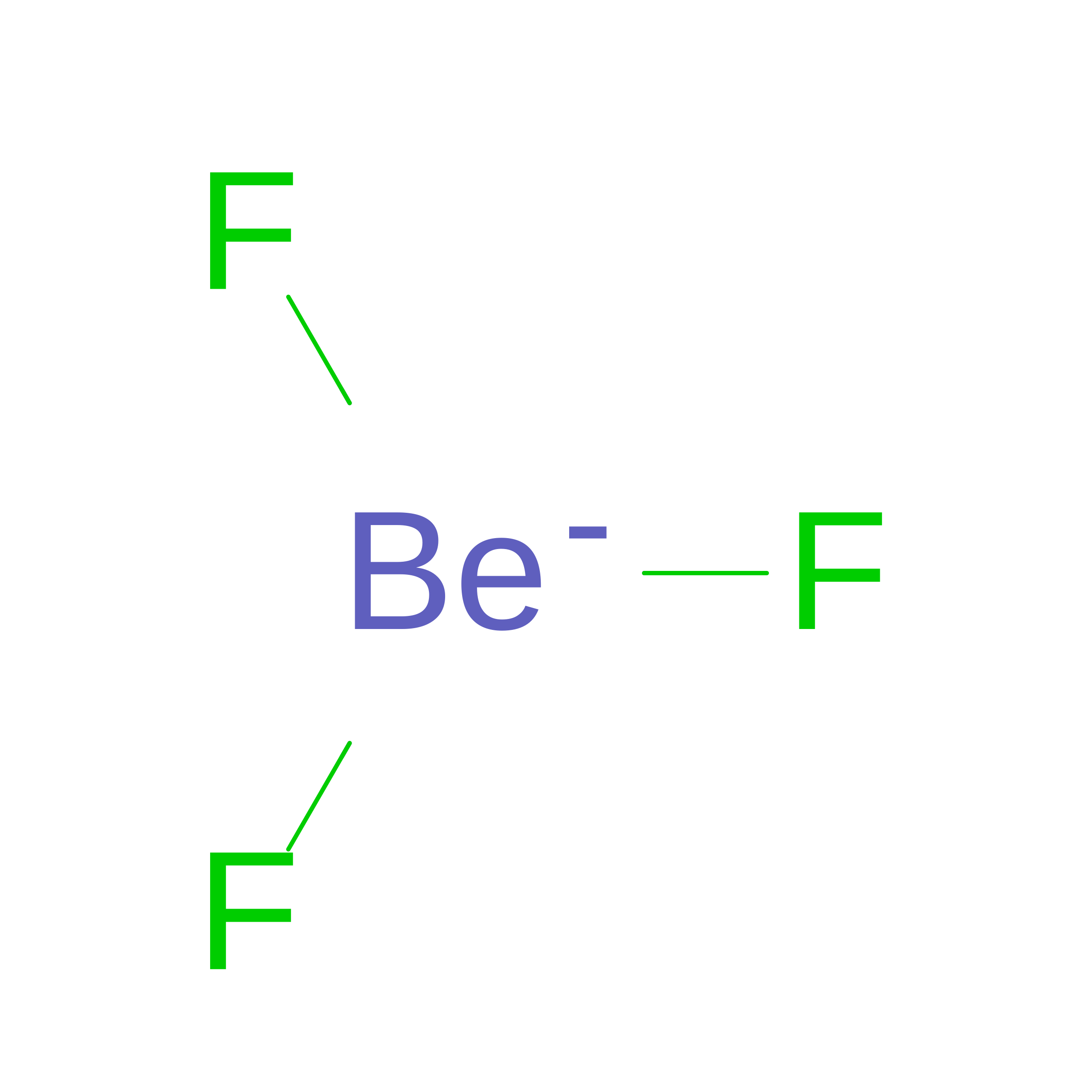
Crystal Structure Of The Mg+2/BeF3-Bound Receiver Domain Of Kdp Potassium Transport System Response Regulator KdpE


Experimental Data Snapshot

  • Method: X-RAY DIFFRACTION
  • Resolution: 2.20 Å
  • R-Value Free: 
    0.265 (Depositor), 0.266 (DCC) 
  • R-Value Work: 
    0.227 (Depositor), 0.226 (DCC) 
  • R-Value Observed: 
    0.229 (Depositor) 

Starting Model: experimental
View more details

wwPDB Validation 3D Report Full Report

Validation slider image for 1ZH4

This is version 1.4 of the entry. See complete history

Literature

A common dimerization interface in bacterial response regulators KdpE and TorR.

Toro-Roman, A.Wu, T.Stock, A.M.

(2005) Protein Sci 14: 3077-3088

  • DOI: https://doi.org/10.1110/ps.051722805
  • Primary Citation Related Structures: 
    1ZGZ, 1ZH2, 1ZH4

  • PubMed Abstract: 

    Bacterial response regulators are key regulatory proteins that function as the final elements of so-called two-component signaling systems. The activities of response regulators in vivo are modulated by phosphorylation that results from interactions between the response regulator and its cognate histidine protein kinase. The level of response regulator phosphorylation, which is regulated by intra-or extracellular signals sensed by the histidine protein kinase, ultimately determines the output response that is initiated or carried out by the response regulator. We have recently hypothesized that in the OmpR/PhoB subfamily of response regulator transcription factors, this activation involves a common mechanism of dimerization using a set of highly conserved residues in the alpha4-beta5-alpha5 face. Here we report the X-ray crystal structures of the regulatory domains of response regulators TorR (1.8 A), Ca(2+)-bound KdpE (2.0 A), and Mg(2+)/BeF(3)(-)-bound KdpE (2.2 A), both members of the OmpR/ PhoB subfamily from Escherichia coli. Both regulatory domains form symmetric dimers in the asymmetric unit that involve the alpha4-beta5-alpha5 face. As observed previously in other OmpR/PhoB response regulators, the dimer interfaces are mediated by highly conserved residues within this subfamily. These results provide further evidence that most all response regulators of the OmpR/ PhoB subfamily share a common mechanism of activation by dimerization.


  • Organizational Affiliation
    • Center for Advanced Biotechnology and Medicine, 679 Hoes Lane, Piscataway, NJ 08854, USA.

Macromolecule Content 

  • Total Structure Weight: 27.16 kDa 
  • Atom Count: 1,983 
  • Modeled Residue Count: 241 
  • Deposited Residue Count: 242 
  • Unique protein chains: 1

Macromolecules

Find similar proteins by:|  3D Structure
Entity ID: 1
MoleculeChains  Sequence LengthOrganismDetailsImage
KDP operon transcriptional regulatory protein kdpE
A, B
121Escherichia coliMutation(s): 1 
Gene Names: kdpE
UniProt
Find proteins for P21866 (Escherichia coli (strain K12))
Explore P21866 
Go to UniProtKB:  P21866
Entity Groups
Sequence Clusters30% Identity50% Identity70% Identity90% Identity95% Identity100% Identity
UniProt GroupP21866
Sequence Annotations
Expand
Reference Sequence

Experimental Data & Validation

Experimental Data

  • Method: X-RAY DIFFRACTION
  • Resolution: 2.20 Å
  • R-Value Free:  0.265 (Depositor), 0.266 (DCC) 
  • R-Value Work:  0.227 (Depositor), 0.226 (DCC) 
  • R-Value Observed: 0.229 (Depositor) 
Space Group: C 2 2 21
Unit Cell:
Length ( Å )Angle ( ˚ )
a = 70.912α = 90
b = 126.675β = 90
c = 62.655γ = 90
Software Package:
Software NamePurpose
REFMACrefinement
DENZOdata reduction
SCALEPACKdata scaling
PHASERphasing

Structure Validation

View Full Validation Report


Entry History 

Deposition Data

Revision History  (Full details and data files)

  • Version 1.0: 2005-12-13
    Type: Initial release
  • Version 1.1: 2008-04-30
    Changes: Version format compliance
  • Version 1.2: 2011-07-13
    Changes: Version format compliance
  • Version 1.3: 2021-10-20
    Changes: Database references, Derived calculations
  • Version 1.4: 2023-08-23
    Changes: Data collection, Refinement description