1ZCH | pdb_00001zch

Structure of the hypothetical oxidoreductase YcnD from Bacillus subtilis


Experimental Data Snapshot

  • Method: X-RAY DIFFRACTION
  • Resolution: 1.85 Å
  • R-Value Free: 
    0.197 (Depositor), 0.176 (DCC) 
  • R-Value Work: 
    0.171 (Depositor), 0.175 (DCC) 
  • R-Value Observed: 
    0.171 (Depositor) 

Starting Model: experimental
View more details

wwPDB Validation 3D Report Full Report

Validation slider image for 1ZCH

Ligand Structure Quality Assessment 


This is version 1.4 of the entry. See complete history

Literature

Structure and Function of YcnD from Bacillus subtilis, a Flavin-Containing Oxidoreductase(,).

Morokutti, A.Lyskowski, A.Sollner, S.Pointner, E.Fitzpatrick, T.B.Kratky, C.Gruber, K.Macheroux, P.

(2005) Biochemistry 44: 13724-13733

  • DOI: https://doi.org/10.1021/bi0510835
  • Primary Citation Related Structures: 
    1ZCH

  • PubMed Abstract: 

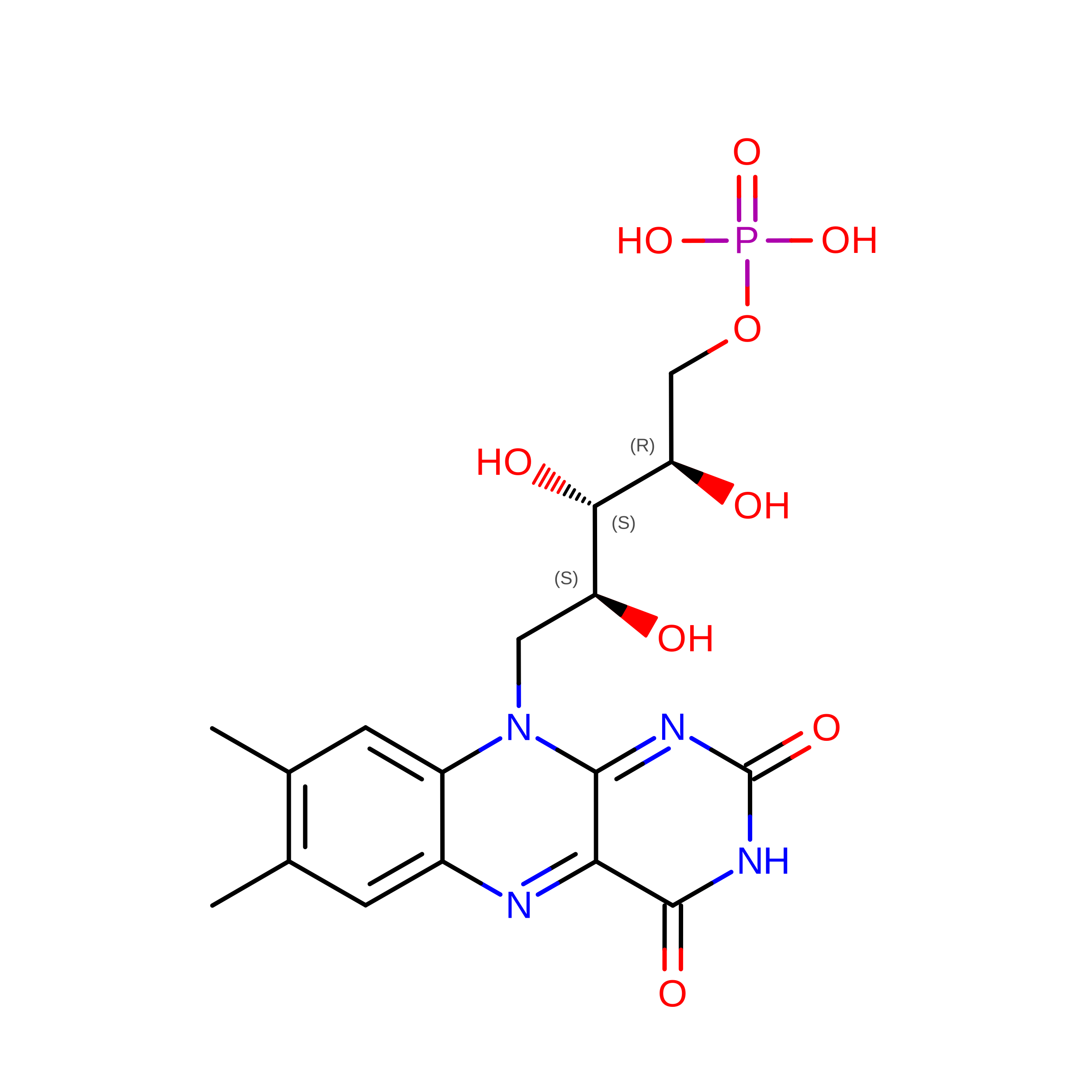
    YcnD from the gram-positive bacterium Bacillus subtilis is a member of a family of bacterial proteins that act as NADH- and/or NADPH-dependent oxidoreductases. Here, we report for the first time on the biochemical characterization of the purified protein, demonstrating that YcnD is an FMN-containing enzyme that can be reduced by NADH or NADPH (Km = 6.4 and 4.4 microM, respectively). In the presence of free FMN as the electron-accepting substrate, the latter reductant showed a ping-pong Bi-Bi reaction mechanism, whereas utilization of NADH is competitively inhibited by this substrate. This finding suggests that NADPH is the physiological reductant of the enzyme. We also show that YcnD reduces nitro-organic compounds, chromate, and a series of azo dyes. The reduction of azo dyes appears to be mediated by free reduced FMN because the reaction is considerably slower in its absence. Structure determination by X-ray crystallography revealed that YcnD folds into a three layer alpha-beta-alpha sandwich strongly resembling the topology of the NADH oxidase superfamily. Similar to homologous bacterial oxidoreductase, YcnD forms homodimers with an extended dimer interface. The biochemical data and the structure are discussed in light of the putative physiological function of YcnD as an oxidoreductase delivering reduced FMN to enzymes that require the reduced cofactor for activity.


  • Organizational Affiliation
    • Institut für Biochemie, Technische Universität Graz, A-8010 Graz, Austria.

Macromolecule Content 

  • Total Structure Weight: 29.26 kDa 
  • Atom Count: 2,288 
  • Modeled Residue Count: 249 
  • Deposited Residue Count: 255 
  • Unique protein chains: 1

Macromolecules

Find similar proteins by:|  3D Structure
Entity ID: 1
MoleculeChains  Sequence LengthOrganismDetailsImage
Hypothetical oxidoreductase ycnD255Bacillus subtilisMutation(s): 0 
Gene Names: ycnD
EC: 1 (PDB Primary Data), 1.5.1.39 (UniProt)
UniProt
Find proteins for P94424 (Bacillus subtilis (strain 168))
Explore P94424 
Go to UniProtKB:  P94424
Entity Groups
Sequence Clusters30% Identity50% Identity70% Identity90% Identity95% Identity100% Identity
UniProt GroupP94424
Sequence Annotations
Expand
Reference Sequence

Experimental Data & Validation

Experimental Data

  • Method: X-RAY DIFFRACTION
  • Resolution: 1.85 Å
  • R-Value Free:  0.197 (Depositor), 0.176 (DCC) 
  • R-Value Work:  0.171 (Depositor), 0.175 (DCC) 
  • R-Value Observed: 0.171 (Depositor) 
Space Group: C 2 2 21
Unit Cell:
Length ( Å )Angle ( ˚ )
a = 59.101α = 90
b = 89.075β = 90
c = 93.608γ = 90
Software Package:
Software NamePurpose
CNSrefinement
MAR345data collection
SCALEPACKdata scaling
EPMRphasing

Structure Validation

View Full Validation Report


Ligand Structure Quality Assessment 


Entry History 

Deposition Data

Revision History  (Full details and data files)

  • Version 1.0: 2005-11-01
    Type: Initial release
  • Version 1.1: 2008-04-30
    Changes: Version format compliance
  • Version 1.2: 2011-07-13
    Changes: Derived calculations, Version format compliance
  • Version 1.3: 2017-10-11
    Changes: Refinement description
  • Version 1.4: 2023-10-25
    Changes: Data collection, Database references, Derived calculations, Refinement description