1Z6R | pdb_00001z6r

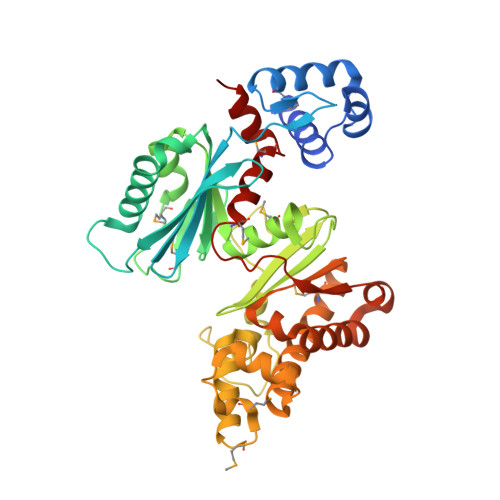
Crystal structure of Mlc from Escherichia coli


Experimental Data Snapshot

  • Method: X-RAY DIFFRACTION
  • Resolution: 2.70 Å
  • R-Value Free: 
    0.263 (Depositor), 0.258 (DCC) 
  • R-Value Work: 
    0.203 (Depositor), 0.201 (DCC) 
  • R-Value Observed: 
    0.206 (Depositor) 

wwPDB Validation 3D Report Full Report

Validation slider image for 1Z6R

This is version 1.5 of the entry. See complete history

Literature

The crystal structure of Mlc, a global regulator of sugar metabolism in Escherichia coli

Schiefner, A.Gerber, K.Seitz, S.Welte, W.Diederichs, K.Boos, W.

(2005) J Biological Chem 280: 29073-29079

  • DOI: https://doi.org/10.1074/jbc.M504215200
  • Primary Citation Related Structures: 
    1Z6R

  • PubMed Abstract: 

    Mlc from Escherichia coli is a transcriptional repressor controlling the expression of a number of genes encoding enzymes of the phosphotransferase system (PTS), including ptsG and manXYZ, the specific enzyme II for glucose and mannose PTS transporters. In addition, Mlc controls the transcription of malT, the gene of the global activator of the mal regulon. The inactivation of Mlc as a repressor is mediated by binding to an actively transporting PtsG (EIICB(Glc)). Here we report the crystal structure of Mlc at 2.7 A resolution representing the first described structure of an ROK (repressors, open reading frames, and kinases) family protein. Mlc forms stable dimers thus explaining its binding affinity to palindromic operator sites. The N-terminal helix-turn-helix domain of Mlc is stabilized by the amphipathic C-terminal helix implicated earlier in EIICB(Glc) binding. Furthermore, the structure revealed a metal-binding site within the cysteine-rich ROK consensus motif that coordinates a structurally important zinc ion. A strongly reduced repressor activity was observed when two of the zinc-coordinating cysteine residues were exchanged against serine or alanine, demonstrating the role of zinc in Mlc-mediated repressor function. The structures of a putative fructokinase from Bacillus subtilis, the glucokinase from Escherichia coli, and a glucomannokinase from Arthrobacter sp. showed high structural homology to the ROK family part of Mlc.


  • Organizational Affiliation
    • Department of Biology, University of Konstanz, Universitätsstrasse 10, 78457 Konstanz, Germany. andre.schiefner@uni-konstanz.de

Macromolecule Content 

  • Total Structure Weight: 179.52 kDa 
  • Atom Count: 11,728 
  • Modeled Residue Count: 1,528 
  • Deposited Residue Count: 1,624 
  • Unique protein chains: 1

Macromolecules

Find similar proteins by:|  3D Structure
Entity ID: 1
MoleculeChains  Sequence LengthOrganismDetailsImage
Mlc protein
A, B, C, D
406Escherichia coliMutation(s): 11 
Gene Names: mlc
UniProt
Find proteins for P50456 (Escherichia coli (strain K12))
Explore P50456 
Go to UniProtKB:  P50456
Entity Groups
Sequence Clusters30% Identity50% Identity70% Identity90% Identity95% Identity100% Identity
UniProt GroupP50456
Sequence Annotations
Expand
Reference Sequence

Experimental Data & Validation

Experimental Data

  • Method: X-RAY DIFFRACTION
  • Resolution: 2.70 Å
  • R-Value Free:  0.263 (Depositor), 0.258 (DCC) 
  • R-Value Work:  0.203 (Depositor), 0.201 (DCC) 
  • R-Value Observed: 0.206 (Depositor) 
Space Group: C 1 2 1
Unit Cell:
Length ( Å )Angle ( ˚ )
a = 235.95α = 90
b = 74.71β = 129.15
c = 154.95γ = 90
Software Package:
Software NamePurpose
REFMACrefinement
MAR345data collection
XDSdata scaling
SHELXDphasing
SHARPphasing
RESOLVEphasing

Structure Validation

View Full Validation Report


Entry History 

Deposition Data

Revision History  (Full details and data files)

  • Version 1.0: 2005-06-14
    Type: Initial release
  • Version 1.1: 2008-04-30
    Changes: Version format compliance
  • Version 1.2: 2011-07-13
    Changes: Advisory, Version format compliance
  • Version 1.3: 2017-10-11
    Changes: Refinement description
  • Version 1.4: 2021-11-10
    Changes: Database references, Derived calculations
  • Version 1.5: 2024-10-16
    Changes: Data collection, Refinement description, Structure summary