1Y7O | pdb_00001y7o

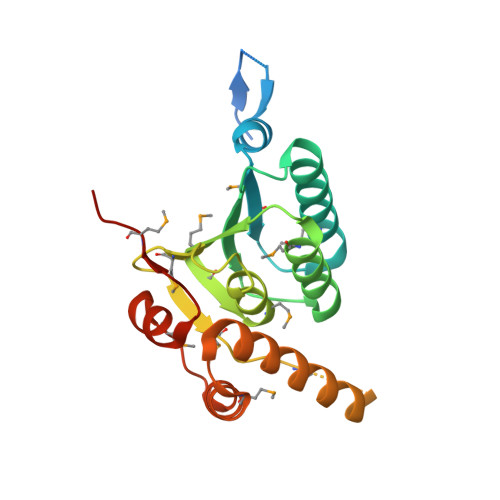
The structure of Streptococcus pneumoniae A153P ClpP


Experimental Data Snapshot

  • Method: X-RAY DIFFRACTION
  • Resolution: 2.51 Å
  • R-Value Free: 
    0.248 (Depositor), 0.251 (DCC) 
  • R-Value Work: 
    0.186 (Depositor), 0.194 (DCC) 
  • R-Value Observed: 
    0.192 (Depositor) 

Starting Model: experimental
View more details

wwPDB Validation 3D Report Full Report

Validation slider image for 1Y7O

This is version 1.7 of the entry. See complete history

Literature

The ClpP double ring tetradecameric protease exhibits plastic ring-ring interactions, and the N termini of its subunits form flexible loops that are essential for ClpXP and ClpAP complex formation.

Gribun, A.Kimber, M.S.Ching, R.Sprangers, R.Fiebig, K.M.Houry, W.A.

(2005) J Biological Chem 280: 16185-16196

  • DOI: https://doi.org/10.1074/jbc.M414124200
  • Primary Citation Related Structures: 
    1Y7O

  • PubMed Abstract: 

    ClpP is a conserved serine-protease with two heptameric rings that enclose a large chamber containing the protease active sites. Each ClpP subunit can be divided into a handle region, which mediates ring-ring interactions, and a head domain. ClpP associates with the hexameric ATPases ClpX and ClpA, which can unfold and translocate substrate proteins through the ClpP axial pores into the protease lumen for degradation. We have determined the x-ray structure of Streptococcus pneumoniae ClpP(A153P) at 2.5 A resolution. The structure revealed two novel features of ClpP which are essential for ClpXP and ClpAP functional activities. First, the Ala --> Pro mutation disrupts the handle region, resulting in an altered ring-ring dimerization interface, which, in conjunction with biochemical data, demonstrates the unusual plasticity of this region. Second, the structure shows the existence of a flexible N-terminal loop in each ClpP subunit. The loops line the axial pores in the ClpP tetradecamer and then protrude from the protease apical surface. The sequence of the N-terminal loop is highly conserved in ClpP across all kingdoms of life. These loops are essential determinants for complex formation between ClpP and ClpX/ClpA. Mutation of several amino acid residues in this loop or the truncation of the loop impairs ClpXP and ClpAP complex formation and prevents the coupling between ClpX/ClpA and ClpP activities.


  • Organizational Affiliation
    • Department of Biochemistry, University of Toronto, Toronto, Ontario M5S 1A8, Canada.

Macromolecule Content 

  • Total Structure Weight: 170.28 kDa 
  • Atom Count: 9,601 
  • Modeled Residue Count: 1,227 
  • Deposited Residue Count: 1,526 
  • Unique protein chains: 1

Macromolecules

Find similar proteins by:|  3D Structure
Entity ID: 1
MoleculeChains  Sequence LengthOrganismDetailsImage
ATP-dependent Clp protease proteolytic subunit
A, B, C, D, E
A, B, C, D, E, F, G
218Streptococcus pneumoniaeMutation(s): 13 
Gene Names: clpP
EC: 3.4.21.92
UniProt
Find proteins for P63788 (Streptococcus pneumoniae (strain ATCC BAA-255 / R6))
Explore P63788 
Go to UniProtKB:  P63788
Entity Groups
Sequence Clusters30% Identity50% Identity70% Identity90% Identity95% Identity100% Identity
UniProt GroupP63788
Sequence Annotations
Expand
Reference Sequence

Small Molecules

Modified Residues  1 Unique
IDChains TypeFormula2D DiagramParent
MSE
Query on MSE
A, B, C, D, E
A, B, C, D, E, F, G
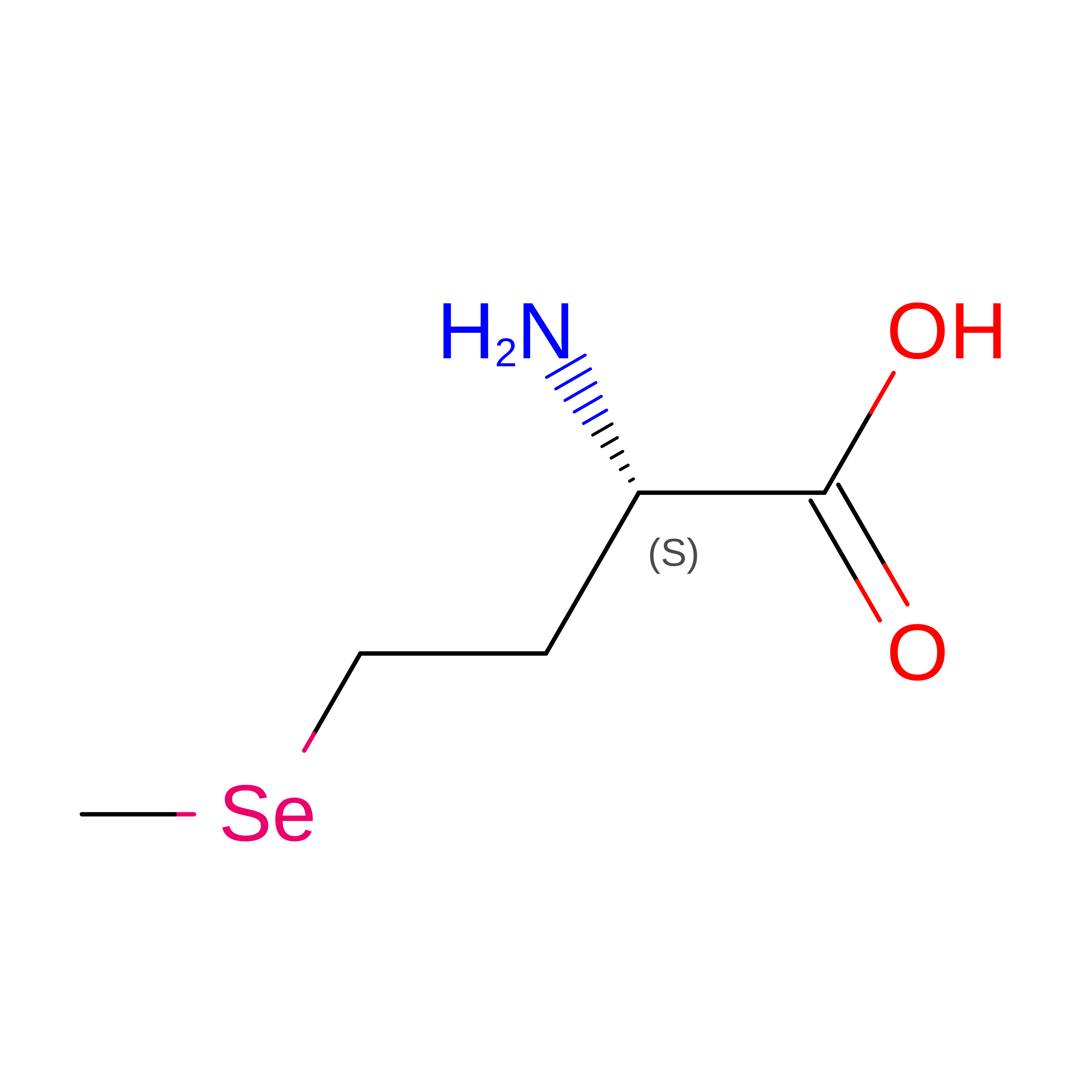
L-PEPTIDE LINKINGC5 H11 N O2 SeMET

Experimental Data & Validation

Experimental Data

  • Method: X-RAY DIFFRACTION
  • Resolution: 2.51 Å
  • R-Value Free:  0.248 (Depositor), 0.251 (DCC) 
  • R-Value Work:  0.186 (Depositor), 0.194 (DCC) 
  • R-Value Observed: 0.192 (Depositor) 
Space Group: P 32 2 1
Unit Cell:
Length ( Å )Angle ( ˚ )
a = 105.65α = 90
b = 105.65β = 90
c = 236.192γ = 120
Software Package:
Software NamePurpose
REFMACrefinement
HKL-2000data reduction
SCALEPACKdata scaling
CNXphasing
CNXrefinement

Structure Validation

View Full Validation Report


Entry History 

Deposition Data

Revision History  (Full details and data files)

  • Version 1.0: 2005-02-08
    Type: Initial release
  • Version 1.1: 2008-04-30
    Changes: Version format compliance
  • Version 1.2: 2011-07-13
    Changes: Advisory, Derived calculations, Version format compliance
  • Version 1.3: 2019-07-24
    Changes: Data collection, Derived calculations, Refinement description
  • Version 1.4: 2021-10-20
    Changes: Database references, Derived calculations
  • Version 1.5: 2023-08-23
    Changes: Data collection, Refinement description
  • Version 1.6: 2023-11-15
    Changes: Data collection
  • Version 1.7: 2024-11-13
    Changes: Structure summary