1WC5 | pdb_00001wc5

Soluble adenylyl cyclase CyaC from S. platensis in complex with alpha, beta-methylene-ATP in presence of bicarbonate


Experimental Data Snapshot

  • Method: X-RAY DIFFRACTION
  • Resolution: 2.30 Å
  • R-Value Free: 
    0.262 (Depositor), 0.275 (DCC) 
  • R-Value Work: 
    0.202 (Depositor), 0.217 (DCC) 
  • R-Value Observed: 
    0.202 (Depositor) 

Starting Model: experimental
View more details

wwPDB Validation 3D Report Full Report

Validation slider image for 1WC5

Ligand Structure Quality Assessment 


This is version 1.3 of the entry. See complete history

Literature

Bicarbonate Activation of Adenylyl Cyclase Via Promotion of Catalytic Active Site Closure and Metal Recruitment

Steegborn, C.Litvin, T.N.Levin, L.R.Buck, J.Wu, H.

(2005) Nat Struct Mol Biol 12: 32

  • DOI: https://doi.org/10.1038/nsmb880
  • Primary Citation Related Structures: 
    1WC0, 1WC1, 1WC3, 1WC4, 1WC5, 1WC6

  • PubMed Abstract: 

    In an evolutionarily conserved signaling pathway, 'soluble' adenylyl cyclases (sACs) synthesize the ubiquitous second messenger cyclic adenosine 3',5'-monophosphate (cAMP) in response to bicarbonate and calcium signals. Here, we present crystal structures of a cyanobacterial sAC enzyme in complex with ATP analogs, calcium and bicarbonate, which represent distinct catalytic states of the enzyme. The structures reveal that calcium occupies the first ion-binding site and directly mediates nucleotide binding. The single ion-occupied, nucleotide-bound state defines a novel, open adenylyl cyclase state. In contrast, bicarbonate increases the catalytic rate by inducing marked active site closure and recruiting a second, catalytic ion. The phosphates of the bound substrate analogs are rearranged, which would facilitate product formation and release. The mechanisms of calcium and bicarbonate sensing define a reaction pathway involving active site closure and metal recruitment that may be universal for class III cyclases.


  • Organizational Affiliation
    • Department of Biochemistry, Weill Medical College of Cornell University, 1300 York Avenue, New York, New York 10021, USA.

Macromolecule Content 

  • Total Structure Weight: 99.04 kDa 
  • Atom Count: 6,226 
  • Modeled Residue Count: 778 
  • Deposited Residue Count: 876 
  • Unique protein chains: 1

Macromolecules

Find similar proteins by:|  3D Structure
Entity ID: 1
MoleculeChains  Sequence LengthOrganismDetailsImage
ADENYLATE CYCLASE
A, B, C, D
219Limnospira platensisMutation(s): 0 
EC: 4.6.1.1 (PDB Primary Data), 2.7.13.3 (UniProt)
UniProt
Find proteins for O32393 (Limnospira platensis)
Explore O32393 
Go to UniProtKB:  O32393
Entity Groups
Sequence Clusters30% Identity50% Identity70% Identity90% Identity95% Identity100% Identity
UniProt GroupO32393
Sequence Annotations
Expand
Reference Sequence

Small Molecules

Ligands 3 Unique
IDChains Name / Formula / InChI Key2D Diagram3D Interactions
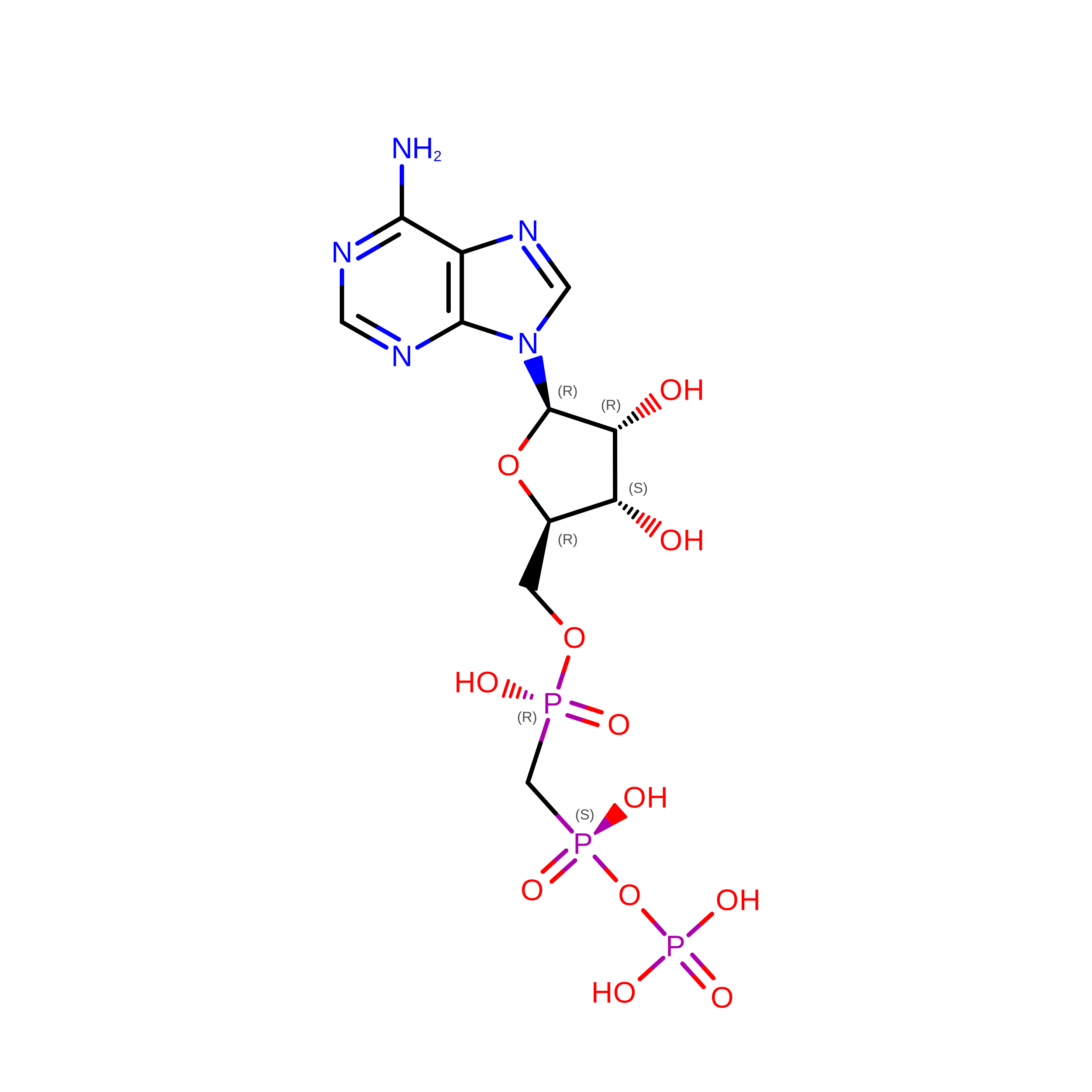
APC

Query on APC


Download:Ideal Coordinates CCD File
E [auth A],
H [auth B],
K [auth C],
N [auth D]
DIPHOSPHOMETHYLPHOSPHONIC ACID ADENOSYL ESTER
C11 H18 N5 O12 P3
CAWZRIXWFRFUQB-IOSLPCCCSA-N
CA

Query on CA


Download:Ideal Coordinates CCD File
G [auth A],
J [auth B],
M [auth C],
P [auth D]
CALCIUM ION
Ca
BHPQYMZQTOCNFJ-UHFFFAOYSA-N
MG

Query on MG


Download:Ideal Coordinates CCD File
F [auth A],
I [auth B],
L [auth C],
O [auth D]
MAGNESIUM ION
Mg
JLVVSXFLKOJNIY-UHFFFAOYSA-N

Experimental Data & Validation

Experimental Data

  • Method: X-RAY DIFFRACTION
  • Resolution: 2.30 Å
  • R-Value Free:  0.262 (Depositor), 0.275 (DCC) 
  • R-Value Work:  0.202 (Depositor), 0.217 (DCC) 
  • R-Value Observed: 0.202 (Depositor) 
Space Group: P 1 21 1
Unit Cell:
Length ( Å )Angle ( ˚ )
a = 53.303α = 90
b = 71.193β = 95.81
c = 106.733γ = 90
Software Package:
Software NamePurpose
CNSrefinement
DENZOdata reduction
SCALEPACKdata scaling
MOLREPphasing

Structure Validation

View Full Validation Report


Ligand Structure Quality Assessment 


Entry History 

Deposition Data

Revision History  (Full details and data files)

  • Version 1.0: 2004-12-20
    Type: Initial release
  • Version 1.1: 2011-05-08
    Changes: Version format compliance
  • Version 1.2: 2011-07-13
    Changes: Version format compliance
  • Version 1.3: 2023-12-13
    Changes: Data collection, Database references, Derived calculations, Other, Refinement description