1W26 | pdb_00001w26

Trigger Factor in Complex with the Ribosome forms a Molecular Cradle for Nascent Proteins


Experimental Data Snapshot

  • Method: X-RAY DIFFRACTION
  • Resolution: 2.70 Å
  • R-Value Free: 
    0.324 (Depositor) 
  • R-Value Work: 
    0.241 (Depositor) 
  • R-Value Observed: 
    0.241 (Depositor) 

wwPDB Validation 3D Report Full Report

Validation slider image for 1W26

This is version 1.3 of the entry. See complete history

Literature

Trigger Factor in Complex with the Ribosome Forms a Molecular Cradle for Nascent Proteins

Ferbitz, L.Maier, T.Patzelt, H.Bukau, B.Deuerling, E.Ban, N.

(2004) Nature 431: 590

  • DOI: https://doi.org/10.1038/nature02899
  • Primary Citation Related Structures: 
    1W26, 1W2B

  • PubMed Abstract: 

    During protein biosynthesis, nascent polypeptide chains that emerge from the ribosomal exit tunnel encounter ribosome-associated chaperones, which assist their folding to the native state. Here we present a 2.7 A crystal structure of Escherichia coli trigger factor, the best-characterized chaperone of this type, together with the structure of its ribosome-binding domain in complex with the Haloarcula marismortui large ribosomal subunit. Trigger factor adopts a unique conformation resembling a crouching dragon with separated domains forming the amino-terminal ribosome-binding 'tail', the peptidyl-prolyl isomerase 'head', the carboxy-terminal 'arms' and connecting regions building up the 'back'. From its attachment point on the ribosome, trigger factor projects the extended domains over the exit of the ribosomal tunnel, creating a protected folding space where nascent polypeptides may be shielded from proteases and aggregation. This study sheds new light on our understanding of co-translational protein folding, and suggests an unexpected mechanism of action for ribosome-associated chaperones.


  • Organizational Affiliation
    • Institut für Molekularbiologie und Biophysik, Eidgenössische Technische Hochschule Hönggerberg (ETH Zürich), HPK Gebäude, CH-8093 Zürich, Switzerland.

Macromolecule Content 

  • Total Structure Weight: 97.54 kDa 
  • Atom Count: 6,860 
  • Modeled Residue Count: 864 
  • Deposited Residue Count: 864 
  • Unique protein chains: 1

Macromolecules

Find similar proteins by:|  3D Structure
Entity ID: 1
MoleculeChains  Sequence LengthOrganismDetailsImage
TRIGGER FACTOR
A, B
432Escherichia coliMutation(s): 0 
EC: 5.2.1.8
UniProt
Find proteins for P0A850 (Escherichia coli (strain K12))
Explore P0A850 
Go to UniProtKB:  P0A850
Entity Groups
Sequence Clusters30% Identity50% Identity70% Identity90% Identity95% Identity100% Identity
UniProt GroupP0A850
Sequence Annotations
Expand
Reference Sequence

Small Molecules

Modified Residues  1 Unique
IDChains TypeFormula2D DiagramParent
MSE
Query on MSE
A, B
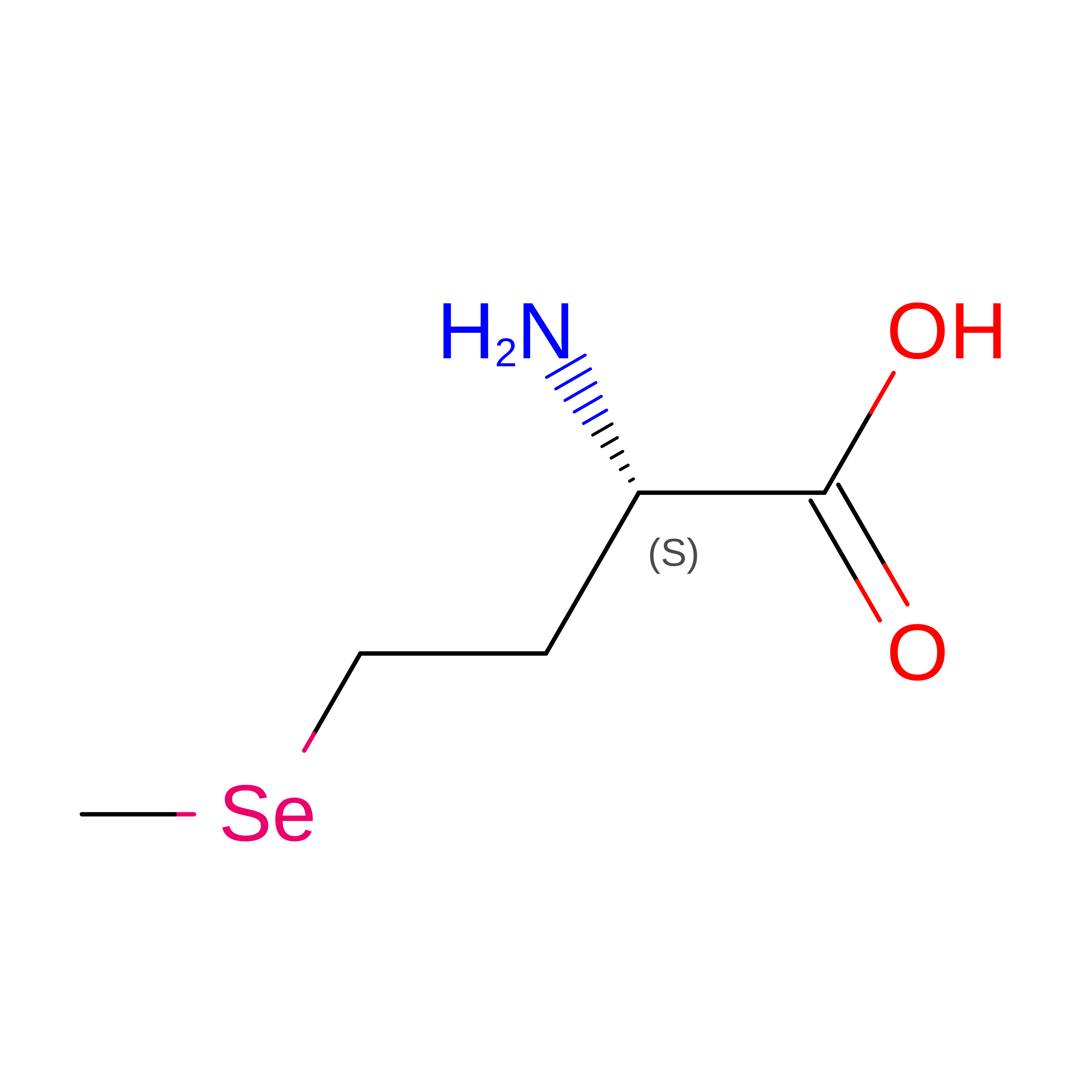
L-PEPTIDE LINKINGC5 H11 N O2 SeMET

Experimental Data & Validation

Experimental Data

  • Method: X-RAY DIFFRACTION
  • Resolution: 2.70 Å
  • R-Value Free:  0.324 (Depositor) 
  • R-Value Work:  0.241 (Depositor) 
  • R-Value Observed: 0.241 (Depositor) 
Space Group: P 1 21 1
Unit Cell:
Length ( Å )Angle ( ˚ )
a = 100.251α = 90
b = 47.415β = 113.66
c = 114.831γ = 90
Software Package:
Software NamePurpose
CNSrefinement
DENZOdata reduction
SCALEPACKdata scaling

Structure Validation

View Full Validation Report


Entry History 

Deposition Data

Revision History  (Full details and data files)

  • Version 1.0: 2004-09-02
    Type: Initial release
  • Version 1.1: 2011-05-08
    Changes: Version format compliance
  • Version 1.2: 2011-07-13
    Changes: Version format compliance
  • Version 1.3: 2024-10-16
    Changes: Data collection, Database references, Derived calculations, Structure summary