1UNF | pdb_00001unf

The crystal structure of the eukaryotic FeSOD from Vigna unguiculata suggests a new enzymatic mechanism


Experimental Data Snapshot

  • Method: X-RAY DIFFRACTION
  • Resolution: 1.97 Å
  • R-Value Free: 
    0.192 (Depositor), 0.199 (DCC) 
  • R-Value Work: 
    0.148 (Depositor), 0.155 (DCC) 
  • R-Value Observed: 
    0.150 (Depositor) 

Starting Model: experimental
View more details

wwPDB Validation 3D Report Full Report

Validation slider image for 1UNF

This is version 1.3 of the entry. See complete history

Literature

The Crystal Structure of an Eukaryotic Iron Superoxide Dismutase Suggests Intersubunit Cooperation During Catalysis

Munoz, I.G.Moran, J.F.Becana, M.Montoya, G.

(2005) Protein Sci 14: 387

  • DOI: https://doi.org/10.1110/ps.04979505
  • Primary Citation Related Structures: 
    1UNF

  • PubMed Abstract: 

    Superoxide dismutases (SODs) are a family of metalloenzymes that catalyze the dismutation of superoxide anion radicals into molecular oxygen and hydrogen peroxide. Iron superoxide dismutases (FeSODs) are only expressed in some prokaryotes and plants. A new and highly active FeSOD with an unusual subcellular localization has recently been isolated from the plant Vigna unguiculata (cowpea). This protein functions as a homodimer and, in contrast to the other members of the SOD family, is localized to the cytosol. The crystal structure of the recombinant enzyme has been solved and the model refined to 1.97 A resolution. The superoxide anion binding site is located in a cleft close to the dimer interface. The coordination geometry of the Fe site is a distorted trigonal bipyramidal arrangement, whose axial ligands are His43 and a solvent molecule, and whose in-plane ligands are His95, Asp195, and His199. A comparison of the structural features of cowpea FeSOD with those of homologous SODs reveals subtle differences in regard to the metal-protein interactions, and confirms the existence of two regions that may control the traffic of substrate and product: one located near the Fe binding site, and another in the dimer interface. The evolutionary conservation of reciprocal interactions of both monomers in neighboring active sites suggests possible subunit cooperation during catalysis.


  • Organizational Affiliation
    • Structural Biology and Biocomputing Program, Spanish National Cancer Center (CNIO), Macromolecular Crystallography Group, c/o Melchor Fernández Almagro 3, 28029 Madrid, Spain.

Macromolecule Content 

  • Total Structure Weight: 26.8 kDa 
  • Atom Count: 1,909 
  • Modeled Residue Count: 214 
  • Deposited Residue Count: 238 
  • Unique protein chains: 1

Macromolecules

Find similar proteins by:|  3D Structure
Entity ID: 1
MoleculeChains  Sequence LengthOrganismDetailsImage
IRON SUPEROXIDE DISMUTASEA [auth X]238Vigna unguiculataMutation(s): 0 
EC: 1.15.1.1
UniProt
Find proteins for Q9M7R2 (Vigna unguiculata)
Explore Q9M7R2 
Go to UniProtKB:  Q9M7R2
Entity Groups
Sequence Clusters30% Identity50% Identity70% Identity90% Identity95% Identity100% Identity
UniProt GroupQ9M7R2
Sequence Annotations
Expand
Reference Sequence

Small Molecules

Ligands 1 Unique
IDChains Name / Formula / InChI Key2D Diagram3D Interactions
FE

Query on FE


Download:Ideal Coordinates CCD File
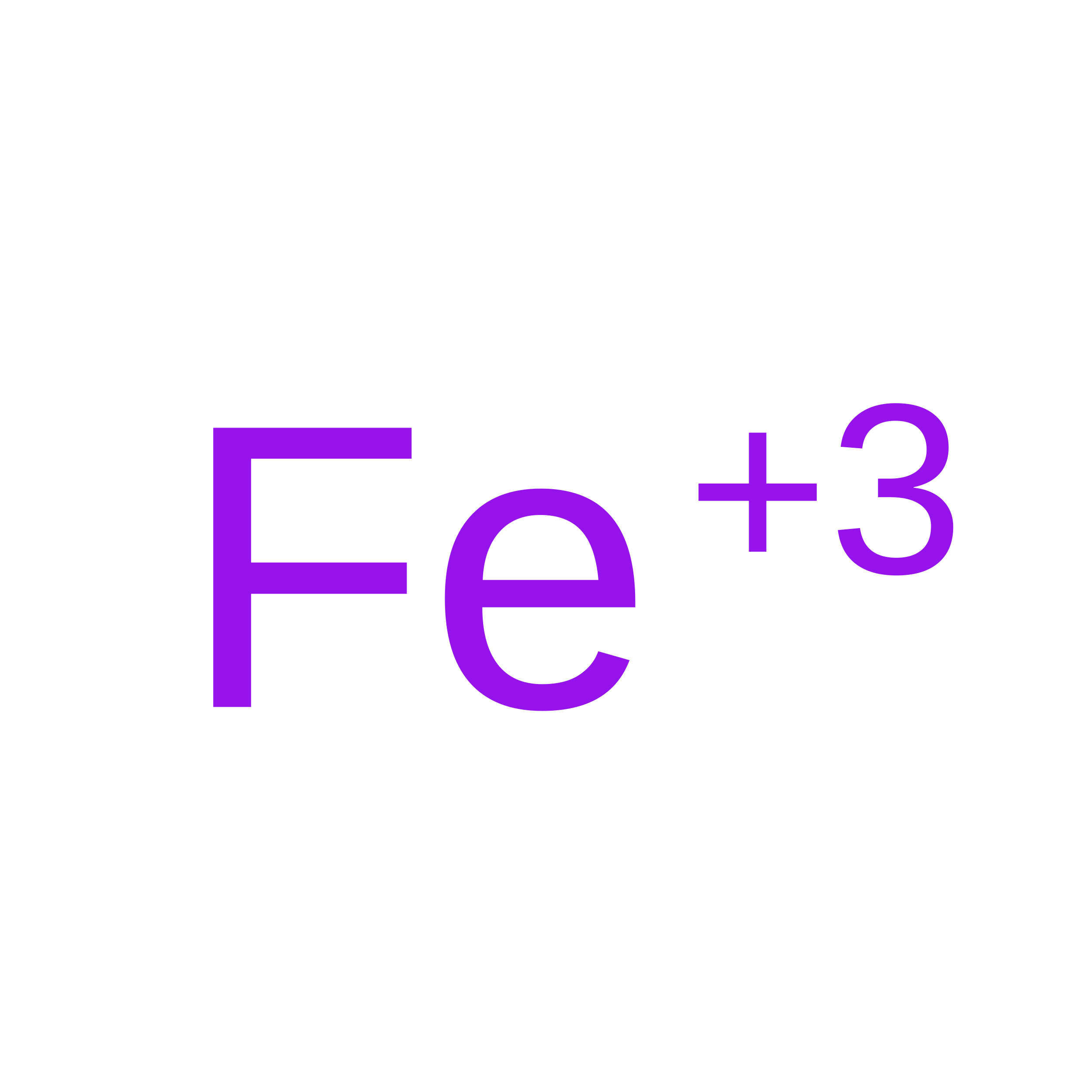
B [auth X]FE (III) ION
Fe
VTLYFUHAOXGGBS-UHFFFAOYSA-N

Experimental Data & Validation

Experimental Data

  • Method: X-RAY DIFFRACTION
  • Resolution: 1.97 Å
  • R-Value Free:  0.192 (Depositor), 0.199 (DCC) 
  • R-Value Work:  0.148 (Depositor), 0.155 (DCC) 
  • R-Value Observed: 0.150 (Depositor) 
Space Group: C 1 2 1
Unit Cell:
Length ( Å )Angle ( ˚ )
a = 81.985α = 90
b = 48.163β = 119.76
c = 63.671γ = 90
Software Package:
Software NamePurpose
REFMACrefinement
MOSFLMdata reduction
SCALAdata scaling
EPMRphasing

Structure Validation

View Full Validation Report


Entry History 

Deposition Data

Revision History  (Full details and data files)

  • Version 1.0: 2004-10-27
    Type: Initial release
  • Version 1.1: 2011-05-08
    Changes: Version format compliance
  • Version 1.2: 2011-07-13
    Changes: Version format compliance
  • Version 1.3: 2023-12-13
    Changes: Data collection, Database references, Derived calculations, Refinement description