1U5Z | pdb_00001u5z

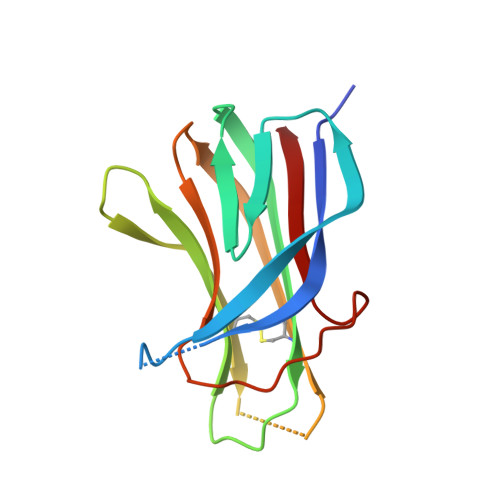
The Crystal structure of murine APRIL, pH 8.5


Experimental Data Snapshot

  • Method: X-RAY DIFFRACTION
  • Resolution: 2.40 Å
  • R-Value Free: 
    0.265 (Depositor), 0.273 (DCC) 
  • R-Value Work: 
    0.219 (Depositor), 0.222 (DCC) 
  • R-Value Observed: 
    0.223 (Depositor) 

Starting Model: experimental
View more details

wwPDB Validation 3D Report Full Report

Validation slider image for 1U5Z

This is version 1.4 of the entry. See complete history

Literature

The Crystal Structure of A Proliferation-inducing Ligand, APRIL.

Wallweber, H.J.Compaan, D.M.Starovasnik, M.A.Hymowitz, S.G.

(2004) J Mol Biology 343: 283-290

  • DOI: https://doi.org/10.1016/j.jmb.2004.08.040
  • Primary Citation Related Structures: 
    1U5X, 1U5Y, 1U5Z

  • PubMed Abstract: 

    A proliferation-inducing ligand (APRIL) is a TNF-like cytokine that stimulates tumor cell growth. Within the TNF ligand superfamily, APRIL is most similar to B-cell activation factor (BAFF) with which it shares 30% sequence identity. APRIL binds the receptors B-cell maturation antigen (BCMA) and TACI with high affinity; both of these receptors have also been shown to bind BAFF, although BCMA has significantly higher affinity for APRIL than BAFF. Determination of the crystal structure of APRIL from three crystallization conditions at resolutions of 1.8-2.4A over a pH range from 5.0 to 8.5 reveals a compact trimeric ligand with a backbone fold very similar to that of BAFF (1.1A RMSD over 122 structurally equivalent Calpha atoms), with the exception of differences in the AA' and DE loop regions. Whereas BAFF has been shown to form 20-trimer assemblies under certain conditions, the molecular determinants required for BAFF-like assemblies are absent in the APRIL structure. No crystal packing suggestive of the formation of higher-order assemblies is seen in any of the crystal forms nor does the structure vary significantly between pH 5.0 and 8.5. Modeling of the APRIL-BCMA complex shows the resulting interface is in agreement with mutagenesis data.


  • Organizational Affiliation
    • Department of Protein Engineering, Genentech, Inc., 1 DNA Way, South San Francisco, CA 94080, USA.

Macromolecule Content 

  • Total Structure Weight: 15.76 kDa 
  • Atom Count: 1,007 
  • Modeled Residue Count: 128 
  • Deposited Residue Count: 140 
  • Unique protein chains: 1

Macromolecules

Find similar proteins by:|  3D Structure
Entity ID: 1
MoleculeChains  Sequence LengthOrganismDetailsImage
Tumor necrosis factor ligand superfamily member 13140Mus musculusMutation(s): 0 
Gene Names: Tnfsf13APRIL
UniProt
Find proteins for Q9D777 (Mus musculus)
Explore Q9D777 
Go to UniProtKB:  Q9D777
Entity Groups
Sequence Clusters30% Identity50% Identity70% Identity90% Identity95% Identity100% Identity
UniProt GroupQ9D777
Sequence Annotations
Expand
Reference Sequence

Small Molecules

Ligands 1 Unique
IDChains Name / Formula / InChI Key2D Diagram3D Interactions
NI

Query on NI


Download:Ideal Coordinates CCD File
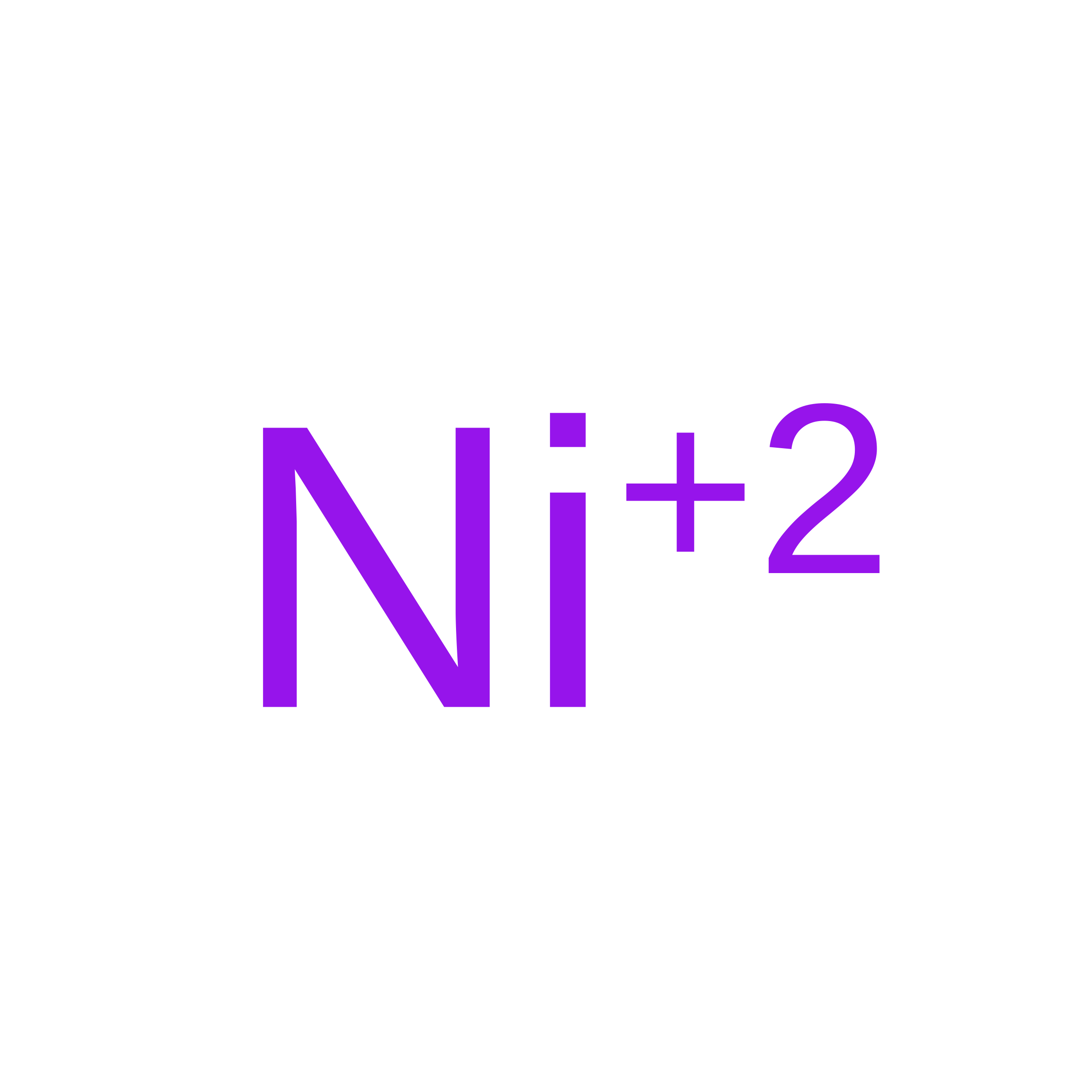
B [auth A]NICKEL (II) ION
Ni
VEQPNABPJHWNSG-UHFFFAOYSA-N

Experimental Data & Validation

Experimental Data

  • Method: X-RAY DIFFRACTION
  • Resolution: 2.40 Å
  • R-Value Free:  0.265 (Depositor), 0.273 (DCC) 
  • R-Value Work:  0.219 (Depositor), 0.222 (DCC) 
  • R-Value Observed: 0.223 (Depositor) 
Space Group: I 2 3
Unit Cell:
Length ( Å )Angle ( ˚ )
a = 92.166α = 90
b = 92.166β = 90
c = 92.166γ = 90
Software Package:
Software NamePurpose
REFMACrefinement
HKL-2000data reduction
SCALEPACKdata scaling
AMoREphasing

Structure Validation

View Full Validation Report


Entry History 

Deposition Data

Revision History  (Full details and data files)

  • Version 1.0: 2004-10-12
    Type: Initial release
  • Version 1.1: 2008-04-30
    Changes: Version format compliance
  • Version 1.2: 2011-07-13
    Changes: Advisory, Derived calculations, Version format compliance
  • Version 1.3: 2023-08-23
    Changes: Data collection, Database references, Derived calculations, Refinement description
  • Version 1.4: 2024-11-06
    Changes: Structure summary