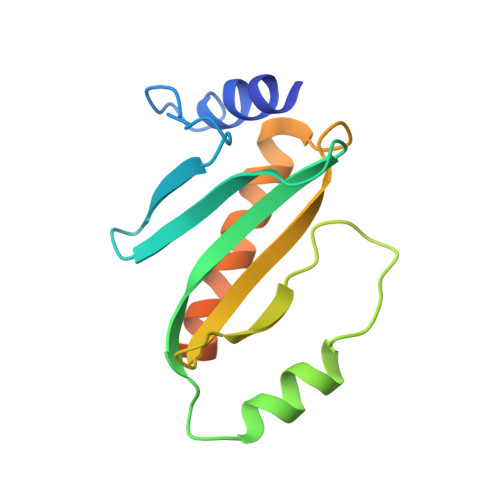
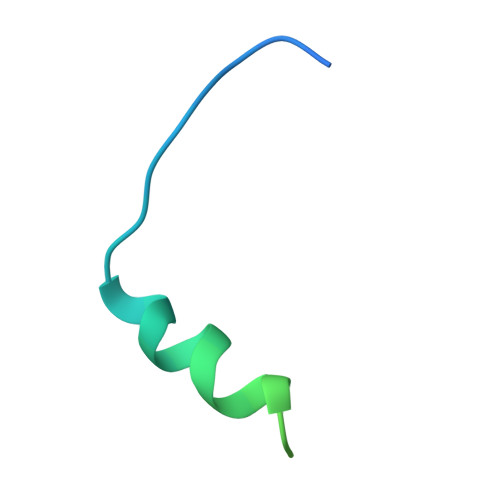
1TTW | pdb_00001ttw

Crystal structure of the Yersinia Pestis type III secretion chaperone SycH in complex with a stable fragment of YscM2


Experimental Data Snapshot

  • Method: X-RAY DIFFRACTION
  • Resolution: 2.38 Å
  • R-Value Free: 
    0.292 (Depositor), 0.249 (DCC) 
  • R-Value Work: 
    0.243 (Depositor), 0.257 (DCC) 
  • R-Value Observed: 
    0.245 (Depositor) 

wwPDB Validation 3D Report Full Report

Validation slider image for 1TTW

This is version 1.4 of the entry. See complete history

Literature

Structure of the Yersinia pestis type III secretion chaperone SycH in complex with a stable fragment of YscM2.

Phan, J.Tropea, J.E.Waugh, D.S.

(2004) Acta Crystallogr D Biol Crystallogr 60: 1591-1599

  • DOI: https://doi.org/10.1107/S0907444904017597
  • Primary Citation Related Structures: 
    1TTW

  • PubMed Abstract: 

    Pathogenic Yersinia species use a type III secretion system to inject cytotoxic effector proteins directly into the cytosol of mammalian cells, where they neutralize the innate immune response by interfering with the signal-transduction pathways that control phagocytosis and inflammation. To be exported efficiently, some effectors must transiently associate with cognate cytoplasmic secretion chaperones. SycH is the chaperone for YopH, a potent eukaryotic-like protein tyrosine phosphatase that is essential for virulence. SycH also binds two negative regulators of type III secretion, YscM1 and YscM2, both of which share significant sequence homology with the chaperone-binding domain of YopH. Here, the structure of a complex between SycH and a stable fragment of YscM2 that was designed on the basis of limited proteolysis experiments is presented. The overall fold of SycH is very similar to the structures of other homodimeric secretion chaperones that have been determined to date. YscM2 wraps around SycH in an extended fashion, with some secondary but no tertiary structure, assuming a conformation distinct from the globular fold that it is predicted to adopt in the absence of SycH.


  • Organizational Affiliation
    • Protein Engineering Section, Macromolecular Crystallography Laboratory, Center for Cancer Research, National Cancer Institute at Frederick, PO Box B, Frederick, MD 21702, USA.

Macromolecule Content 

  • Total Structure Weight: 21.99 kDa 
  • Atom Count: 1,034 
  • Modeled Residue Count: 138 
  • Deposited Residue Count: 194 
  • Unique protein chains: 2

Macromolecules

Find similar proteins by:|  3D Structure
Entity ID: 1
MoleculeChains  Sequence LengthOrganismDetailsImage
secretion chaperone138Yersinia pestis CO92Mutation(s): 0 
UniProt
Find proteins for Q7BTX0 (Yersinia pestis)
Explore Q7BTX0 
Go to UniProtKB:  Q7BTX0
Entity Groups
Sequence Clusters30% Identity50% Identity70% Identity90% Identity95% Identity100% Identity
UniProt GroupQ7BTX0
Sequence Annotations
Expand
Reference Sequence
Find similar proteins by:|  3D Structure
Entity ID: 2
MoleculeChains  Sequence LengthOrganismDetailsImage
YscM256N/AMutation(s): 0 
UniProt
Find proteins for Q93KQ4 (Yersinia enterocolitica)
Explore Q93KQ4 
Go to UniProtKB:  Q93KQ4
Entity Groups
Sequence Clusters30% Identity50% Identity70% Identity90% Identity95% Identity100% Identity
UniProt GroupQ93KQ4
Sequence Annotations
Expand
Reference Sequence

Experimental Data & Validation

Experimental Data

  • Method: X-RAY DIFFRACTION
  • Resolution: 2.38 Å
  • R-Value Free:  0.292 (Depositor), 0.249 (DCC) 
  • R-Value Work:  0.243 (Depositor), 0.257 (DCC) 
  • R-Value Observed: 0.245 (Depositor) 
Space Group: P 61 2 2
Unit Cell:
Length ( Å )Angle ( ˚ )
a = 63.664α = 90
b = 63.664β = 90
c = 162.263γ = 120
Software Package:
Software NamePurpose
REFMACrefinement
MAR345data collection
SCALEPACKdata scaling
SOLVEphasing

Structure Validation

View Full Validation Report


Entry History 

Deposition Data

Revision History  (Full details and data files)

  • Version 1.0: 2004-08-31
    Type: Initial release
  • Version 1.1: 2008-04-30
    Changes: Version format compliance
  • Version 1.2: 2011-07-13
    Changes: Derived calculations, Source and taxonomy, Version format compliance
  • Version 1.3: 2017-10-11
    Changes: Refinement description
  • Version 1.4: 2024-02-14
    Changes: Data collection, Database references, Derived calculations