Download Mendeley
The alpha2delta auxiliary subunit reduces affinity of omega-conotoxins for recombinant N-type (Cav2.2) calcium channels
Mould, J., Yasuda, T., Schroeder, C.I., Beedle, A.M., Doering, C.J., Zamponi, G.W., Adams, D.J., Lewis, R.J.(2004) J Biol Chem 279: 34705-34714
- PubMed: 15166237 Search on PubMed
- DOI: https://doi.org/10.1074/jbc.M310848200
- Primary Citation Related Structures:
1TR6, 1TTL - PubMed Abstract:
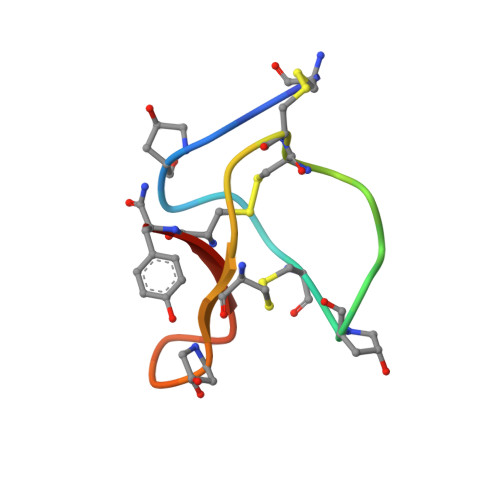
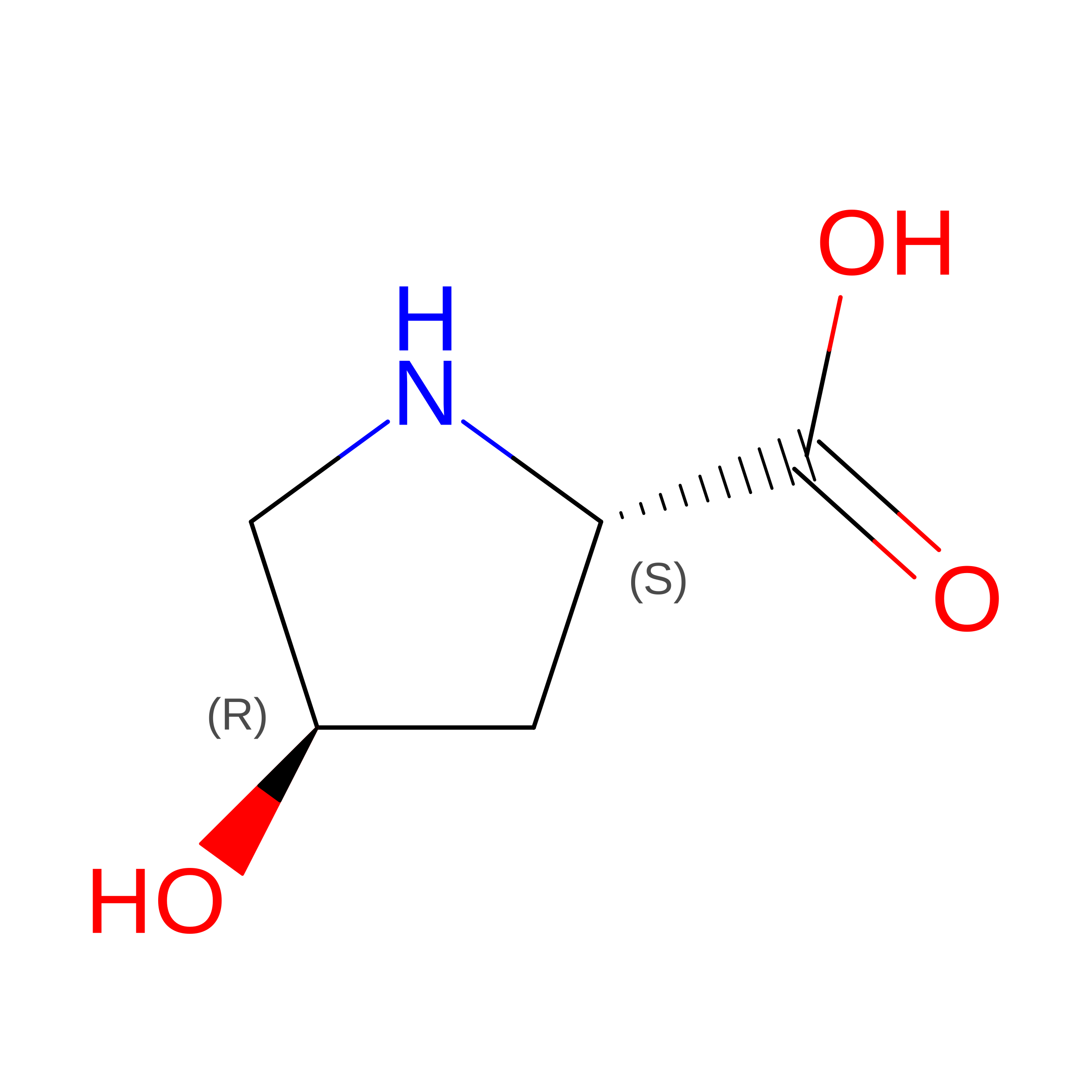
The omega-conotoxins from fish-hunting cone snails are potent inhibitors of voltage-gated calcium channels. The omega-conotoxins MVIIA and CVID are selective N-type calcium channel inhibitors with potential in the treatment of chronic pain. The beta and alpha(2)delta-1 auxiliary subunits influence the expression and characteristics of the alpha(1B) subunit of N-type channels and are differentially regulated in disease states, including pain. In this study, we examined the influence of these auxiliary subunits on the ability of the omega-conotoxins GVIA, MVIIA, CVID and analogues to inhibit peripheral and central forms of the rat N-type channels. Although the beta3 subunit had little influence on the on- and off-rates of omega-conotoxins, coexpression of alpha(2)delta with alpha(1B) significantly reduced on-rates and equilibrium inhibition at both the central and peripheral isoforms of the N-type channels. The alpha(2)delta also enhanced the selectivity of MVIIA, but not CVID, for the central isoform. Similar but less pronounced trends were also observed for N-type channels expressed in human embryonic kidney cells. The influence of alpha(2)delta was not affected by oocyte deglycosylation. The extent of recovery from the omega-conotoxin block was least for GVIA, intermediate for MVIIA, and almost complete for CVID. Application of a hyperpolarizing holding potential (-120 mV) did not significantly enhance the extent of CVID recovery. Interestingly, [R10K]MVIIA and [O10K]GVIA had greater recovery from the block, whereas [K10R]CVID had reduced recovery from the block, indicating that position 10 had an important influence on the extent of omega-conotoxin reversibility. Recovery from CVID block was reduced in the presence of alpha(2)delta in human embryonic kidney cells and in oocytes expressing alpha(1B-b). These results may have implications for the antinociceptive properties of omega-conotoxins, given that the alpha(2)delta subunit is up-regulated in certain pain states.
- Institute for Molecular Bioscience, University of Queensland, Queensland 4072, Australia.
Organizational Affiliation: