1TI1 | pdb_00001ti1

crystal structure of a mutant DsbA


Experimental Data Snapshot

  • Method: X-RAY DIFFRACTION
  • Resolution: 2.60 Å
  • R-Value Free: 
    0.279 (Depositor), 0.298 (DCC) 
  • R-Value Work: 
    0.247 (Depositor), 0.246 (DCC) 

Starting Model: experimental
View more details

wwPDB Validation 3D Report Full Report

Validation slider image for 1TI1

Ligand Structure Quality Assessment 


This is version 1.5 of the entry. See complete history

Literature

Intriguing conformation changes associated with the trans/cis isomerization of a prolyl residue in the active site of the DsbA C33A mutant.

Ondo-Mbele, E.Vives, C.Kone, A.Serre, L.

(2005) J Mol Biology 347: 555-563

  • DOI: https://doi.org/10.1016/j.jmb.2005.01.049
  • Primary Citation Related Structures: 
    1TI1, 1U3A

  • PubMed Abstract: 

    Escherichia coli DsbA belongs to the thioredoxin family and catalyzes the formation of disulfide bonds during the folding of proteins in the bacterial periplasm. It active site (C30-P31-H32-C33) consists of a disulfide bridge that is transferred to newly translocated proteins. The work reported here refers to the DsbA mutant termed C33A that retains, towards reduced unfolded thrombin inhibitor, an activity comparable with the wild-type enzyme. Besides, C33A is also able to form a stable covalent complex with DsbB, the membrane protein responsible for maintaining DsbA in its active form. We have determined the crystal structure of C33A at 2.0 angstroms resolution. Although the general architecture of wt DsbA is conserved, we observe the trans/cis isomerization of P31 in the active site and further conformational changes in the so-called "peptide binding groove" region. Interestingly, these modifications involve residues that are specific to DsbA but not to the thioredoxin family fold. The C33A crystal structure exhibits as well a hydrophobic ligand bound close to the active site of the enzyme. The structural analysis of C33A may actually explain the peculiar behavior of this mutant in regards with its interaction with DsbB and thus provides new insights for understanding the catalytic cycle of DsbA.


  • Organizational Affiliation
    • Laboratoire des Protéines Membranaires, Institut de Biologie Structurale Jean-Pierre Ebel CEA/CNRS/UJF. 41, rue Jules Horowitz, 38027 Grenoble cedex 01, France.

Macromolecule Content 

  • Total Structure Weight: 21.29 kDa 
  • Atom Count: 1,476 
  • Modeled Residue Count: 186 
  • Deposited Residue Count: 189 
  • Unique protein chains: 1

Macromolecules

Find similar proteins by:|  3D Structure
Entity ID: 1
MoleculeChains  Sequence LengthOrganismDetailsImage
Thiol:disulfide interchange protein dsbA189Escherichia coli O157:H7Mutation(s): 1 
Gene Names: DSBAPPFADSFB3860Z5392ECS4783
UniProt
Find proteins for P0AEG4 (Escherichia coli (strain K12))
Explore P0AEG4 
Go to UniProtKB:  P0AEG4
Entity Groups
Sequence Clusters30% Identity50% Identity70% Identity90% Identity95% Identity100% Identity
UniProt GroupP0AEG4
Sequence Annotations
Expand
Reference Sequence

Small Molecules

Ligands 1 Unique
IDChains Name / Formula / InChI Key2D Diagram3D Interactions
D12

Query on D12


Download:Ideal Coordinates CCD File
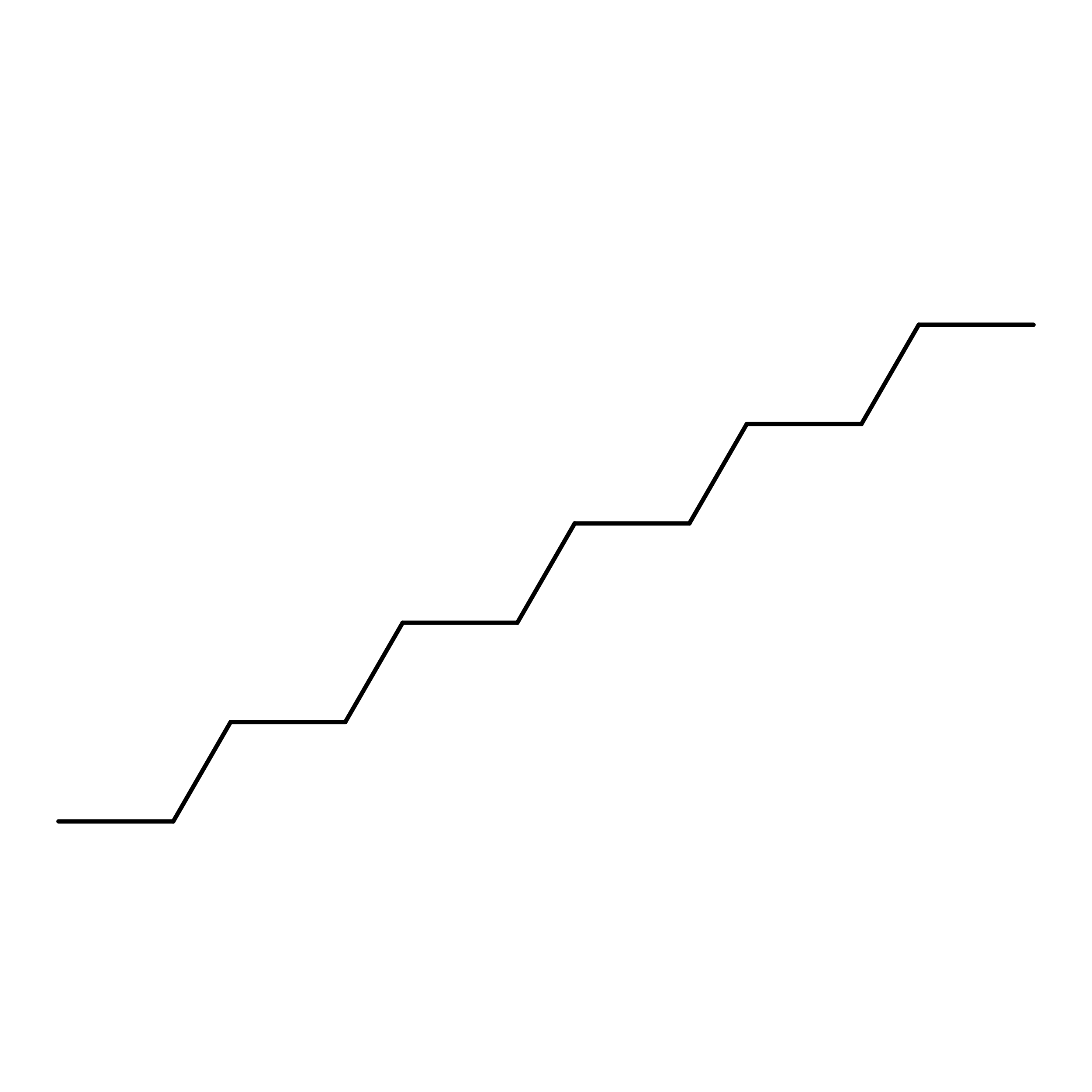
B [auth A]DODECANE
C12 H26
SNRUBQQJIBEYMU-UHFFFAOYSA-N

Experimental Data & Validation

Experimental Data

  • Method: X-RAY DIFFRACTION
  • Resolution: 2.60 Å
  • R-Value Free:  0.279 (Depositor), 0.298 (DCC) 
  • R-Value Work:  0.247 (Depositor), 0.246 (DCC) 
Space Group: P 62
Unit Cell:
Length ( Å )Angle ( ˚ )
a = 57.16α = 90
b = 57.16β = 90
c = 109.8γ = 120
Software Package:
Software NamePurpose
MOSFLMdata reduction
SCALAdata scaling
AMoREphasing
CNSrefinement
CCP4data scaling

Structure Validation

View Full Validation Report


Ligand Structure Quality Assessment 


Entry History 

Deposition Data

Revision History  (Full details and data files)

  • Version 1.0: 2005-05-03
    Type: Initial release
  • Version 1.1: 2008-04-30
    Changes: Version format compliance
  • Version 1.2: 2011-07-13
    Changes: Source and taxonomy, Version format compliance
  • Version 1.3: 2021-10-27
    Changes: Database references, Derived calculations
  • Version 1.4: 2023-08-23
    Changes: Data collection, Refinement description
  • Version 1.5: 2024-10-30
    Changes: Structure summary