1T3S | pdb_00001t3s

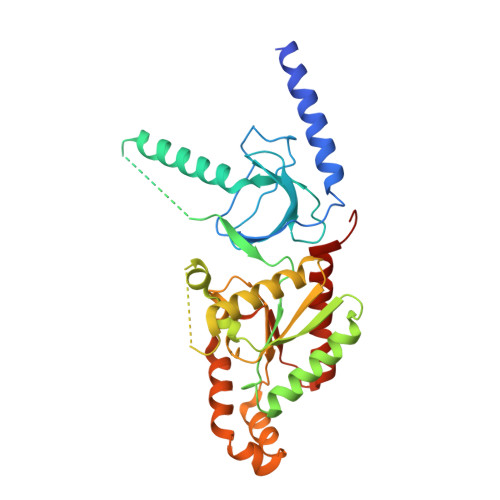
Structural Analysis of the Voltage-Dependent Calcium Channel Beta Subunit Functional Core


Experimental Data Snapshot

  • Method: X-RAY DIFFRACTION
  • Resolution: 2.30 Å
  • R-Value Free: 
    0.277 (Depositor) 
  • R-Value Work: 
    0.261 (Depositor) 
  • R-Value Observed: 
    0.262 (Depositor) 

Starting Model: experimental
View more details

wwPDB Validation 3D Report Full Report

Validation slider image for 1T3S

This is version 1.7 of the entry. See complete history

Literature

Structural analysis of the voltage-dependent calcium channel beta subunit functional core and its complex with the alpha 1 interaction domain.

Opatowsky, Y.Chen, C.C.Campbell, K.P.Hirsch, J.A.

(2004) Neuron 42: 387-399

  • DOI: https://doi.org/10.1016/s0896-6273(04)00250-8
  • Primary Citation Related Structures: 
    1T3L, 1T3S

  • PubMed Abstract: 

    Voltage-dependent calcium channels (VDCC) are multiprotein assemblies that regulate the entry of extracellular calcium into electrically excitable cells and serve as signal transduction centers. The alpha1 subunit forms the membrane pore while the intracellular beta subunit is responsible for trafficking of the channel to the plasma membrane and modulation of its electrophysiological properties. Crystallographic analyses of a beta subunit functional core alone and in complex with a alpha1 interaction domain (AID) peptide, the primary binding site of beta to the alpha1 subunit, reveal that beta represents a novel member of the MAGUK protein family. The findings illustrate how the guanylate kinase fold has been fashioned into a protein-protein interaction module by alteration of one of its substrate sites. Combined results indicate that the AID peptide undergoes a helical transition in binding to beta. We outline the mechanistic implications for understanding the beta subunit's broad regulatory role of the VDCC, particularly via the AID.


  • Organizational Affiliation
    • Department of Biochemistry, Faculty of Life Sciences, Tel Aviv University, Ramat Aviv 69978, Israel.

Macromolecule Content 

  • Total Structure Weight: 38.54 kDa 
  • Atom Count: 2,370 
  • Modeled Residue Count: 294 
  • Deposited Residue Count: 337 
  • Unique protein chains: 1

Macromolecules

Find similar proteins by:|  3D Structure
Entity ID: 1
MoleculeChains  Sequence LengthOrganismDetailsImage
Dihydropyridine-sensitive L-type, calcium channel beta-2 subunit337Oryctolagus cuniculusMutation(s): 1 
Gene Names: CACNB2CACNLB2
UniProt
Find proteins for P54288 (Oryctolagus cuniculus)
Explore P54288 
Go to UniProtKB:  P54288
Entity Groups
Sequence Clusters30% Identity50% Identity70% Identity90% Identity95% Identity100% Identity
UniProt GroupP54288
Sequence Annotations
Expand
Reference Sequence

Small Molecules

Ligands 1 Unique
IDChains Name / Formula / InChI Key2D Diagram3D Interactions
HG

Query on HG


Download:Ideal Coordinates CCD File
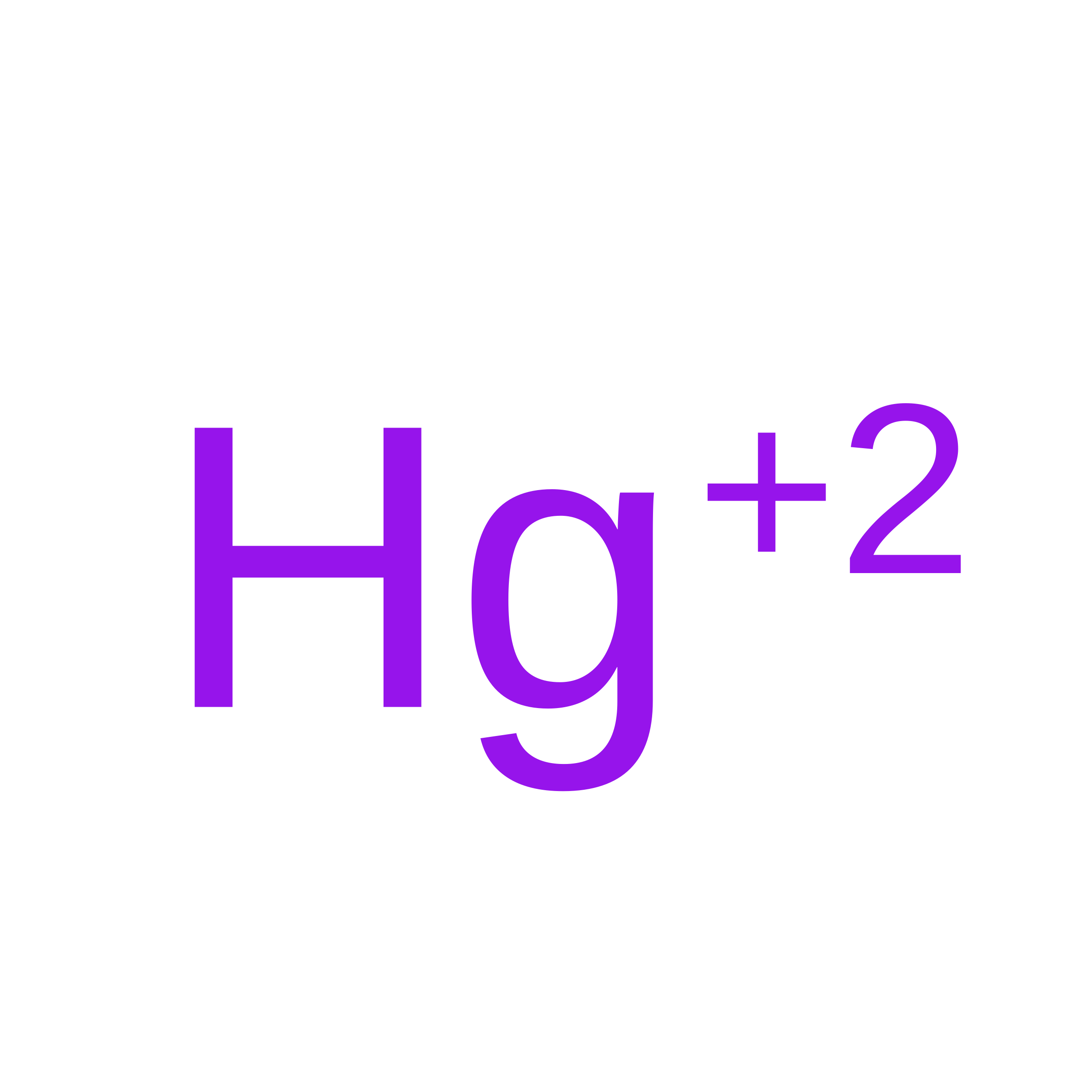
B [auth A]MERCURY (II) ION
Hg
BQPIGGFYSBELGY-UHFFFAOYSA-N

Experimental Data & Validation

Experimental Data

  • Method: X-RAY DIFFRACTION
  • Resolution: 2.30 Å
  • R-Value Free:  0.277 (Depositor) 
  • R-Value Work:  0.261 (Depositor) 
  • R-Value Observed: 0.262 (Depositor) 
Space Group: P 21 21 2
Unit Cell:
Length ( Å )Angle ( ˚ )
a = 74.066α = 90
b = 163.841β = 90
c = 34.761γ = 90
Software Package:
Software NamePurpose
REFMACrefinement
DENZOdata reduction
SCALEPACKdata scaling
SOLVEphasing

Structure Validation

View Full Validation Report


Entry History 

Deposition Data

Revision History  (Full details and data files)

  • Version 1.0: 2004-05-25
    Type: Initial release
  • Version 1.1: 2008-04-30
    Changes: Version format compliance
  • Version 1.2: 2011-07-13
    Changes: Version format compliance
  • Version 1.3: 2014-02-12
    Changes: Database references
  • Version 1.4: 2017-08-23
    Changes: Source and taxonomy
  • Version 1.5: 2021-10-27
    Changes: Database references, Derived calculations
  • Version 1.6: 2024-02-14
    Changes: Data collection
  • Version 1.7: 2024-04-03
    Changes: Refinement description