Download Mendeley
Structure and Biochemical Function of a Prototypical Arabidopsis U-box Domain
Andersen, P., Kragelund, B.B., Olsen, A.N., Larsen, F.H., Chua, N.-H., Poulsen, F.M., Skriver, K.(2004) J Biol Chem 279: 40053-40061
- PubMed: 15231834 Search on PubMed
- DOI: https://doi.org/10.1074/jbc.M405057200
- Primary Citation Related Structures:
1T1H - PubMed Abstract:
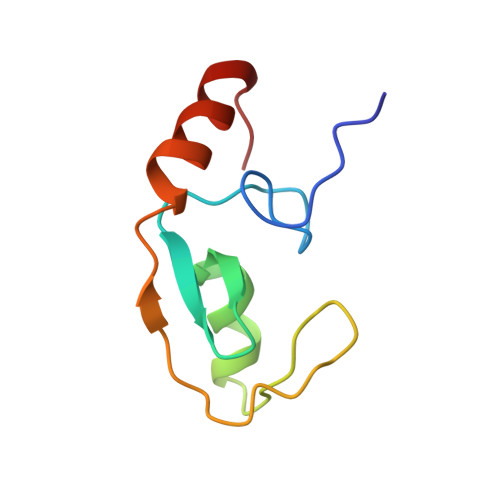
U-box proteins, as well as other proteins involved in regulated protein degradation, are apparently over-represented in Arabidopsis compared with other model eukaryotes. The Arabidopsis protein AtPUB14 contains a typical U-box domain followed by an Armadillo repeat region, a domain organization that is frequently found in plant U-box proteins. In vitro ubiquitination assays demonstrated that AtPUB14 functions as an E3 ubiquitin ligase with specific E2 ubiquitin-conjugating enzymes. The structure of the AtPUB14 U-box domain was determined by NMR spectroscopy. It adopts the betabetaalphabeta fold of the Prp19p U-box and RING finger domains. In these proteins, conserved hydrophobic residues form a putative E2-binding cleft. By contrast, they contain no common polar E2 binding site motif. Two hydrophobic cores stabilize the AtPUB14 U-box fold, and hydrogen bonds and salt bridges interconnect the residues corresponding to zinc ion-coordinating residues in RING domains. Residues from a C-terminal alpha-helix interact with the core domain and contribute to stabilization. The Prp19p U-box lacks a corresponding C-terminal alpha-helix. Chemical shift analysis suggested that aromatic residues exposed at the N terminus and the C-terminal alpha-helix of the AtPUB14 U-box participate in dimerization. Thus, AtPUB14 may form a biologically relevant dimer. This is the first plant U-box structure to be determined, and it provides a model for studies of the many plant U-box proteins and their interactions. Structural insight into these interactions is important, because ubiquitin-dependent protein degradation is a prevalent regulatory mechanism in plants.
- Institute of Molecular Biology, University of Copenhagen, DK-1353 Copenhagen K, Denmark.
Organizational Affiliation: