1RM8 | pdb_00001rm8

Crystal structure of the catalytic domain of MMP-16/MT3-MMP: Characterization of MT-MMP specific features


Experimental Data Snapshot

  • Method: X-RAY DIFFRACTION
  • Resolution: 1.80 Å
  • R-Value Free: 
    0.236 (Depositor) 
  • R-Value Work: 
    0.208 (Depositor) 
  • R-Value Observed: 
    0.209 (Depositor) 

Starting Model: experimental
View more details

wwPDB Validation 3D Report Full Report

Validation slider image for 1RM8

This is version 1.5 of the entry. See complete history

Literature

Crystal structure of the catalytic domain of MMP-16/MT3-MMP: characterization of MT-MMP specific features.

Lang, R.Braun, M.Sounni, N.E.Noel, A.Frankenne, F.Foidart, J.M.Bode, W.Maskos, K.

(2004) J Mol Biology 336: 213-225

  • DOI: https://doi.org/10.1016/j.jmb.2003.12.022
  • Primary Citation Related Structures: 
    1RM8

  • PubMed Abstract: 

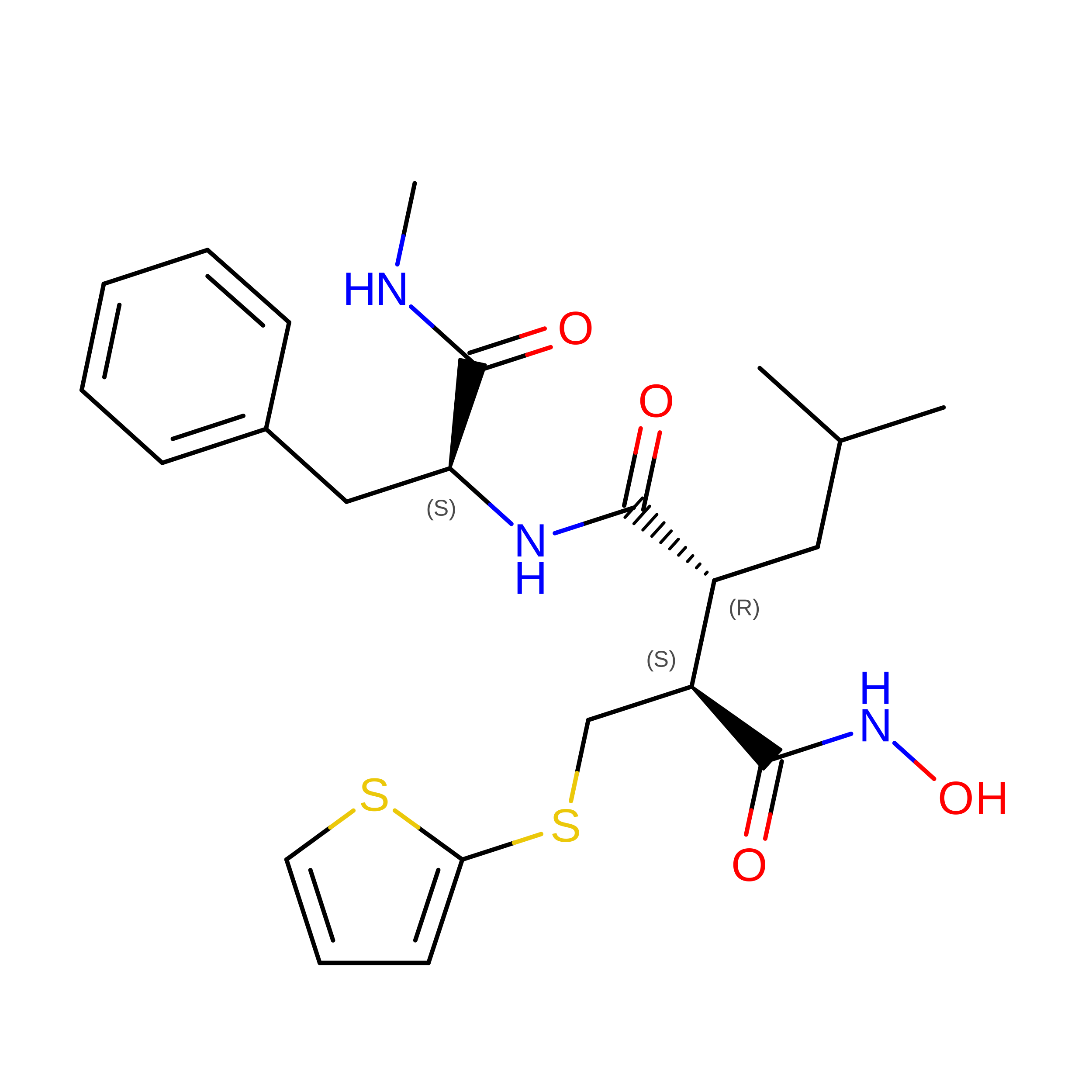
    Membrane-type matrix metalloproteinases (MT-MMPs) have attracted strong attention, because four of them can activate a key player in the tumor scenario, proMMP-2/progelatinase A. In addition to this indirect effect on the cellular environment, these MT-MMPs degrade extracellular matrix proteins, and their overproduction is associated with tumor growth. We have solved the structure of the catalytic domain (cd) of MT3-MMP/MMP-16 in complex with the hydroxamic acid inhibitor batimastat. CdMT3-MMP exhibits a classical MMP-fold with similarity to MT1-MMP. Nevertheless, it also shows unique properties such as a modified MT-specific loop and a closed S1' specificity pocket, which might help to design specific inhibitors. Some MT-MMP-specific features, derived from the crystal structures of MT-1-MMP determined previously and MT3-MMP, and revealed in recent mutagenesis experiments, explain the impaired interaction of the MT-MMPs with TIMP-1. Docking experiments with proMMP-2 show some exposed loops including the MT-loop of cdMT3-MMP involved in the interaction with the proMMP-2 prodomain in the activation encounter complex. This model might help to understand the experimentally proven importance of the MT-loop for the activation of proMMP-2.


  • Organizational Affiliation
    • Max-Planck-Institut für Biochemie, Abteilung Strukturforschung, Am Klopferspitz 18a, D-82152 Martinsried-bei-munchen, Germany.

Macromolecule Content 

  • Total Structure Weight: 19.56 kDa 
  • Atom Count: 1,495 
  • Modeled Residue Count: 169 
  • Deposited Residue Count: 169 
  • Unique protein chains: 1

Macromolecules

Find similar proteins by:|  3D Structure
Entity ID: 1
MoleculeChains  Sequence LengthOrganismDetailsImage
Matrix metalloproteinase-16169Homo sapiensMutation(s): 0 
EC: 3.4.24
UniProt & NIH Common Fund Data Resources
Find proteins for P51512 (Homo sapiens)
Explore P51512 
Go to UniProtKB:  P51512
PHAROS:  P51512
GTEx:  ENSG00000156103 
Entity Groups
Sequence Clusters30% Identity50% Identity70% Identity90% Identity95% Identity100% Identity
UniProt GroupP51512
Sequence Annotations
Expand
Reference Sequence

Experimental Data & Validation

Experimental Data

  • Method: X-RAY DIFFRACTION
  • Resolution: 1.80 Å
  • R-Value Free:  0.236 (Depositor) 
  • R-Value Work:  0.208 (Depositor) 
  • R-Value Observed: 0.209 (Depositor) 
Space Group: P 43 2 2
Unit Cell:
Length ( Å )Angle ( ˚ )
a = 51.21α = 90
b = 51.21β = 90
c = 149.368γ = 90
Software Package:
Software NamePurpose
DENZOdata reduction
SCALEPACKdata scaling
AMoREphasing
REFMACrefinement

Structure Validation

View Full Validation Report


Entry History 

Deposition Data

Revision History  (Full details and data files)

  • Version 1.0: 2004-03-09
    Type: Initial release
  • Version 1.1: 2008-04-29
    Changes: Version format compliance
  • Version 1.2: 2011-07-13
    Changes: Version format compliance
  • Version 1.3: 2017-02-08
    Changes: Structure summary
  • Version 1.4: 2021-07-28
    Changes: Advisory, Derived calculations, Refinement description
  • Version 1.5: 2023-08-23
    Changes: Advisory, Data collection, Database references, Refinement description