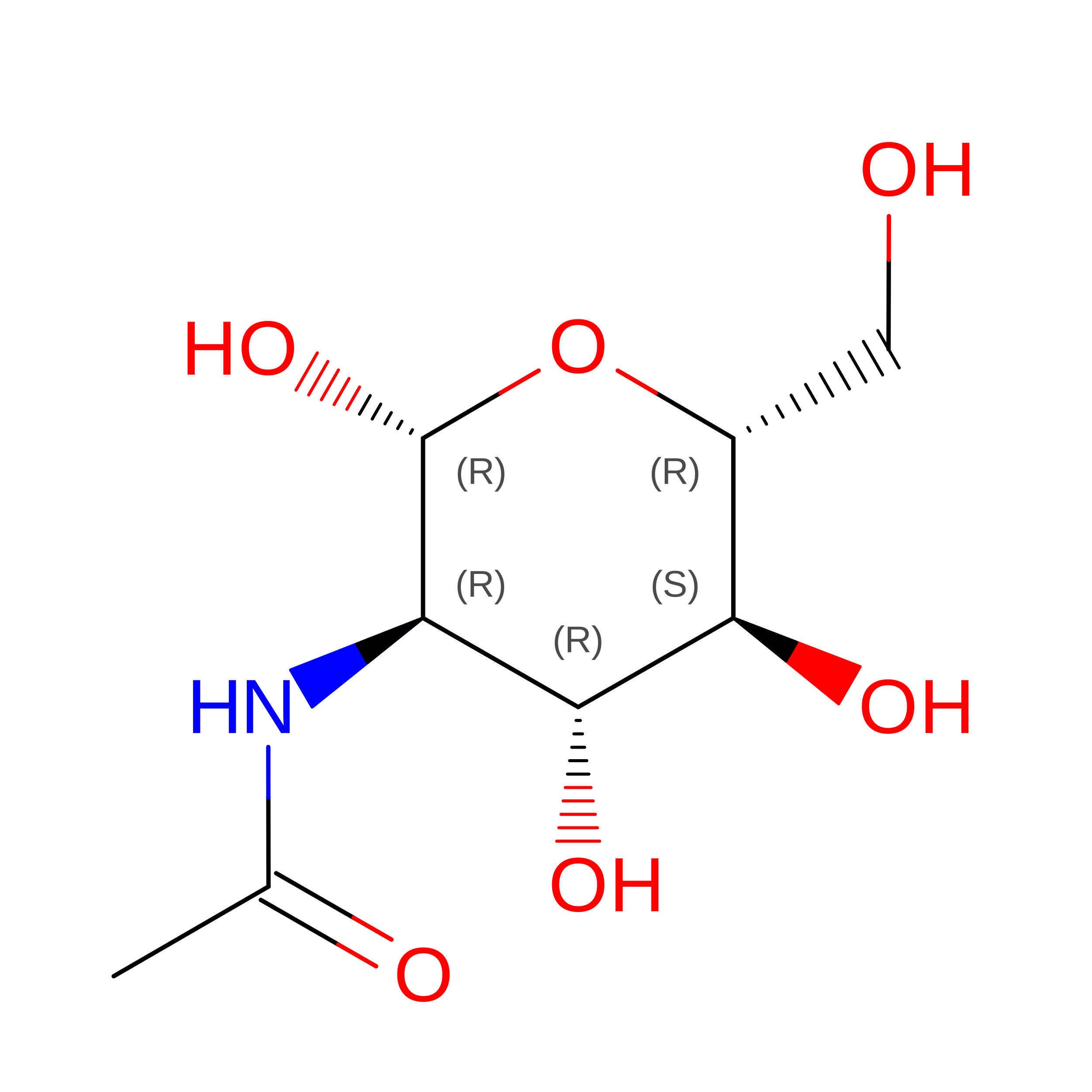
1QOZ | pdb_00001qoz

Catalytic core domain of acetyl xylan esterase from Trichoderma reesei


Experimental Data Snapshot

  • Method: X-RAY DIFFRACTION
  • Resolution: 1.90 Å
  • R-Value Free: 
    0.247 (Depositor) 
  • R-Value Work: 
    0.186 (Depositor), 0.189 (DCC) 
  • R-Value Observed: 
    0.186 (Depositor) 

Starting Model: experimental
View more details

wwPDB Validation 3D Report Full Report

Validation slider image for 1QOZ

Ligand Structure Quality Assessment 


This is version 2.3 of the entry. See complete history

Literature

Three-Dimensional Structure of the Catalytic Core of Acetylxylan Esterase from Trichoderma Reesei: Insights Into the Deacetylation Mechanism

Hakulinen, N.Tenkanen, M.Rouvinen, J.

(2000) J Struct Biol 132: 180

  • DOI: https://doi.org/10.1006/jsbi.2000.4318
  • Primary Citation Related Structures: 
    1QOZ

  • PubMed Abstract: 

    Acetylxylan esterase from Trichoderma reesei removes acetyl side groups from xylan. The crystal structure of the catalytic core of the enzyme was solved at 1.9 A resolution. The core has an alpha/beta/alpha sandwich fold, similar to that of homologous acetylxylan esterase from Penicillium purpurogenum and cutinase from Fusarium solani. All three enzymes belong to family 5 of the carbohydrate esterases and the superfamily of the alpha/beta hydrolase fold. Evidently, the enzymes have diverged from a common ancestor and they share the same catalytic mechanism. The catalytic machinery of acetylxylan esterase from T. reesei was studied by comparison with cutinase, the catalytic site of which is well known. Acetylxylan esterase is a pure serine esterase having a catalytic triad (Ser90, His187, and Asp175) and an oxyanion hole (Thr13 N, and Thr13 O gamma). Although the catalytic triad of acetylxylan esterase has been reported previously, there has been no mention of the oxyanion hole. A model for the binding of substrates is presented on the basis of the docking of xylose. Acetylxylan esterase from T. reesei is able to deacetylate both mono- and double-acetylated residues, but it is not able to remove acetyl groups located close to large side groups such as 4-O-methylglucuronic acid. If the xylopyranoside residue is double-acetylated, both acetyl groups are removed by the catalytic triad: first one acetyl group is removed and then the residue is reorientated so that the nucleophilic oxygen of serine can attack the second acetyl group.


  • Organizational Affiliation
    • Department of Chemistry, University of Joensuu, FIN-80101 Joensuu, Finland. nina.hakulinen@joesnuu.fi

Macromolecule Content 

  • Total Structure Weight: 42.46 kDa 
  • Atom Count: 3,390 
  • Modeled Residue Count: 413 
  • Deposited Residue Count: 414 
  • Unique protein chains: 1

Macromolecules

Find similar proteins by:|  3D Structure
Entity ID: 1
MoleculeChains  Sequence LengthOrganismDetailsImage
ACETYL XYLAN ESTERASE
A, B
207Trichoderma reeseiMutation(s): 0 
EC: 3.1.1.72
UniProt
Find proteins for Q99034 (Hypocrea jecorina)
Explore Q99034 
Go to UniProtKB:  Q99034
Entity Groups
Sequence Clusters30% Identity50% Identity70% Identity90% Identity95% Identity100% Identity
UniProt GroupQ99034
Glycosylation
Glycosylation Sites: 1
Sequence Annotations
Expand
Reference Sequence

Small Molecules

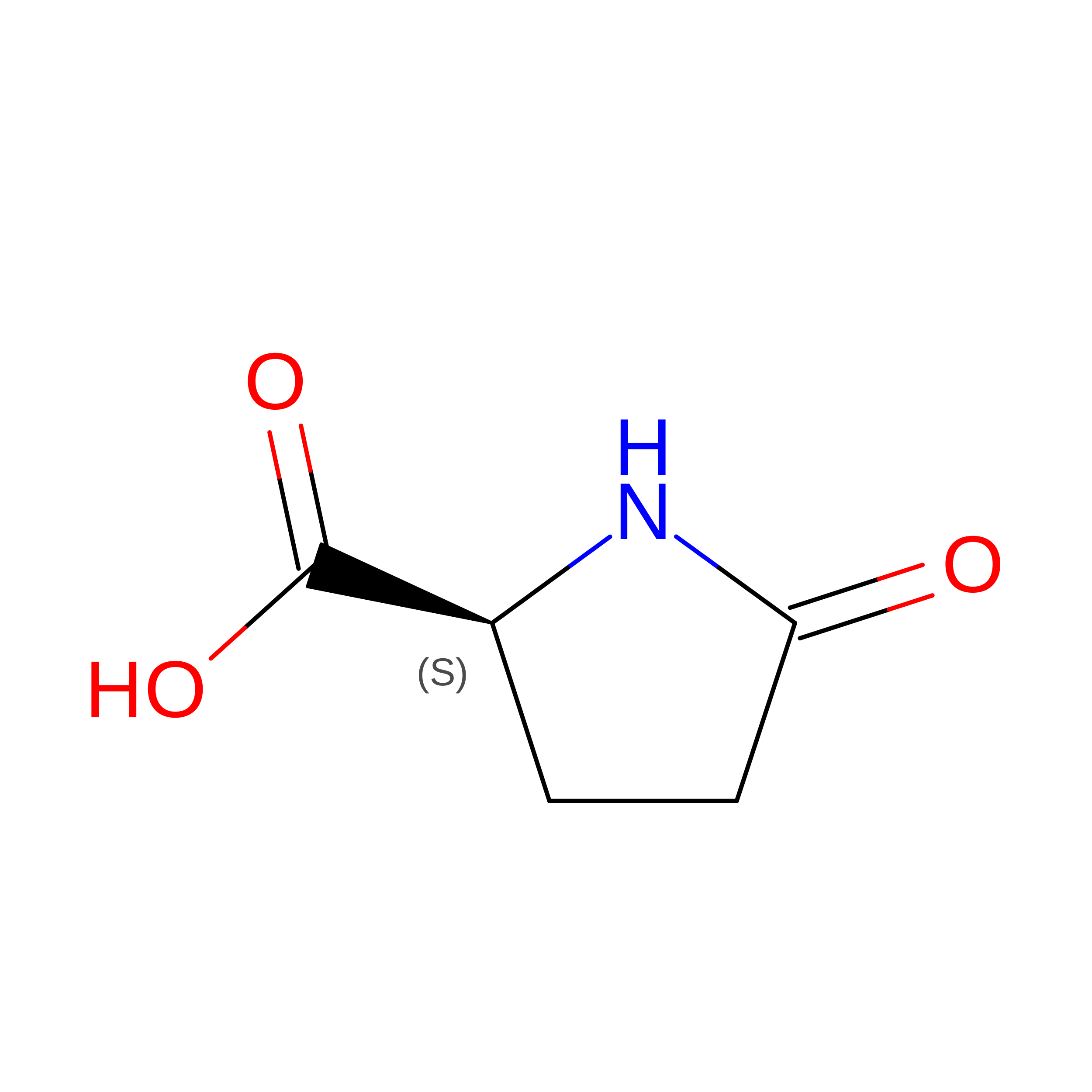
Modified Residues  1 Unique
IDChains TypeFormula2D DiagramParent
PCA
Query on PCA
A, B
L-PEPTIDE LINKINGC5 H7 N O3GLN

Experimental Data & Validation

Experimental Data

  • Method: X-RAY DIFFRACTION
  • Resolution: 1.90 Å
  • R-Value Free:  0.247 (Depositor) 
  • R-Value Work:  0.186 (Depositor), 0.189 (DCC) 
  • R-Value Observed: 0.186 (Depositor) 
Space Group: P 1
Unit Cell:
Length ( Å )Angle ( ˚ )
a = 50.3α = 107.7
b = 61β = 113.5
c = 40γ = 98.8
Software Package:
Software NamePurpose
X-PLORrefinement
DENZOdata reduction
SCALEPACKdata scaling
X-PLORphasing

Structure Validation

View Full Validation Report


Ligand Structure Quality Assessment 


Entry History 

Deposition Data

Revision History  (Full details and data files)

  • Version 1.0: 2000-11-24
    Type: Initial release
  • Version 1.1: 2011-05-08
    Changes: Version format compliance
  • Version 1.2: 2011-07-13
    Changes: Version format compliance
  • Version 1.3: 2017-07-05
    Changes: Data collection
  • Version 2.0: 2020-03-11
    Changes: Data collection, Derived calculations, Other, Polymer sequence
  • Version 2.1: 2020-07-29
    Type: Remediation
    Reason: Carbohydrate remediation
    Changes: Data collection, Derived calculations, Structure summary
  • Version 2.2: 2023-12-13
    Changes: Data collection, Database references, Refinement description, Structure summary
  • Version 2.3: 2024-10-09
    Changes: Structure summary