1Q71 | pdb_00001q71

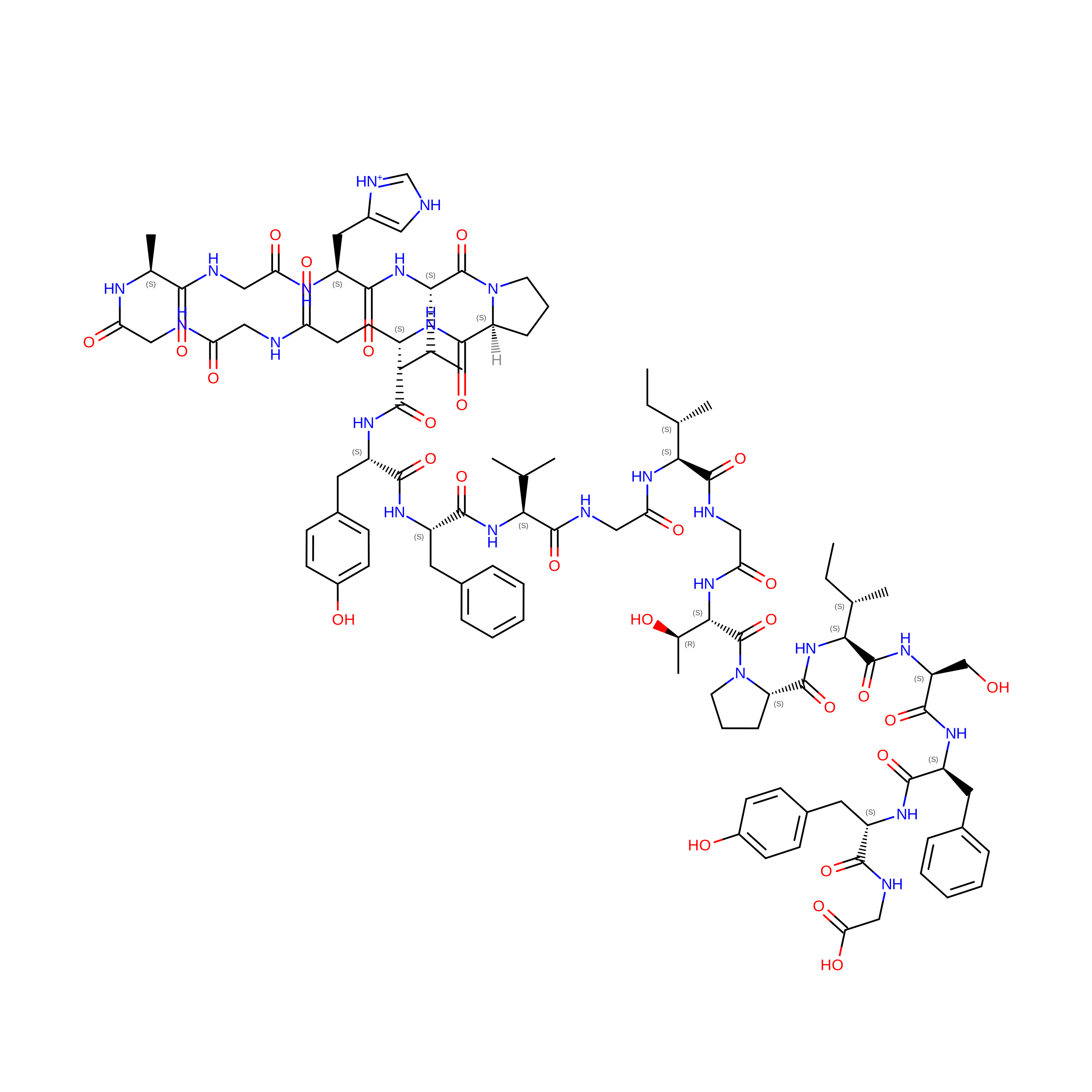
The structure of microcin J25 is a threaded sidechain-to-backbone ring structure and not a head-to-tail cyclized backbone


Experimental Data Snapshot

  • Method: SOLUTION NMR
  • Conformers Calculated: 50 
  • Conformers Submitted: 20 
  • Selection Criteria: structures with the least restraint violations,structures with the lowest energy 

wwPDB Validation 3D Report Full Report

Validation slider image for 1Q71

This is version 1.5 of the entry. See complete history

Literature

Microcin J25 has a threaded sidechain-to-backbone ring structure and not a head-to-tail cyclized backbone.

Rosengren, K.J.Clark, R.J.Daly, N.L.Goransson, U.Jones, A.Craik, D.J.

(2003) J Am Chem Soc 125: 12464-12474

  • DOI: https://doi.org/10.1021/ja0367703
  • Primary Citation Related Structures: 
    1Q71

  • PubMed Abstract: 

    Microcin J25 is a 21 amino acid bacterial peptide that has potent antibacterial activity against Gram-negative bacteria, resulting from its interaction with RNA polymerase. The peptide was previously proposed to have a head-to-tail cyclized peptide backbone and a tight globular structure (Blond, A., Péduzzi, J., Goulard, C., Chiuchiolo, M. J., Barthélémy, M., Prigent, Y., Salomón, R. A., Farías, R. N., Moreno, F. & Rebuffat, S. Eur. J. Biochem. 1999, 259, 747-755). It exhibits remarkable thermal stability for a peptide of its size lacking disulfide bonds and in part this was previously proposed to derive from its macrocyclic structure. We show here that in fact the peptide does not have a head-to-tail cyclic structure but rather a side chain to backbone cyclization between Glu8 and the N-terminus. This creates an embedded ring that is threaded by the C-terminal tail of the molecule, forming a noose-like feature. The three-dimensional structure deduced from NMR data suggests that slippage of the noose is prevented by two aromatic residues flanking the embedded ring. Unthreading does not occur even when the molecule is enzymatically digested with thermolysin. The new structural interpretation fully accounts for previously reported NMR and biophysical data and is consistent with the remarkable stability of this potent antimicrobial peptide.


  • Organizational Affiliation
    • Institute for Molecular Bioscience, University of Queensland, Brisbane QLD 4072, Australia.

Macromolecule Content 

  • Total Structure Weight: 2.13 kDa 
  • Atom Count: 151 
  • Modeled Residue Count: 21 
  • Deposited Residue Count: 21 
  • Unique protein chains: 1

Macromolecules

Find similar proteins by:  Sequence   |   3D Structure  
Entity ID: 1
MoleculeChains  Sequence LengthOrganismDetailsImage
microcin J2521Escherichia coliMutation(s): 0 
Gene Names: mcjA
UniProt
Find proteins for Q9X2V7 (Escherichia coli)
Explore Q9X2V7 
Go to UniProtKB:  Q9X2V7
Entity Groups
Sequence Clusters30% Identity50% Identity70% Identity90% Identity95% Identity100% Identity
UniProt GroupQ9X2V7
Sequence Annotations
Expand
Reference Sequence

Biologically Interesting Molecules (External Reference) 

1 Unique
Entity ID: 1
IDChains NameType/Class2D Diagram3D Interactions
PRD_000184
Query on PRD_000184
A
Microcin J25Polypeptide / Inhibitor

Experimental Data & Validation

Experimental Data

  • Method: SOLUTION NMR
  • Conformers Calculated: 50 
  • Conformers Submitted: 20 
  • Selection Criteria: structures with the least restraint violations,structures with the lowest energy 

Structure Validation

View Full Validation Report


Entry History 

Deposition Data

Revision History  (Full details and data files)

  • Version 1.0: 2003-12-16
    Type: Initial release
  • Version 1.1: 2008-04-29
    Changes: Version format compliance
  • Version 1.2: 2011-07-13
    Changes: Version format compliance
  • Version 1.3: 2011-07-27
    Changes: Non-polymer description, Structure summary
  • Version 1.4: 2012-12-12
    Changes: Other
  • Version 1.5: 2024-11-20
    Changes: Data collection, Database references, Derived calculations, Structure summary