1Q25 | pdb_00001q25

Crystal structure of N-terminal 3 domains of CI-MPR


Experimental Data Snapshot

  • Method: X-RAY DIFFRACTION
  • Resolution: 1.80 Å
  • R-Value Free: 
    0.283 (Depositor), 0.290 (DCC) 
  • R-Value Work: 
    0.235 (Depositor), 0.245 (DCC) 

wwPDB Validation 3D Report Full Report

Validation slider image for 1Q25

This is version 2.1 of the entry. See complete history

Literature

Structure of uPAR, plasminogen, and sugar-binding sites of the 300 kDa mannose 6-phosphate receptor

Olson, L.J.Yammani, R.D.Dahms, N.M.Kim, J.-J.P.

(2004) EMBO J 23: 2019-2028

  • DOI: https://doi.org/10.1038/sj.emboj.7600215
  • Primary Citation Related Structures: 
    1Q25

  • PubMed Abstract: 

    The 300 kDa cation-independent mannose 6-phosphate receptor (CI-MPR) mediates the intracellular transport of newly synthesized lysosomal enzymes containing mannose 6-phosphate on their N-linked oligosaccharides. In addition to its role in lysosome biogenesis, the CI-MPR interacts with a number of different extracellular ligands at the cell surface, including latent transforming growth factor-beta, insulin-like growth factor-II, plasminogen, and urokinase-type plasminogen activator receptor (uPAR), to regulate cell growth and motility. We have solved the crystal structure of the N-terminal 432 residues of the CI-MPR at 1.8 A resolution, which encompass three out of the 15 repetitive domains of its extracytoplasmic region. The three domains, which exhibit similar topology to each other and to the 46 kDa cation-dependent mannose 6-phosphate receptor, assemble into a compact structure with the uPAR/plasminogen and the carbohydrate-binding sites situated on opposite faces of the molecule. Knowledge of the arrangement of these three domains has allowed us to propose a model of the entire extracytoplasmic region of the CI-MPR that provides a context with which to envision the numerous binding interactions carried out by this multi-faceted receptor.


  • Organizational Affiliation
    • Department of Biochemistry, Medical College of Wisconsin, Watertown Plank Road, Milwaukee, WI 53226, USA.

Macromolecule Content 

  • Total Structure Weight: 49.05 kDa 
  • Atom Count: 3,763 
  • Modeled Residue Count: 428 
  • Deposited Residue Count: 432 
  • Unique protein chains: 1

Macromolecules

Find similar proteins by:|  3D Structure
Entity ID: 1
MoleculeChains  Sequence LengthOrganismDetailsImage
cation-independent mannose 6-phosphate receptor432Bos taurusMutation(s): 0 
Gene Names: IGF2R
UniProt
Find proteins for P08169 (Bos taurus)
Explore P08169 
Go to UniProtKB:  P08169
Entity Groups
Sequence Clusters30% Identity50% Identity70% Identity90% Identity95% Identity100% Identity
UniProt GroupP08169
Glycosylation
Glycosylation Sites: 2
Sequence Annotations
Expand
Reference Sequence

Oligosaccharides

Help  
Entity ID: 2
MoleculeChains Length2D Diagram GlycosylationD Interactions
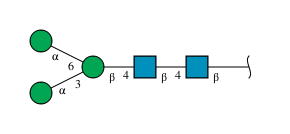
alpha-D-mannopyranose-(1-3)-[alpha-D-mannopyranose-(1-6)]beta-D-mannopyranose-(1-4)-2-acetamido-2-deoxy-beta-D-glucopyranose-(1-4)-2-acetamido-2-deoxy-beta-D-glucopyranose
B
5N-Glycosylation
Glycosylation Resources
GlyTouCan: G22768VO
GlyCosmos: G22768VO
GlyGen: G22768VO
Entity ID: 3
MoleculeChains Length2D Diagram GlycosylationD Interactions
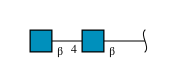
2-acetamido-2-deoxy-beta-D-glucopyranose-(1-4)-2-acetamido-2-deoxy-beta-D-glucopyranose
C
2N-Glycosylation
Glycosylation Resources
GlyTouCan: G42666HT
GlyCosmos: G42666HT
GlyGen: G42666HT

Small Molecules

Ligands 1 Unique
IDChains Name / Formula / InChI Key2D Diagram3D Interactions
GOL

Query on GOL


Download:Ideal Coordinates CCD File
D [auth A]GLYCEROL
C3 H8 O3
PEDCQBHIVMGVHV-UHFFFAOYSA-N

Experimental Data & Validation

Experimental Data

  • Method: X-RAY DIFFRACTION
  • Resolution: 1.80 Å
  • R-Value Free:  0.283 (Depositor), 0.290 (DCC) 
  • R-Value Work:  0.235 (Depositor), 0.245 (DCC) 
Space Group: P 21 21 21
Unit Cell:
Length ( Å )Angle ( ˚ )
a = 61.157α = 90
b = 84.746β = 90
c = 96.051γ = 90
Software Package:
Software NamePurpose
DENZOdata reduction
SCALEPACKdata scaling
SOLVEphasing
RESOLVEmodel building
CNSrefinement
RESOLVEphasing

Structure Validation

View Full Validation Report


Entry History 

Deposition Data

Revision History  (Full details and data files)

  • Version 1.0: 2004-06-29
    Type: Initial release
  • Version 1.1: 2008-04-29
    Changes: Version format compliance
  • Version 1.2: 2011-07-13
    Changes: Non-polymer description, Version format compliance
  • Version 2.0: 2020-07-29
    Type: Remediation
    Reason: Carbohydrate remediation
    Changes: Atomic model, Data collection, Derived calculations, Structure summary
  • Version 2.1: 2024-11-13
    Changes: Data collection, Database references, Structure summary