1PYI | pdb_00001pyi

CRYSTAL STRUCTURE OF A PPR1-DNA COMPLEX: DNA RECOGNITION BY PROTEINS CONTAINING A ZN2CYS6 BINUCLEAR CLUSTER


Experimental Data Snapshot

  • Method: X-RAY DIFFRACTION
  • Resolution: 3.20 Å
  • R-Value Free: 
    0.330 (Depositor), 0.350 (DCC) 
  • R-Value Work: 
    0.285 (DCC) 
  • R-Value Observed: 
    0.245 (Depositor) 

wwPDB Validation 3D Report Full Report

Validation slider image for 1PYI

This is version 1.3 of the entry. See complete history

Literature

Crystal structure of a PPR1-DNA complex: DNA recognition by proteins containing a Zn2Cys6 binuclear cluster.

Marmorstein, R.Harrison, S.C.

(1994) Genes Dev 8: 2504-2512

  • DOI: https://doi.org/10.1101/gad.8.20.2504
  • Primary Citation Related Structures: 
    1PYI

  • PubMed Abstract: 

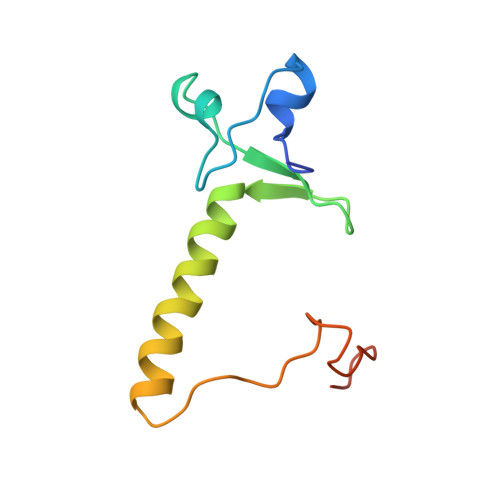
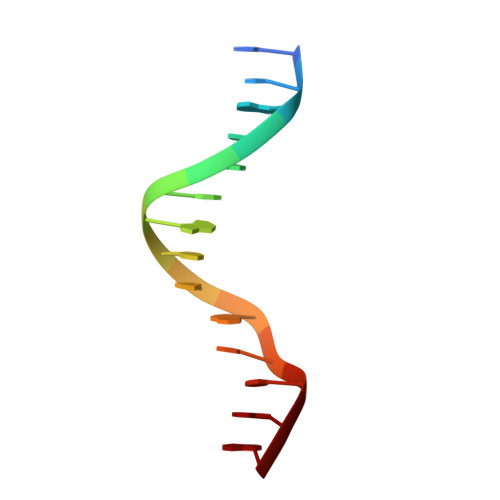
    PPR1 is a yeast transcription factor that contains a six-cysteine, two-zinc (Zn) domain, homologous to a similar structure in GAL4. Like GAL4, it binds to DNA sites with conserved CGG triplets symmetrically placed near each end. Whereas the GAL4 site has 11 intervening base pairs, the PPR1 site has 6. The crystal structure of a 95-residue fragment of PPR1 in specific complex with DNA shows that the protein binds to a symmetrical 14-bp recognition site as a nonsymmetrical homodimer. An amino-terminal Zn domain interacts with a conserved CGG triplet near each end of the site through major groove contacts, and the carboxy-terminal residues mediate dimerization through a coiled-coil element and an extended strand. A linker region, connecting the Zn domain and the coiled-coil, folds into a beta-hairpin. This hairpin packs differently on the two subunits and leads to a striking asymmetry, which is largely restricted to the dimerization and linker regions of the protein. Comparison with the GAL4-DNA structure shows that their specificities for sites of different length are determined by the preferred folds of their respective linker segments and by residues at the amino-terminal ends of their coiled-coils. None of these residues contact DNA in PPR1, and they contact only the sugar phosphate backbone in GAL4. We propose that this novel mode of DNA site selection is employed by other proteins that contain a Zn2Cys6 binuclear cluster.


  • Organizational Affiliation
    • Harvard University, Department of Biochemistry and Molecular Biology, Cambridge, Massachusetts.

Macromolecule Content 

  • Total Structure Weight: 30.74 kDa 
  • Atom Count: 1,826 
  • Modeled Residue Count: 186 
  • Deposited Residue Count: 220 
  • Unique protein chains: 1
  • Unique nucleic acid chains: 1

Macromolecules


Find similar proteins by:|  3D Structure
Entity ID: 2
MoleculeChains  Sequence LengthOrganismDetailsImage
PROTEIN (PYRIMIDINE PATHWAY REGULATOR 1)C [auth A],
D [auth B]
96Saccharomyces cerevisiaeMutation(s): 0 
Gene Names: YSCPPR1 (ACCESSION X01739)
UniProt
Find proteins for P07272 (Saccharomyces cerevisiae (strain ATCC 204508 / S288c))
Explore P07272 
Go to UniProtKB:  P07272
Entity Groups
Sequence Clusters30% Identity50% Identity70% Identity90% Identity95% Identity100% Identity
UniProt GroupP07272
Sequence Annotations
Expand
Reference Sequence
Find similar nucleic acids by:  Sequence
Entity ID: 1
MoleculeChains LengthOrganismImage
DNA (5'-D(*TP*CP*GP*GP*CP*AP*AP*TP*TP*GP*CP*CP*GP*A)-3')A [auth D],
B [auth E]
14N/A
Sequence Annotations
Expand
Reference Sequence

Experimental Data & Validation

Experimental Data

  • Method: X-RAY DIFFRACTION
  • Resolution: 3.20 Å
  • R-Value Free:  0.330 (Depositor), 0.350 (DCC) 
  • R-Value Work:  0.285 (DCC) 
  • R-Value Observed: 0.245 (Depositor) 
Space Group: I 2 2 2
Unit Cell:
Length ( Å )Angle ( ˚ )
a = 53.8α = 90
b = 92.6β = 90
c = 174.7γ = 90
Software Package:
Software NamePurpose
XDSdata reduction

Structure Validation

View Full Validation Report


Entry History 

Deposition Data

Revision History  (Full details and data files)

  • Version 1.0: 1995-02-27
    Type: Initial release
  • Version 1.1: 2008-05-22
    Changes: Version format compliance
  • Version 1.2: 2011-07-13
    Changes: Version format compliance
  • Version 1.3: 2024-02-14
    Changes: Data collection, Database references, Derived calculations